Why Pizza Robots Keep Falling Short: The Business Case Behind Kitchen Automation
From costly machines left idle after supplier failures to new attempts at ultra-fast production, pizza robotics exposes the gap between technical ambition, commercial viability and the value of human service.

The restaurant industry has spent years treating pizza production as an obvious candidate for automation. The process appears structured enough for machines to divide dough, distribute sauce and cheese, add toppings, bake the product and prepare it for customers. Yet the experience of several robotics companies shows that turning that apparently simple production sequence into a profitable commercial system is considerably harder than the technology narrative initially suggested.
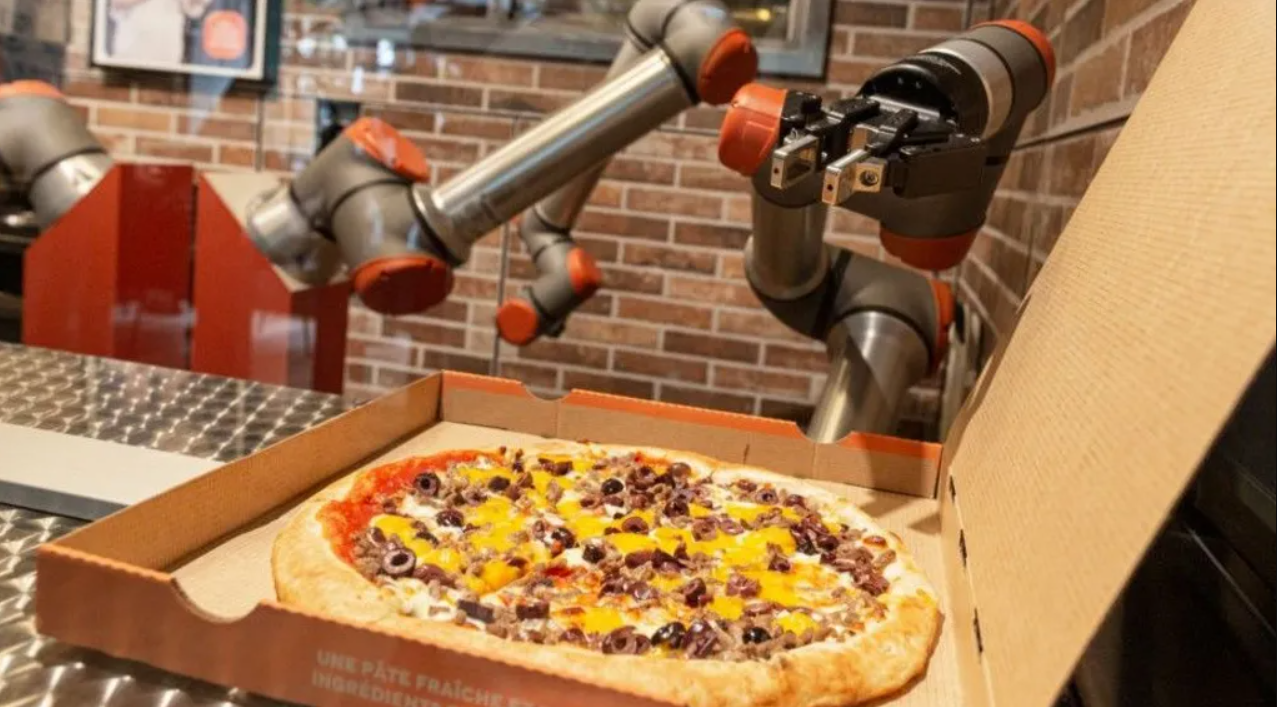
One of the clearest examples is Moto Pizza in Seattle, where two machines supplied by Picnic were designed to automate important stages of pizza preparation. The equipment included dedicated mechanisms for feeding dough, applying sauce and cheese and distributing pepperoni. Instead of becoming a long-term productivity asset, however, the machines were effectively stranded when Picnic shut down in May. With the supplier gone, technical support disappeared as well, leaving Moto Pizza founder and chief executive Lee Kindell with approximately $160,000 worth of cabinet-sized equipment whose usefulness had suddenly become uncertain.
The episode highlights one of the central economic risks of restaurant automation: the value of a machine does not depend only on whether it can technically perform a task. It also depends on the survival of the company providing maintenance, software, replacement parts, updates and operational support. A restaurant can therefore invest heavily in automation and still end up holding an expensive asset that cannot be maintained when the technology supplier fails. For operators, this makes vendor stability almost as important as the machine's performance.
The difficulties are not isolated to Picnic. The pizza-robotics sector has experienced a series of setbacks involving companies such as Zume and Pazzi, which pursued robotic pizza assembly, as well as Basil Street, which developed automated pizza vending machines. These failures have weakened the assumption that food preparation is automatically an easy market for robotics. The physical environment of a kitchen is unpredictable, ingredients vary, and seemingly straightforward operations can require continuous adjustment.
Sara Senatore, a senior restaurants analyst at Bank of America, argues that the industry's expected success stories have not yet emerged at the scale or consistency originally anticipated. Food-preparation robots can sometimes place ingredients inaccurately or struggle with movements that human workers perform naturally. Human pizza makers, by contrast, can adapt their movements quickly to variations in dough, ingredients and production conditions.
For Kindell, however, the setbacks do not invalidate the larger idea. He remains interested in complete automation and envisions a system in which a customer could order from a kiosk and receive a freshly prepared pizza without conventional kitchen intervention. His interest partly developed from personal experience: after previously making dough manually, an elbow tendon injury pushed him toward machines as a way of reducing physical strain.
Kindell is now developing his own pizza-making machine. He has not disclosed the detailed engineering design, but says the system will produce square, pan-style pizzas and will draw inspiration from the operating principles of 3D printers. His target is to have a fully operational version by summer 2027. The ambition is notable because Kindell acknowledges that he has no professional robotics background. His argument is that previous failures have nevertheless produced valuable technical knowledge, data and engineering progress, meaning that unsuccessful companies may contribute to a future system even when their original businesses disappear.
The employment question also complicates the automation debate. Kindell does not believe that fully autonomous pizza systems necessarily have to eliminate restaurant employment. At T-Mobile Park, home of the Seattle Mariners, he previously used Picnic's equipment in a high-volume pizza operation. A conventional setup would require roughly 10 people to produce the pizzas, while the automated system reduced the number directly involved in production to two. According to Kindell, the remaining eight employees were not dismissed; instead, they moved toward customer-facing and promotional responsibilities, including distributing pizzas and interacting with customers.
From his perspective, automation therefore changed the composition of labour rather than simply eliminating it. The machines allowed more people to focus on serving customers and helped increase the speed at which pizzas could be distributed. This illustrates an important distinction in automation economics: productivity gains can come from reallocating workers toward activities where human interaction creates more value rather than solely from reducing headcount.
Speed remains another major reason companies continue to pursue robotic pizza production. Canadian robotics company Appetronix installed a 24-hour robotic pizza unit for the Donatos chain at John Glenn Columbus International Airport in Ohio. The company is developing newer generations of its technology with a much more aggressive production target: eventually producing one pizza approximately every minute.
Achieving that speed requires redesigning individual stages of the process rather than simply making the existing machinery move faster. Appetronix co-founder and chief executive Nipun Sharma says the company is investigating ways to apply sauce significantly faster than its current process, which takes about 9.5 seconds. One proposed approach resembles a high-speed shower head capable of distributing sauce in roughly 1.5 seconds. The company is also examining technologies such as lasers and ultrasound as potential alternatives to conventional knife-based pizza cutting.
These engineering efforts reveal the strategic objective behind automation for large restaurant chains. The goal is not necessarily to reproduce the craftsmanship of a traditional pizzeria. Instead, it is to create a standardized production system capable of delivering the same product repeatedly, rapidly and across multiple locations. Sharma describes the target market as restaurant chains where consistency is a commercial priority: customers should receive substantially the same product regardless of which branch they visit.
That proposition, however, creates a direct tension with another segment of the pizza market: businesses whose brand identity is built around craftsmanship, hospitality and personal interaction. Paul Giannone, owner of Paulie Gee's pizza restaurants, has maintained his opposition to robotic pizza production. His position is based less on technical capability than on the experience his restaurants are designed to provide, where personal customer service is a central part of the product itself.
This distinction is commercially significant. A pizza restaurant does not sell only calories or standardized ingredients. For many businesses, the product includes atmosphere, preparation, interaction and the perception of authenticity. Removing people from the production process may improve consistency and reduce labour dependency, but it can simultaneously weaken the intangible elements that differentiate one restaurant brand from another.
Senatore argues that human interaction may be even more important for restaurants considering automation. A restaurant that becomes too dependent on machines risks losing the human character customers associate with dining out. There is also an operational risk: when an automated system fails, the absence of experienced employees can turn a technical problem into a customer-service problem. A machine malfunction during a busy service period can cause delays, frustration and reputational damage if no employee is available to intervene immediately.
The recent history of pizza robotics nevertheless suggests that the technology is unlikely to disappear. Even companies that failed commercially can leave behind valuable intellectual property. Zume, once one of the most prominent names in automated pizza production, accumulated more than 300 patents before its business disappeared. In 2026, Miso Robotics acquired Zume's technology and intellectual property, giving the surviving robotics company access to hardware, software and a large portfolio of patents covering food robotics and related technologies.
Miso Robotics chief executive Rich Hull views Zume differently from a simple failed startup. In his assessment, Zume's underlying technological vision was strong, but the company entered the market before customers and restaurant economics were ready for its proposition. Miso's strategy demonstrates how technological failures can become assets for later companies: rather than rebuilding every capability from scratch, a surviving operator can acquire patents and engineering knowledge and attempt to commercialize them under more favourable market conditions.
Miso already operates Flippy, a robotic system designed for frying food in fast-food environments. The company believes Zume's intellectual property may help expand its capabilities, although the precise applications remain under development. The broader strategy is therefore shifting from the idea of a single-purpose pizza robot toward a wider restaurant-automation platform in which technology, intellectual property and operational software can be combined.
The continuing interest in automation is also linked to the economics of restaurant labour. Operators face pressure to control labour costs, improve consistency and maintain output during periods when finding and retaining kitchen workers can be difficult. Robotics can potentially address all three pressures, but only if the machines deliver sufficient reliability and return on investment to justify their acquisition, maintenance and integration costs.
The challenge is that restaurant automation must compete not only against labour costs but also against human flexibility. A worker can adapt immediately to an unusual ingredient, a change in an order, a production error or a customer request. A robotic system requires engineering, programming and maintenance to accommodate many of those variations. The more complex the food and the more diverse the customer requirements, the more difficult it becomes to build a machine that is simultaneously fast, reliable, affordable and flexible.
The future of robotic pizza therefore appears less like a straightforward replacement of humans and more like a competition between different restaurant operating models. High-volume chains may find greater value in machines capable of delivering predictable output around the clock, while independent and premium restaurants may continue to treat human craftsmanship as part of their brand identity.
The story also demonstrates that technical performance alone cannot determine whether an automation product succeeds. The Picnic experience shows the importance of supplier resilience. Appetronix illustrates the pursuit of speed and standardized output. Kindell's experiment represents the belief that failed technologies can provide a foundation for the next generation. Paulie Gee's position demonstrates that automation can conflict with a brand proposition built around human service. Miso's acquisition of Zume shows how intellectual property from failed ventures can return to the market through a different company and business model.
Ultimately, the question is no longer whether a robot can technically make a pizza. It is whether a robotic system can do so reliably, economically and at sufficient scale while preserving the aspects of the restaurant experience that customers value. Lee Kindell remains convinced that a fully autonomous pizza robot will eventually become a reality. The unresolved commercial question is not whether the technology can be built, but which company will build a system capable of surviving the economics, operational complexity and human expectations of the restaurant industry.
News You Should See
2026 Nobel Medicine Prize Honors Scientists Behind Optogenetics Breakthrough
Oil Prices Edge Lower as Stronger Middle East Exports and G7 Reserves Ease Supply Concerns
Trump Offers U.S. Assistance to Russia After Death at Siberian Plague Research Institute
Trump Takes Economic Message to Nebraska as GOP Faces Rising Cost-of-Living Pressure
U.S. Appeals Court Weighs Trump Administration’s $2.6 Billion Harvard Funding Fight
U.S. Midterm Elections Begin With Resilient Jobs Market and Persistent Cost Pressures
Latest News
The 2026 Nobel Prize in Physiology or Medicine honors Karl Deisseroth, Peter Hegemann and Georg Nagel for pioneering research behind optogenetics and its impact on neuroscience.
Oil prices edged lower as stronger Middle Eastern exports and a planned G7 release of 100 million barrels eased immediate supply concerns, while Gulf security risks and the Strait of Hormuz kept markets alert.
President Donald Trump said the United States would help Russia if needed after a laboratory worker died at a Siberian plague research institute, as Russian authorities imposed precautionary quarantine measures.
Trump’s Nebraska campaign stop highlights rising fuel and grocery costs, beef prices and growing economic pressure on Republicans ahead of the November midterm elections.
A U.S. appeals court is reviewing the Trump administration’s effort to cut Harvard’s federal research funding, with more than $2.6 billion at stake.
The U.S. enters the 2026 midterm elections with unemployment at 4.2%, while higher living and energy costs create economic pressure for households and businesses.
US services growth eased in September as input prices climbed to their highest level since July 2022, with fuel costs, supply-chain disruptions and strong demand increasing pressure on businesses.
Rising Treasury yields are increasing U.S. borrowing costs as Washington manages record debt, persistent inflation and strong economic demand, narrowing its policy options.
A EGP 16 million corporate partnership will establish and equip a bone marrow transplant unit at Cairo’s Coptic Hospital, supporting access to specialized treatment for patients.