Why Most Americans Aren’t Planning to Wait Until 70 for Social Security
Retirement planning is increasingly shaped by immediate income needs, uncertainty over Social Security and the trade-off between larger payments later and cash flow today.

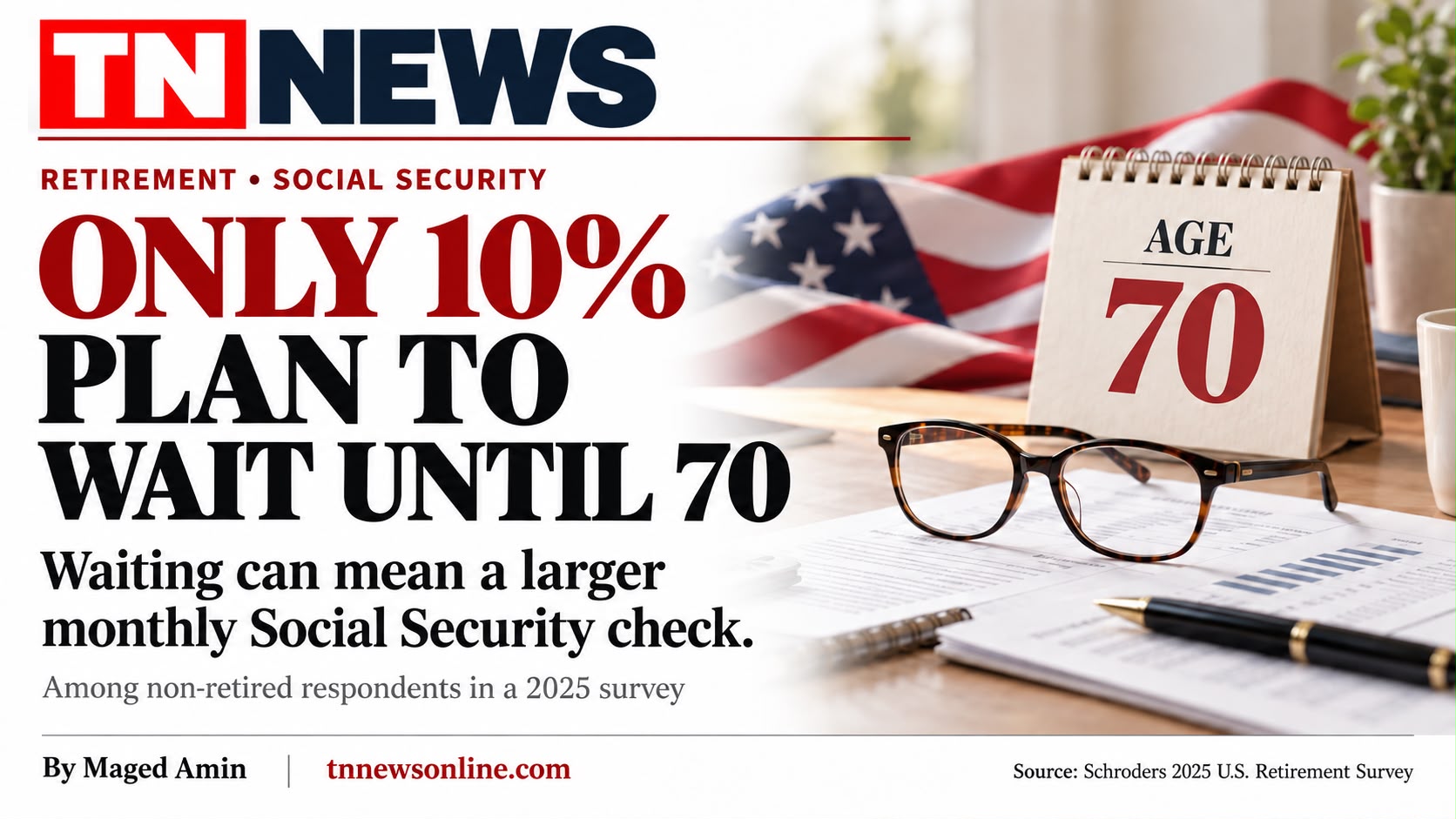
NEW YORK — Waiting until age 70 can mean a larger monthly Social Security check. But a 2025 survey suggests relatively few Americans approaching retirement intend to wait that long.
According to Schroders’ 2025 U.S. Retirement Survey, only 10% of non-retired respondents planned to claim benefits at 70. Meanwhile, 44% expected to begin collecting before 67—the full retirement age for people born in 1960 or later.
The findings help explain the widely circulated “90%” headline. That figure refers to non-retired survey respondents who did not plan to wait until 70, rather than a count of all Americans. The overall survey included 1,500 U.S. investors ages 29–79 and was conducted between March 25 and April 17, 2025.
Respondents’ reasons for claiming before 70 included wanting access to their money sooner, concerns about Social Security’s future, and needing income for everyday expenses. Some 70% of non-retired respondents understood that delaying could increase their monthly payments. Source: Schroders survey release
The financial difference can be significant. For someone born in 1960 or later, claiming retirement benefits at 62 generally means receiving 30% less per month than at the full retirement age of 67. Source: Social Security Administration
For people born in 1943 or later, delaying beyond full retirement age earns credits equal to an 8% annual increase, up to age 70. Waiting beyond 70 produces no additional delayed-retirement credits. Source: Social Security Administration
However, a larger monthly check does not automatically make waiting the right decision for everyone. Claiming earlier provides payments for more years; claiming later provides larger payments for fewer years. Lifetime totals depend partly on how long a person lives.
The Social Security Administration emphasizes that there is no single best claiming age. Employment, life expectancy and personal circumstances all matter. For households facing immediate bills or limited savings, waiting may be difficult—even when they understand the potential long-term benefit. Source: Social Security Administration
For TN News readers, the practical takeaway is to understand the trade-off before filing: how much income is needed today, what other resources are available, and how the claiming decision could affect financial security later in life.
News You Should See
2026 Nobel Medicine Prize Honors Scientists Behind Optogenetics Breakthrough
Oil Prices Edge Lower as Stronger Middle East Exports and G7 Reserves Ease Supply Concerns
Trump Offers U.S. Assistance to Russia After Death at Siberian Plague Research Institute
Trump Takes Economic Message to Nebraska as GOP Faces Rising Cost-of-Living Pressure
U.S. Appeals Court Weighs Trump Administration’s $2.6 Billion Harvard Funding Fight
U.S. Midterm Elections Begin With Resilient Jobs Market and Persistent Cost Pressures
Latest News
The 2026 Nobel Prize in Physiology or Medicine honors Karl Deisseroth, Peter Hegemann and Georg Nagel for pioneering research behind optogenetics and its impact on neuroscience.
Oil prices edged lower as stronger Middle Eastern exports and a planned G7 release of 100 million barrels eased immediate supply concerns, while Gulf security risks and the Strait of Hormuz kept markets alert.
President Donald Trump said the United States would help Russia if needed after a laboratory worker died at a Siberian plague research institute, as Russian authorities imposed precautionary quarantine measures.
Trump’s Nebraska campaign stop highlights rising fuel and grocery costs, beef prices and growing economic pressure on Republicans ahead of the November midterm elections.
A U.S. appeals court is reviewing the Trump administration’s effort to cut Harvard’s federal research funding, with more than $2.6 billion at stake.
The U.S. enters the 2026 midterm elections with unemployment at 4.2%, while higher living and energy costs create economic pressure for households and businesses.
US services growth eased in September as input prices climbed to their highest level since July 2022, with fuel costs, supply-chain disruptions and strong demand increasing pressure on businesses.
Rising Treasury yields are increasing U.S. borrowing costs as Washington manages record debt, persistent inflation and strong economic demand, narrowing its policy options.
A EGP 16 million corporate partnership will establish and equip a bone marrow transplant unit at Cairo’s Coptic Hospital, supporting access to specialized treatment for patients.