When Robots Ask for Tips, the Real Question Is Who Gets Paid
The rise of automated service is creating a new economic and ethical fault line, forcing businesses and customers to reconsider the meaning of gratuity when the worker is a machine

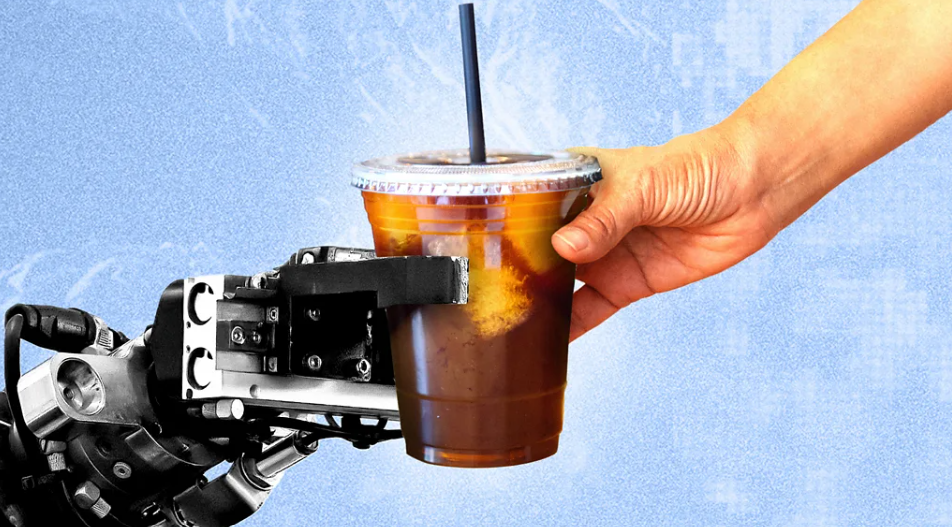
The arrival of robots in restaurants, cafés and other service environments is creating an unexpected problem that has little to do with whether machines can perform their tasks. As automated systems increasingly prepare drinks, deliver food and operate self-service points, some of them are also beginning to ask customers for tips. The development may appear humorous at first, but it raises a serious economic question: when a machine performs the visible part of a service and a customer adds a gratuity, who is actually supposed to receive that money?
The issue is becoming visible in a growing number of service settings. At The Tipsy Robot, a bar inside Las Vegas' Venetian Hotel, robotic arms prepare cocktails after customers place their orders through a screen. A margarita costing $17 was accompanied by an additional 10% service charge, effectively creating a request for gratuity from an automated bartender. The experience illustrates how tipping mechanisms can remain embedded in a service transaction even when the traditional human server has been replaced by a machine.
Similar situations have appeared elsewhere. A robotic barista at Artly Coffee in New York reportedly presented customers with a tip request, while a self-checkout machine at Newark Liberty International Airport suggested leaving a gratuity when customers purchased a bottle of water from an unattended kiosk. At Top Burmese in Portland, Oregon, the ordering process involved a human employee, but a robot was responsible for bringing the meal to the table. These examples show that automation does not necessarily eliminate tipping culture; instead, it can insert tipping prompts into transactions where the relationship between service, labour and payment becomes considerably less obvious.
The confusion becomes especially significant because traditional tipping is built around a human relationship. Customers generally understand that a tip is intended to reward a waiter, bartender or another service employee, compensate for relatively low wages, or express appreciation for personal effort. A machine has no salary, household expenses or personal financial needs. Consequently, the psychological and economic logic behind gratuity becomes much less straightforward once the visible service provider is an automated system.
The question is not simply whether customers should tip a robot. The more consequential issue is whether the tip is actually being transferred to the human workers who remain behind the automated experience. Representatives for The Tipsy Robot and Artly Coffee told the BBC that their human employees receive the tips and that the businesses themselves do not take the gratuities. Artly subsequently disabled its digital tip prompts after the author encountered them, although some of its locations continue to provide physical tip jars. The company says that 100% of those tips go to human staff.
Those examples, however, may not represent the entire industry. Holona Ochs, an associate professor of political science at Lehigh University and co-author of the book Gratuity, argues that there is reason to suspect some employers could be retaining tips generated through robotic systems. Her central concern is the absence of a clearly established legal standard determining who owns money given as a tip to a machine. The ambiguity becomes particularly important when customers assume that their payment is supporting workers while the business may be treating the gratuity as additional revenue.
The uncertainty emerges within a broader transformation of tipping itself. Since the pandemic, digital payment systems have made gratuity prompts common in an expanding range of transactions. Customers are increasingly confronted with preset percentages and touchscreen requests, sometimes in situations where the traditional justification for tipping is weak or absent. Critics describe this phenomenon as a form of psychological pressure in which customers feel uncomfortable selecting "no tip" even when they are unsure why a tip is expected.
The United States provides a particularly important economic context because tipping has historically been integrated into the structure of service-sector wages. The federal minimum wage is $7.25 per hour, while the federal cash minimum for tipped employees can be as low as $2.13 per hour, provided the applicable legal conditions are satisfied. Under existing rules, employers, owners and supervisors generally cannot take employees' tips. But those protections were designed around human workers, creating uncertainty when a digital payment interface labels a charge as a tip associated with a machine.
This creates a potentially important legal gap. If a customer gives money to a human employee, the regulatory framework provides relatively clear expectations about who can benefit from that money. If the customer gives the same percentage to a robot, however, the machine cannot legally own or spend the funds in the ordinary sense. The money therefore ultimately belongs to a business, an employee pool or another party designated by the payment system. Without transparent rules, customers may be making decisions based on assumptions that do not match the actual distribution of revenue.
The issue is also connected to changes in labour regulation and worker bargaining power. Ochs argues that workers may have limited visibility into what happens to gratuities associated with automated systems, particularly when employees are reluctant to challenge employers over concerns about retaliation. This creates a transparency problem: customers can see the tip prompt, but may have no practical way of knowing where the money ultimately goes.
Yet it would be too simplistic to describe robotic service as inherently harmful to workers. In some businesses, automation is part of the product's identity rather than merely a mechanism for reducing labour costs. The robotic bartender at The Tipsy Robot and robotic systems used by Artly Coffee create an attraction that itself draws customers. The human employees working alongside those machines may therefore exist precisely because the technology creates a differentiated experience. In such cases, the robot is not necessarily replacing an equivalent human job; it is helping create a new service format.
Artly presents its approach as an example of this distinction. Abigail Smathers, the company's director of content, said the company disabled its tip prompts and raised worker pay partly in response to customer complaints. The company also maintains that it does not believe automation should be pursued for cost reduction at the expense of people. Smathers argues that robots can help address labour shortages in hospitality, although she acknowledges that artificial intelligence and automation can also be introduced into environments where their use is inappropriate.
That perspective highlights an important design principle for automated services: the technology itself does not determine whether the business model is ethical. The outcome depends on the purpose for which the technology is deployed, how responsibilities are divided between machines and people, and how revenue generated through the automated interface is distributed. A robot can theoretically reduce repetitive physical work while allowing human employees to focus on tasks requiring judgement, hospitality and interpersonal interaction. But it can also become a mechanism for disguising labour reductions or creating additional charges that customers do not fully understand.
Katerina Berezina, an associate professor at the University of Mississippi who studies hospitality technology, offers a more nuanced interpretation. She argues that it is unfair to assume every company introducing robot tipping is simply attempting to extract more money. In some circumstances, a service fee or gratuity associated with automation may be intended to cover the labour, maintenance or software updates necessary to operate the robotic system. From this perspective, the charge is less about rewarding the machine and more about financing the wider service infrastructure surrounding it.
That distinction is economically important. A service robot is not a cost-free employee replacement. It requires hardware, software, electricity, maintenance, replacement parts, monitoring, integration with payment systems and, in many cases, human supervision. A company may therefore view an additional service fee as part of the cost structure of running an automated operation. The problem arises when the customer is presented with that fee as though it were a conventional employee tip without being told whether the money supports workers, maintains the machine or simply increases corporate revenue.
Advocacy groups such as One Fair Wage approach the issue from another direction. Their argument is that businesses may use automation to preserve a low-wage service model instead of addressing the underlying labour conditions that contribute to staffing shortages. If robots become a justification for keeping wages low while businesses continue asking customers for increasingly large gratuities, automation could potentially transfer more responsibility for labour costs from employers to consumers.
This is why robot tipping is ultimately a question about the architecture of the service economy. The introduction of machines does not automatically eliminate the old economic relationships; it can reproduce them through new interfaces. A touchscreen can still ask for 15%, 20% or 25% even if the person who performed the visible service has disappeared from the interaction. The technology changes the delivery mechanism, but the financial expectations surrounding hospitality can survive almost unchanged.
Consumer psychology may determine whether this model becomes sustainable. Michael Lynn, professor emeritus at Cornell University and author of The Psychology of Tipping, identifies several traditional reasons people leave gratuities. They may reward good service, help compensate workers whose wages are relatively low, or simply avoid the social discomfort associated with refusing to tip. There can also be an element of status and approval: customers may worry about appearing ungenerous. These motivations are substantially weaker when the recipient is a machine.
Research suggests that most people are initially resistant to tipping robots. One study cited by the BBC found that only around 11% of participants said they would tip a robot bartender. However, actual experience with robotic bartenders increased people's willingness to tip compared with people who had not interacted with such systems. The most revealing result came when participants were told that the money would go to human employees: approximately 42% changed their position and became willing to tip.
That finding points to the central role of transparency. Customers may not object to paying extra when they understand that the money supports people. What they resist is the ambiguity created when a machine asks for money without clearly identifying the beneficiary. If a robot delivers a meal but the kitchen staff, technicians or service employees receive the gratuity, the transaction can still fit within familiar social expectations. If the money simply becomes another revenue stream for the company, the ethical justification becomes considerably weaker.
The design of the payment interface therefore becomes part of the economic relationship. A tip screen is not a neutral piece of software. Its wording, default percentages, timing and placement can influence consumer behaviour. When such an interface appears after a machine has performed a task, the customer may interpret the prompt as an expected component of service rather than an optional contribution. This is particularly significant because digital interfaces can standardise a tipping culture across locations and transactions without requiring employees to make a direct request.
For businesses, the strategic challenge is to avoid turning automation into a source of reputational friction. Robot service can be marketed as futuristic, entertaining and efficient, but repeated requests for tips may undermine that positioning if customers perceive the technology as an excuse for additional charges. The novelty that attracts customers can quickly become a liability if the financial model appears opaque.
This creates a branding issue as much as an operational one. Companies adopting robots are not merely introducing machines; they are defining what their brand believes service should look like in an automated economy. A company that clearly explains where gratuities go can position itself as transparent and worker-conscious. A company that hides the destination of the money risks being perceived as exploiting technology to normalise additional charges.
The distinction is particularly important for hospitality brands because the service experience is inseparable from trust. Customers are not simply purchasing food or drinks. They are purchasing convenience, reliability and a particular social experience. If the automated interface introduces uncertainty about pricing or compensation, the technological novelty may cease to feel innovative and begin to feel extractive.
The same issue could become more important as robots move into additional industries. If automated systems eventually provide services in hotels, transportation, healthcare, retail or personal assistance, the question of whether a tip should follow the machine will become increasingly difficult to isolate from broader questions about compensation and business revenue. A tipping prompt that initially appears absurd may become routine if customers become accustomed to treating automated systems as service providers.
At the same time, the continued existence of human workers behind automated systems complicates the simple narrative that "robots do not need tips." A robot may be the visible interface while people remain responsible for preparation, supervision, maintenance, customer support and system management. The economic value generated by the robot is therefore embedded in a larger human production chain.
The most defensible approach may therefore be to distinguish between a genuine employee tip and an automation-related service charge. If money is intended for human workers, businesses should say so explicitly and provide transparent information about distribution. If the charge exists to finance equipment maintenance or technology infrastructure, it should be labelled as a service or technology fee rather than presented as a conventional gratuity. The distinction gives customers the information needed to make an informed choice.
Ultimately, the question is not whether a robot deserves a tip. Machines do not experience gratitude, financial hardship or professional recognition. The more meaningful question is what the tipping interface represents in the economic system surrounding the machine. Is it a mechanism for transferring money to human workers? Is it a technology maintenance charge? Or is it simply another method for increasing the amount a customer pays?
Michael Lynn believes robot tipping may ultimately fail if consumers reject it. Businesses can introduce a prompt, but they cannot force a social norm into existence indefinitely. If customers repeatedly refuse to tip machines, companies may conclude that the practice damages the customer experience more than it increases revenue. In that scenario, robot tipping could become a temporary experiment associated with the early stages of automation rather than a permanent feature of digital commerce.
The broader lesson is that automation does not eliminate economic questions about service; it makes them more visible. When a human asks for a tip, the recipient is obvious and the social contract is familiar. When a machine asks, the transaction exposes the hidden structure behind the service: who built the system, who maintains it, who operates it, who employs the people around it and who ultimately captures the additional revenue.
For consumers, the most rational response is therefore not automatically to tip or refuse every robot. Instead, the key consideration is transparency. Customers should know whether the money goes to human workers, supports the operation of the technology or becomes ordinary business revenue. For companies, the strategic priority should be equally clear: automation can strengthen a brand when it makes service more efficient or distinctive, but it can weaken trust when technology is used to obscure who is being paid and why.
The future of robot tipping will consequently depend less on whether machines can physically extend a digital hand and more on whether customers accept the economic story behind that gesture. If businesses can connect automated service with clear pricing, fair worker compensation and transparent payment practices, robots may become another tool in the evolution of hospitality. If tipping becomes another opaque charge attached to increasingly automated transactions, customers may eventually reject not the robots themselves, but the business model built around them.
News You Should See
2026 Nobel Medicine Prize Honors Scientists Behind Optogenetics Breakthrough
Oil Prices Edge Lower as Stronger Middle East Exports and G7 Reserves Ease Supply Concerns
Trump Offers U.S. Assistance to Russia After Death at Siberian Plague Research Institute
Trump Takes Economic Message to Nebraska as GOP Faces Rising Cost-of-Living Pressure
U.S. Appeals Court Weighs Trump Administration’s $2.6 Billion Harvard Funding Fight
U.S. Midterm Elections Begin With Resilient Jobs Market and Persistent Cost Pressures
Latest News
The 2026 Nobel Prize in Physiology or Medicine honors Karl Deisseroth, Peter Hegemann and Georg Nagel for pioneering research behind optogenetics and its impact on neuroscience.
Oil prices edged lower as stronger Middle Eastern exports and a planned G7 release of 100 million barrels eased immediate supply concerns, while Gulf security risks and the Strait of Hormuz kept markets alert.
President Donald Trump said the United States would help Russia if needed after a laboratory worker died at a Siberian plague research institute, as Russian authorities imposed precautionary quarantine measures.
Trump’s Nebraska campaign stop highlights rising fuel and grocery costs, beef prices and growing economic pressure on Republicans ahead of the November midterm elections.
A U.S. appeals court is reviewing the Trump administration’s effort to cut Harvard’s federal research funding, with more than $2.6 billion at stake.
The U.S. enters the 2026 midterm elections with unemployment at 4.2%, while higher living and energy costs create economic pressure for households and businesses.
US services growth eased in September as input prices climbed to their highest level since July 2022, with fuel costs, supply-chain disruptions and strong demand increasing pressure on businesses.
Rising Treasury yields are increasing U.S. borrowing costs as Washington manages record debt, persistent inflation and strong economic demand, narrowing its policy options.
A EGP 16 million corporate partnership will establish and equip a bone marrow transplant unit at Cairo’s Coptic Hospital, supporting access to specialized treatment for patients.