WhatsApp Explores Smarter Business Messaging with Dedicated Inbox Organization
The new organizational approach reflects Meta's strategy to balance commercial communication with a cleaner messaging experience while strengthening the platform's business ecosystem.

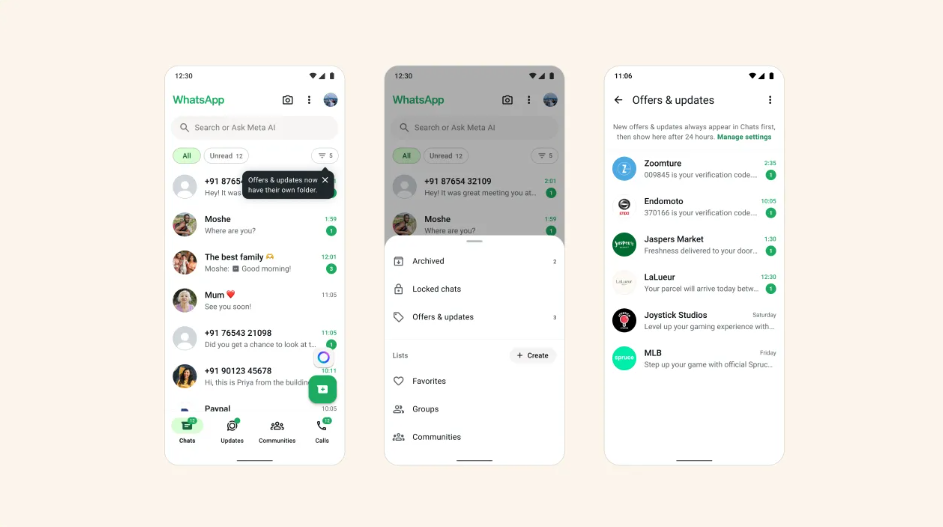
WhatsApp continues to refine its platform as digital communication evolves beyond personal conversations into a broader ecosystem that includes customer service, online shopping, business notifications, and commercial engagement. The latest feature under development—a dedicated folder designed to organize messages received from larger businesses—illustrates how messaging platforms are adapting to increasing commercial activity while attempting to preserve a simple and user-friendly interface.
Over the past several years, messaging applications have become essential communication channels for businesses of all sizes. From delivery updates and payment confirmations to customer support and promotional campaigns, users now receive a growing volume of commercial conversations alongside private chats. While this transformation has strengthened the role of messaging platforms in digital commerce, it has also introduced new challenges related to inbox management and information overload.
The proposed organizational feature addresses this challenge by separating high-volume business conversations from personal interactions. Rather than treating every conversation equally, the platform appears to be moving toward a more contextual communication model in which different categories of interactions receive specialized organizational treatment. This approach has the potential to improve navigation, reduce clutter, and help users locate important commercial information without affecting personal conversations.
From a user experience perspective, interface organization has become one of the most important competitive differentiators among communication platforms. As messaging services continue adding payment features, AI-powered assistants, business tools, communities, and shopping experiences, maintaining interface simplicity becomes increasingly difficult. Introducing dedicated organizational spaces enables platforms to expand functionality without overwhelming users with additional complexity.
The development also reflects Meta's broader strategy of strengthening WhatsApp as a commercial platform while preserving the privacy-centered identity that has long defined the application. Businesses increasingly rely on WhatsApp Business and related services to manage customer relationships, automate responses, and support digital transactions. More effective message organization may encourage greater commercial adoption while simultaneously improving customer satisfaction.
Economically, business messaging has become an increasingly valuable segment within the digital economy. Companies seek direct communication channels that offer high engagement rates compared with traditional email marketing or advertising. Messaging platforms therefore continue investing in features that make commercial interactions more structured, reliable, and efficient for both organizations and consumers.
The feature may also influence how brands design their communication strategies. If business conversations become easier to access and manage, organizations may shift toward more personalized customer engagement rather than relying on high-frequency promotional messaging. Better organization encourages quality interactions over communication volume, potentially strengthening long-term customer trust.
From a product design perspective, the initiative demonstrates a broader philosophy centered on intelligent organization rather than feature expansion alone. Instead of introducing entirely new communication tools, WhatsApp appears focused on redesigning information architecture so users can process different categories of conversations more naturally. Such design decisions often produce significant improvements without fundamentally changing familiar user behavior.
Brand identity also plays an important role in this evolution. WhatsApp has consistently positioned itself as a private, reliable, and intuitive messaging platform. As commercial functionality grows, maintaining this identity requires careful product decisions that prevent business services from diminishing the simplicity users expect. Features that organize commercial communication while protecting personal conversations reinforce the platform's promise of convenience without sacrificing clarity.
Looking ahead, intelligent inbox organization could become a standard capability across messaging platforms as digital commerce continues expanding. Companies capable of balancing commercial innovation with thoughtful user experience design are likely to strengthen both customer loyalty and long-term platform value in an increasingly competitive communications market.
News You Should See
2026 Nobel Medicine Prize Honors Scientists Behind Optogenetics Breakthrough
Oil Prices Edge Lower as Stronger Middle East Exports and G7 Reserves Ease Supply Concerns
Trump Offers U.S. Assistance to Russia After Death at Siberian Plague Research Institute
Trump Takes Economic Message to Nebraska as GOP Faces Rising Cost-of-Living Pressure
U.S. Appeals Court Weighs Trump Administration’s $2.6 Billion Harvard Funding Fight
U.S. Midterm Elections Begin With Resilient Jobs Market and Persistent Cost Pressures
Latest News
The 2026 Nobel Prize in Physiology or Medicine honors Karl Deisseroth, Peter Hegemann and Georg Nagel for pioneering research behind optogenetics and its impact on neuroscience.
Oil prices edged lower as stronger Middle Eastern exports and a planned G7 release of 100 million barrels eased immediate supply concerns, while Gulf security risks and the Strait of Hormuz kept markets alert.
President Donald Trump said the United States would help Russia if needed after a laboratory worker died at a Siberian plague research institute, as Russian authorities imposed precautionary quarantine measures.
Trump’s Nebraska campaign stop highlights rising fuel and grocery costs, beef prices and growing economic pressure on Republicans ahead of the November midterm elections.
A U.S. appeals court is reviewing the Trump administration’s effort to cut Harvard’s federal research funding, with more than $2.6 billion at stake.
The U.S. enters the 2026 midterm elections with unemployment at 4.2%, while higher living and energy costs create economic pressure for households and businesses.
US services growth eased in September as input prices climbed to their highest level since July 2022, with fuel costs, supply-chain disruptions and strong demand increasing pressure on businesses.
Rising Treasury yields are increasing U.S. borrowing costs as Washington manages record debt, persistent inflation and strong economic demand, narrowing its policy options.
A EGP 16 million corporate partnership will establish and equip a bone marrow transplant unit at Cairo’s Coptic Hospital, supporting access to specialized treatment for patients.