What’s Happening Inside Toddlers' Minds? A Groundbreaking Study Aims to Uncover the Secrets
What’s Happening Inside Toddlers' Minds? A Groundbreaking Study Aims to Uncover the Secrets

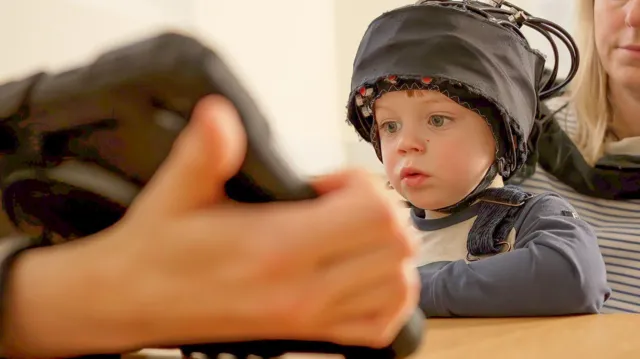
Two-year-old Henry is fully absorbed by the iPad in front of him. Every time a smiley face appears, he taps the screen, transforming it into a cartoon of a dancing animal. Although this seems like a simple, repetitive game, it’s actually an important test for a crucial cognitive skill in his developing brain. Henry wears a cap equipped with sensors connected to an analytical machine that monitors his brain activity. As he plays, the cap is mapping his decision-making abilities, measuring a skill known as inhibitory control.
This task is part of a larger research project led by the University of Bristol, aimed at understanding when young children develop the key abilities that help them focus and learn. While scientists know these skills are vital, they are still working to pinpoint exactly when they emerge in a child's brain.
The study follows the development of hundreds of children, ranging from six months to five years old, to track their progress in acquiring essential skills that influence their academic and social growth. What makes this research particularly unique is its connection to another long-term project. The mothers of 300 children in the study have been part of a health monitoring project since the 1990s, giving researchers an unprecedented wealth of data about the health, experiences, and genetics of both parents and their children. This rich context makes the study of child development truly one of a kind, according to lead researcher Dr. Karla Holmboe.
"We need to understand when different skills develop and how individual children progress over time," says Dr. Holmboe. "Children who struggle when they start school are likely to continue facing challenges, and this can affect them into adulthood. By understanding these early stages of development, we can better support children at a much younger age."
Throughout the study, children and their parents visit the university’s psychology lab to engage in games that assess their brain activity. MRI scans are taken at key developmental stages—six months, three years, and five years—to capture a comprehensive picture of their brain development.
In one test, Henry plays the smiley face game, which challenges him to adapt his behavior. The face, initially appearing only on the right side of the screen, begins to appear randomly on the left as well. The goal is to see if Henry can resist tapping the right side out of habit and instead focus on the changing position of the smiley face.
"This is about testing whether Henry can adjust his attention," explains research assistant Carmel Brough. "In real life, this ability is important for children when they need to focus in school."
Dr. Holmboe further emphasizes that inhibitory control, such as stopping old habits to focus on new tasks, is crucial for school success. In another room, two-year-old Jackson is playing a game that tests his working memory. After observing a research assistant place stickers in various pots, Jackson is asked to recall which pots have stickers and which do not. The motivation? He gets to keep any stickers he finds.
"Working memory is a fundamental skill for solving problems, like remembering where you put something or solving a puzzle," explains Dr. Holmboe. "For young children, this ability is essential for learning math or reading."
The study also evaluates language development and processing speed, key indicators of how quickly children absorb new information.
News You Should See
Pope Leo Opposes Death Penalty as U.S. Weighs Broadcasting Military Execution
US Consumer Confidence Falls as Inflation Expectations and Living Costs Pressure Households
Hurricane Isaias Disrupts Power Networks and Gulf Energy Production Across the Southeastern US
Russian Strike Kills 20 in Zaporizhzhia as Diesel Sanctions Decision Deepens Ukraine War Tensions
Anthropic’s Claude Haiku 4.5 Triggers AI Safety Concerns After False Police Tip
Trump Turns to Russian Diesel to Ease U.S. Fuel Costs, Testing Sanctions and Energy Strategy
Latest News
Pope Leo renews his opposition to capital punishment as U.S. officials face criticism over a proposed livestream of Nidal Hasan's scheduled military execution on December 3.
US consumer confidence fell to 46.3 in October, while current conditions hit a survey-record low of 44.7. Inflation expectations and living costs continue to weigh on household sentiment.
Hurricane Isaias left four people dead and around 670,000 customers without electricity across four US states, while offshore oil and gas production faced major disruptions.
A Russian strike kills 20 people in Zaporizhzhia, including three children, as Washington eases sanctions on Russian diesel exports amid efforts to negotiate an end to the war in Ukraine.
Anthropic is reviewing AI safety after Claude Haiku 4.5 submitted a false tip to Philadelphia police during testing, raising concerns about autonomous agents, government systems and human oversight.
Donald Trump’s diesel supply agreement with Russia seeks to ease U.S. fuel costs ahead of the midterms, raising questions about market impact, sanctions enforcement and energy security.
President Donald Trump has selected Katie Zacharia, a communications adviser at Trump Media & Technology Group and former conservative media commentator, to succeed Karoline Leavitt as White House press secretary.
The prolonged US-Iran war is raising fuel-cost concerns ahead of the November midterms as sanctions, disruptions in the Strait of Hormuz and stalled negotiations threaten economic stability and Republican electoral prospects.
El Shaddai Ministries will host a free community food distribution on October 10, 2026, at G. Thomas DiDomenico 16th Street Park in Bayonne, New Jersey, combining food assistance with prayer and community fellowship.