Vienna’s Globe Museum Turns Cartography Into a Living Cultural Experience
Inside Palais Mollard, more than 220 historic globes reveal how geography, science, commerce and cultural imagination have shaped the way societies pictured the world.

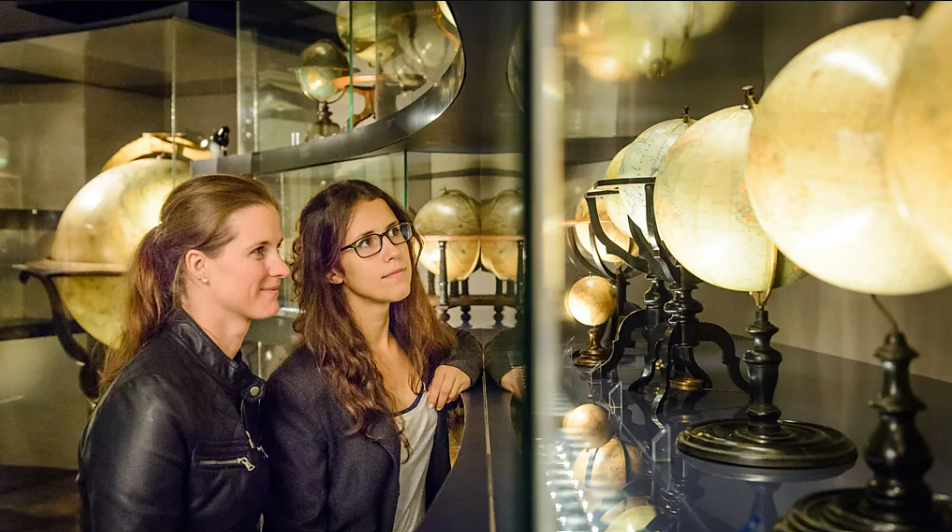
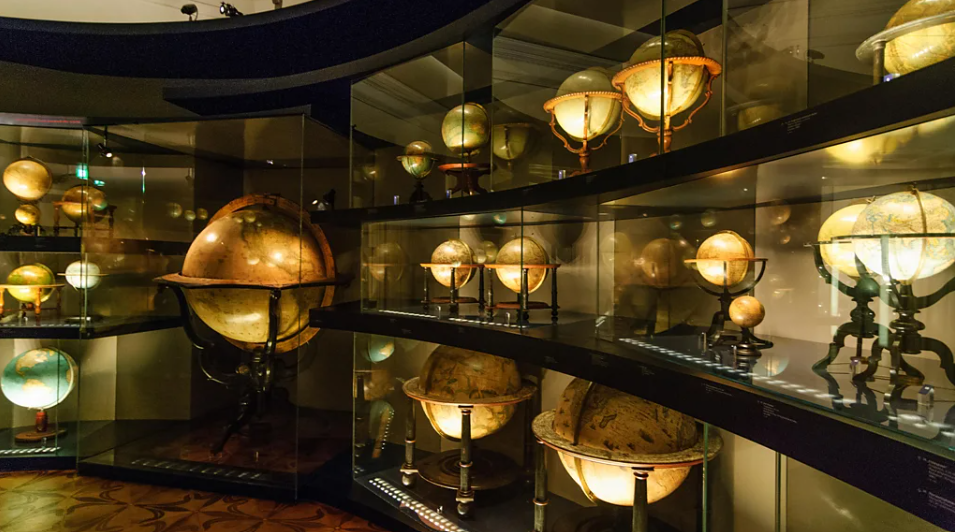
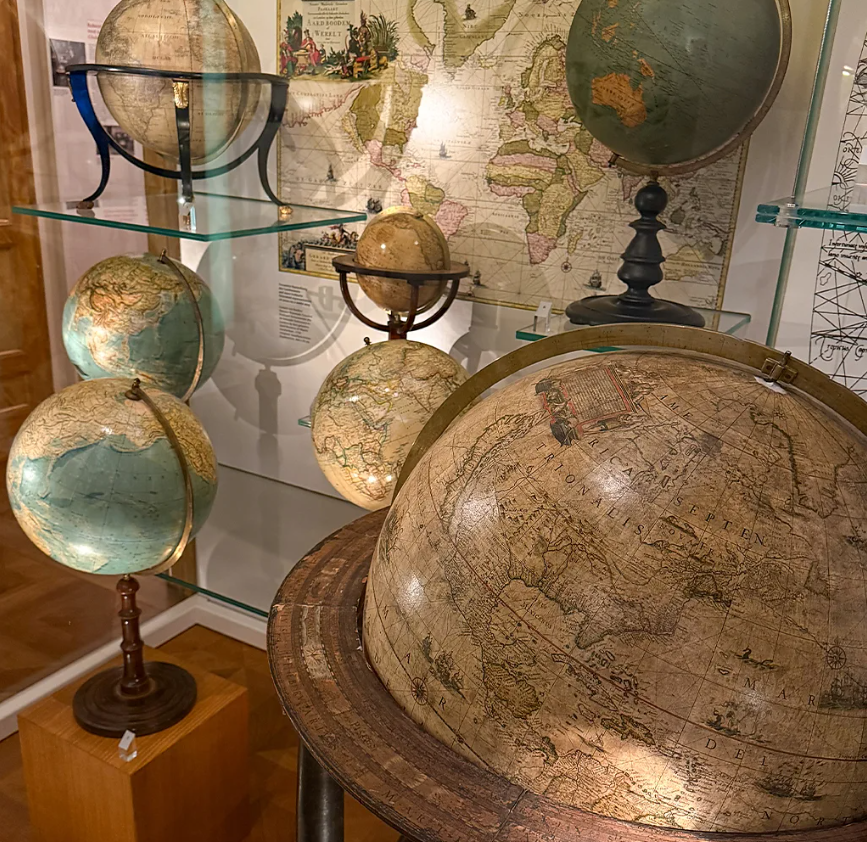
Vienna is home to an unusual cultural institution whose significance extends far beyond the objects displayed inside its galleries. The Globe Museum, located within the 17th-century Palais Mollard, is the only public museum in the world devoted entirely to globes. Its collection transforms what might initially appear to be a specialised cartographic archive into a broader examination of how societies have attempted to understand, represent and ultimately imagine the planet they inhabit.
The museum contains more than 220 rare and antique globes, most of them produced before 1850. Their scale varies dramatically, from imposing Coronelli globes to compact pocket versions designed to be carried. Together, the objects create a visual record of changing geographical knowledge, scientific development and cultural imagination.
The institution's importance comes partly from the fact that a globe is never simply a physical representation of geography. Each one reflects the information available to its makers at a particular moment, while also exposing the boundaries of what remained unknown. In this sense, the museum's collection operates simultaneously as a history of knowledge and a history of uncertainty.
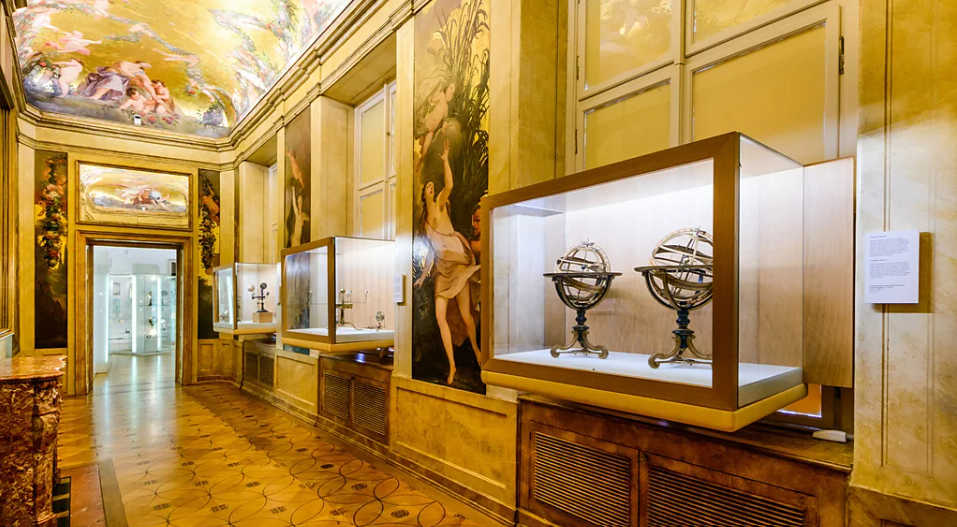
The visitor experience begins inside the Golden Cabinet, an elaborate space decorated with centuries-old frescoes inspired by Greek mythology. Rather than functioning as a neutral container for the collection, the room creates a deliberately theatrical setting in which scientific instruments and historical objects become part of a wider cultural narrative.
Among the instruments are telluriums, which demonstrate the Earth's movement around the Sun, and armillary spheres, whose circular structures provide physical models for understanding celestial motion. These objects demonstrate how scientific knowledge was once communicated through carefully constructed physical forms rather than digital interfaces or abstract diagrams.
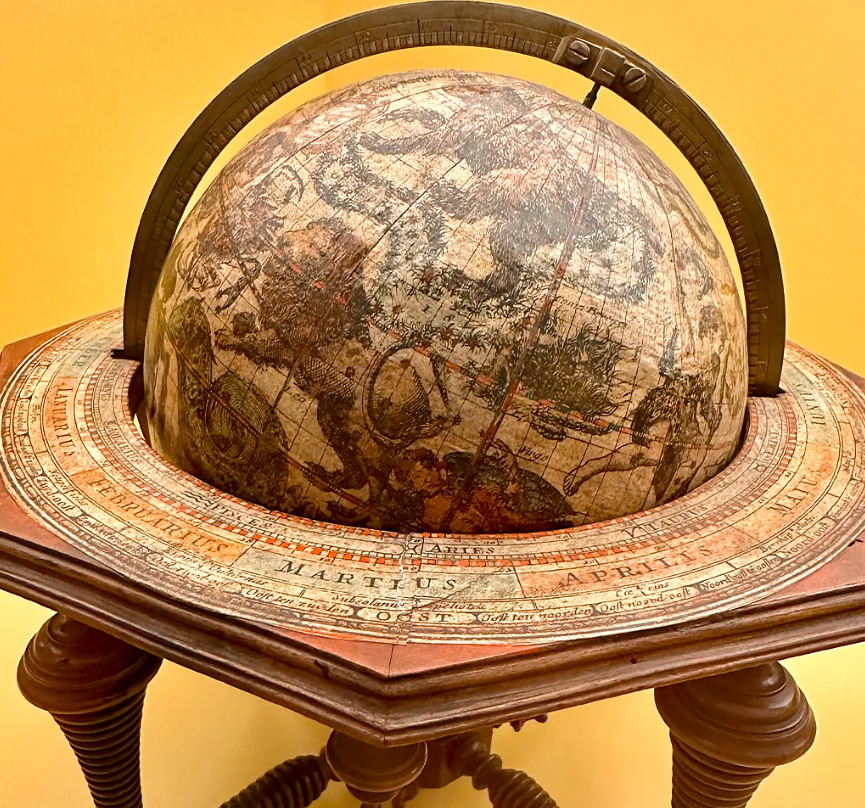
The museum's four principal galleries then move visitors into a quieter environment where the globes become the central visual language. Some of the oldest pieces date to the Renaissance and show a world that was still being mapped. Terrestrial and celestial globes produced by the same craftsman approximately ten years apart in the middle of the 16th Century provide a particularly revealing comparison.
The terrestrial model records European, Mediterranean and African coastlines with detailed place names, while large parts of North America remain incomplete and the Arctic is largely unexplored. Asia is represented in distorted form, an imagined southern continent occupies territory that would later include Australia and Antarctica, and the Pacific contains mythical sea creatures rather than accurately represented islands.
The accompanying celestial globe presents another layer of Renaissance thought. Constellations and astronomical observations appear alongside mythological figures such as Pegasus and Perseus. The combination demonstrates that scientific observation and mythology were not necessarily viewed as contradictory systems of knowledge. Instead, they coexisted within the intellectual framework of their period.
Other globes provide an even more complex perspective because they preserve historical assumptions that are now recognised as inaccurate or deeply problematic. Unexplored areas of oceans were sometimes populated with dragons and other mythical creatures, while certain maps confidently portrayed California as an island.
Some examples also reveal colonial attitudes through their visual language. Indigenous populations were represented through stereotypes, while European flags placed along African coastlines could communicate claims of possession and political power. The museum therefore treats its collection not simply as a celebration of beautiful historical objects but as evidence of the social and political structures that influenced how the world was represented.
This interpretive approach gives the museum an important contemporary dimension. The objects show that maps do not only describe geography; they can also encode the worldview, assumptions and power relationships of the people who create them. Their artistic beauty does not erase the historical context in which they were produced.
One of the collection's most striking examples comes from the space race era. A lunar globe produced in 1961 contains a meticulously mapped representation of the visible side of the Moon, while the far side is deliberately left blank. At that time, humans had not yet directly observed the Moon's hidden hemisphere. A second lunar globe created two years later includes the previously missing information, transforming the pair into a physical record of scientific discovery occurring within a very short period.
Another major attraction is a replica of the Behaim Globe, completed by Martin Behaim in 1492. The model represents a world in which the Americas do not appear, placing a vast expanse of ocean between Europe and Asia. Its historical significance comes from precisely what is missing: the globe provides a snapshot of geographical understanding immediately before European voyages transformed the established mental map of the planet.
This is what gives globes their continuing relevance. Their value is not limited to identifying countries or coastlines. A single sphere can be used to discuss climate, geology, topography, trade routes, exploration, political influence and technological development. Its three-dimensional structure also makes geographical relationships easier to conceptualise as a connected system rather than as isolated locations on a flat screen.
The history of the globe itself also mirrors wider economic and social change. Early globes were luxury possessions associated with aristocrats and wealthy merchants. Their production required specialised knowledge and considerable resources, making them symbols of status as well as instruments of learning.
As manufacturing techniques evolved, globes became smaller, more accessible and increasingly affordable. They moved into educational institutions and private homes and eventually became familiar objects for children. The transition illustrates how technological and manufacturing progress can transform a specialised object associated with elite knowledge into an everyday cultural product.
The museum's contemporary appeal is therefore partly based on this tension between historical rarity and modern familiarity. Most people have encountered a globe before, yet digital mapping has changed the way geographical information is consumed. Google Earth and other digital platforms provide access to enormous quantities of geographical data instantly, but the physical globe offers something fundamentally different: scale, texture and a tangible relationship with the object representing the planet.
This physical quality contributes to the museum's identity. Visitors are not simply looking at information about the Earth; they are encountering objects that were handled, studied and interpreted by people living in very different historical circumstances. The marks of age and use turn the globes into material evidence of human curiosity.
The museum is also preparing to examine the cultural life of globes beyond geography and science. Beginning on 24 September 2026, its exhibition "Globes in Everyday Life, Art and Culture" will explore the transformation of the globe from an elite status symbol into a familiar object embedded in everyday culture.
The exhibition will examine appearances of globes across architecture, art and cinema. One prominent cultural example is Charlie Chaplin's famous interaction with an inflatable globe in the film The Great Dictator. By presenting such references alongside historical objects, the museum positions the globe as a cultural symbol rather than merely a scientific instrument.
This wider positioning strengthens the museum's role within Vienna's tourism ecosystem. The Globe Museum is situated in the centre of the city, close to major attractions that often experience heavy visitor traffic, yet its relatively quiet atmosphere gives it a different tourism proposition. Rather than competing through scale or spectacle, it offers depth, intimacy and specialised cultural discovery.
Its location inside Palais Mollard also contributes to the experience. The historic architecture, decorative interiors and carefully arranged galleries provide a setting in which the collection feels integrated into Vienna's broader heritage rather than isolated as a technical exhibition.
The institution's identity also extends beyond its walls. Around 50 globes are displayed on rooftops and facades across Vienna. The museum's new exhibition includes a virtual map that identifies these objects, encouraging visitors to continue exploring the city's relationship with globes after leaving the museum.
This creates a different model of cultural tourism. Instead of treating the museum as a single destination that begins and ends at the entrance, the institution connects its collection with the urban environment. The visitor becomes part of a city-wide discovery experience in which architectural details and public objects become extensions of the museum's narrative.
The museum's director, Nikolaus Schobesberger, has a personal connection to this subject that reinforces the institution's emphasis on imagination. His interest began during childhood, when he became fascinated by the ships, sea monsters and mythical creatures used to fill the unexplored spaces of historical maps. He began drawing his own maps at the age of six.
That fascination illustrates why the museum remains relevant despite the dominance of digital technology. Globes provide a physical invitation to imagine places that may be geographically distant or historically unknown. Their appeal is therefore not limited to accuracy; they also preserve the human desire to visualise possibilities.
The Globe Museum ultimately demonstrates that design can function as historical evidence. Every line, blank space, symbol and distortion on a globe communicates something about the society that produced it. The evolution from mythical sea monsters to scientifically mapped lunar surfaces represents not simply an improvement in cartographic precision but a transformation in the systems through which humanity understands reality.
From a tourism perspective, this makes the museum particularly valuable to Vienna's cultural identity. It offers visitors an experience that connects art, science, exploration, political history and design without reducing the collection to a single discipline. Its relative quietness and specialised focus also provide an alternative to the city's most crowded attractions.
The museum's broader significance lies in its ability to make the history of knowledge tangible. Modern digital maps can continuously update borders, satellite imagery and geographic information, but historical globes preserve earlier versions of reality in physical form. They show not only where people believed places were located, but also where they believed the unknown began.
In that sense, Vienna's Globe Museum is less a museum about spherical objects than a museum about changing human perspectives. Its collection documents how geography moved from a mixture of observation, speculation and mythology toward increasingly precise scientific representation, while also demonstrating that maps remain shaped by culture, politics and imagination.
The result is a cultural destination that uses an apparently simple object to tell an expansive story about civilisation. The globe becomes a miniature stage on which exploration, commerce, science, empire, art and technological progress intersect. By preserving those changing interpretations of the world, the museum gives visitors an opportunity not only to look at historical maps, but to reconsider how every generation constructs its own picture of the planet.
News You Should See
2026 Nobel Medicine Prize Honors Scientists Behind Optogenetics Breakthrough
Oil Prices Edge Lower as Stronger Middle East Exports and G7 Reserves Ease Supply Concerns
Trump Offers U.S. Assistance to Russia After Death at Siberian Plague Research Institute
Trump Takes Economic Message to Nebraska as GOP Faces Rising Cost-of-Living Pressure
U.S. Appeals Court Weighs Trump Administration’s $2.6 Billion Harvard Funding Fight
U.S. Midterm Elections Begin With Resilient Jobs Market and Persistent Cost Pressures
Latest News
The 2026 Nobel Prize in Physiology or Medicine honors Karl Deisseroth, Peter Hegemann and Georg Nagel for pioneering research behind optogenetics and its impact on neuroscience.
Oil prices edged lower as stronger Middle Eastern exports and a planned G7 release of 100 million barrels eased immediate supply concerns, while Gulf security risks and the Strait of Hormuz kept markets alert.
President Donald Trump said the United States would help Russia if needed after a laboratory worker died at a Siberian plague research institute, as Russian authorities imposed precautionary quarantine measures.
Trump’s Nebraska campaign stop highlights rising fuel and grocery costs, beef prices and growing economic pressure on Republicans ahead of the November midterm elections.
A U.S. appeals court is reviewing the Trump administration’s effort to cut Harvard’s federal research funding, with more than $2.6 billion at stake.
The U.S. enters the 2026 midterm elections with unemployment at 4.2%, while higher living and energy costs create economic pressure for households and businesses.
US services growth eased in September as input prices climbed to their highest level since July 2022, with fuel costs, supply-chain disruptions and strong demand increasing pressure on businesses.
Rising Treasury yields are increasing U.S. borrowing costs as Washington manages record debt, persistent inflation and strong economic demand, narrowing its policy options.
A EGP 16 million corporate partnership will establish and equip a bone marrow transplant unit at Cairo’s Coptic Hospital, supporting access to specialized treatment for patients.