Venice Beyond Overtourism: How to Experience the City Without Losing Its Soul
A more thoughtful approach to Venice can ease pressure on residents while giving travelers a deeper connection with the city’s neighborhoods, businesses and traditions

Venice has become one of the clearest examples of the tension between global tourism and the survival of historic cities.
The Italian lagoon city remains one of the world’s most recognizable destinations, attracting visitors with its canals, architecture, art and unusual urban landscape. Yet its popularity has created a difficult paradox: the same international attention that sustains the tourism economy can also place pressure on housing, public spaces, infrastructure and the city’s permanent population.
Venice’s resident population has declined dramatically over the decades. The number of full-time residents fell below 50,000 in 2023, while the city can receive visitor numbers many times larger than its permanent population during busy periods. The result is a destination where tourism is not simply an economic sector but one of the forces shaping everyday life.
This makes the question for travelers more complicated than whether Venice is crowded.
The more important question is how visitors can participate in the city’s tourism economy without contributing unnecessarily to the forces that are making Venice harder to live in.
One of the most visible responses has been the Venice Access Fee.
In 2026, the city expanded the system to 60 chargeable days, primarily during periods when day-trip demand is expected to be highest. The fee is aimed at visitors who enter Venice without staying overnight, while residents, children under 14 and several other categories are exempt. Overnight visitors generally do not pay the access charge but must complete the appropriate exemption process.
The policy represents an important shift in how destinations think about tourism management.
Rather than treating visitor numbers as an unlimited source of economic growth, Venice is attempting to manage when and how large numbers of tourists enter its most sensitive areas.
The measure is controversial, however. Critics argue that a fee alone cannot resolve the structural problems facing the city and could risk turning access to Venice into something resembling admission to a theme park.
The larger challenge is therefore not simply reducing visitor numbers.
It is changing the distribution and behavior of tourism.
For travelers, one of the easiest ways to do that is to reconsider the timing of a visit.
Summer is traditionally the most popular period, but it also combines heavy visitor volumes with heat and humidity. Venice can offer a very different experience during autumn and winter, when fewer visitors can make the narrow streets and canals feel considerably less congested.
The quieter months can also change the economic rhythm of a trip.
Instead of moving rapidly between the most famous landmarks, visitors have more opportunities to explore neighborhood businesses, small restaurants and less prominent cultural spaces.
This matters because Venice is not a museum.
It is a functioning city whose narrow streets and bridges are used every day by residents, workers, schoolchildren and people transporting goods.
That physical reality makes tourist behavior unusually important.
A group stopping in the middle of a narrow passage to take photographs may seem insignificant, but repeated behavior of that kind can create bottlenecks in streets that offer few alternative routes.
For the visitor, basic spatial awareness is therefore part of responsible tourism.
Moving aside when residents or workers need to pass, avoiding unnecessary obstruction and treating public spaces as shared infrastructure can have a measurable effect on the quality of life in a city with such limited physical capacity.
Accommodation choices also have wider consequences.
Short-term rentals can provide visitors with an attractive alternative to hotels, but the expansion of tourist accommodation can put additional pressure on housing availability when residential properties are converted into visitor-focused units.
Choosing a locally operated hotel or bed-and-breakfast can therefore have a different economic impact from simply selecting the cheapest available apartment.
The principle extends to food.
Venice's culinary identity is increasingly being shaped by local families, independent restaurants and younger chefs who are attempting to maintain traditional cuisine while developing new interpretations.
Choosing family-run establishments can redirect part of a visitor's spending toward businesses embedded in the local community.
This is particularly relevant because tourism spending does not automatically translate into benefits for residents.
The economic question is not only how much visitors spend, but where that money goes.
A meal at an independent Venetian restaurant, a purchase from a local artisan or a stay with a locally operated hospitality business can help strengthen the economic ecosystem that makes the destination culturally distinctive.
Venice's challenge is therefore partly a question of economic circulation.
If tourism revenue concentrates overwhelmingly in businesses designed around high-volume visitors, the city risks becoming increasingly dependent on a model that weakens the residential and cultural infrastructure that originally made it attractive.
If more spending reaches local businesses and traditional trades, tourism can become a tool for preserving the city's identity rather than simply consuming it.
Another way to experience Venice differently is to stop trying to see everything.
The city's most famous locations, including Rialto and Piazza San Marco, naturally attract enormous numbers of visitors.
But the physical structure of Venice rewards travelers who are willing to walk beyond the headline attractions.
A few streets away from the busiest routes, visitors can encounter quieter neighborhoods where everyday Venetian life continues with considerably less tourist pressure. Recent travel guidance also emphasizes spending several days in the city rather than treating it as a quick checklist destination.
This slower approach has an economic benefit as well.
Longer stays distribute spending across more days, meals, neighborhoods and businesses. They also reduce the dominance of the day-trip model, in which large numbers of visitors arrive simultaneously, concentrate around a handful of landmarks and leave without contributing as extensively to the wider local economy.
The city has also invested in technology to better understand visitor movement.
Venice has used cameras, sensors and mobile-phone data to monitor concentrations of people and identify areas where congestion is developing. The objective is to provide officials with information that can help manage pedestrian flows and respond to overcrowding.
This approach illustrates how tourism management is becoming increasingly data-driven.
For destinations facing extreme visitor concentration, knowing how many people are present is no longer enough. Authorities need to understand where crowds accumulate, when pressure reaches critical levels and how visitors move between different parts of a city.
But technology cannot solve every aspect of overtourism.
Crowd management can reduce congestion, but it cannot by itself reverse population decline, restore housing affordability or preserve local businesses.
Those challenges require long-term urban and economic policies.
Venice also has an advantage that can be overlooked in discussions about overtourism: its identity remains remarkably resilient.
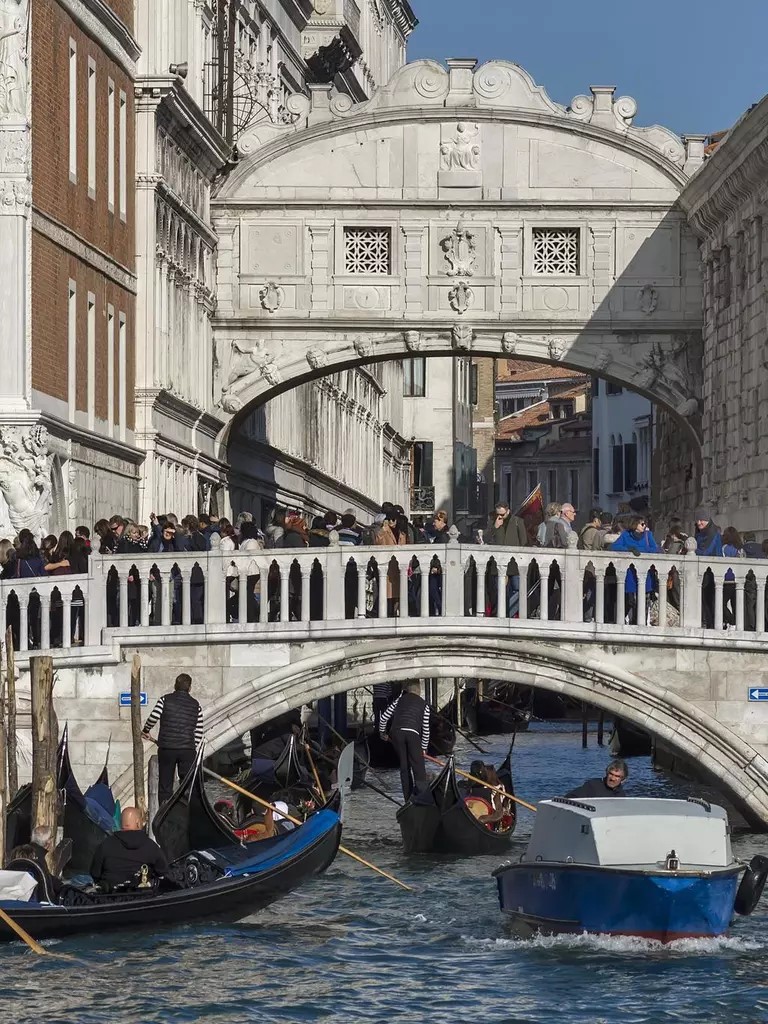
The city is more than the Rialto Bridge, gondolas and the Grand Canal.
Its cultural calendar extends beyond the internationally famous Carnival, Biennale and Venice Film Festival. Local celebrations and events provide additional ways to understand the city through its traditions rather than simply through its most photographed landmarks.
This distinction is important for the future of tourism.
A destination becomes more vulnerable when visitors consume a simplified image of it.
The more Venice is reduced to a collection of iconic photographs, the greater the pressure becomes on a small number of locations.
A more distributed tourism model can spread visitors geographically and economically while providing travelers with a richer experience.
The future of Venice therefore depends on a balance between access and protection.
The city cannot realistically eliminate tourism, nor should it. Tourism provides employment, supports businesses and connects Venice with a global audience.
The challenge is to prevent tourism from becoming so dominant that it undermines the very community and cultural environment that visitors came to experience.
For travelers, responsible tourism does not require abandoning Venice.
It requires approaching the city differently.
Visit outside the busiest periods when possible. Stay overnight rather than making only a day trip. Give residents room to move through narrow streets. Choose independent and family-run businesses. Explore neighborhoods beyond the standard itinerary. Spend enough time to understand the city rather than simply photographing it.
These choices may seem small, but collectively they can change the economic and social impact of tourism.
Venice is not a destination that has run out of value.
It is a city facing the consequences of being exceptionally valuable to the rest of the world.
Its future will depend not only on what local authorities do, but also on how the global tourism industry and individual travelers respond.
The most sustainable way to visit Venice may ultimately be the simplest: slow down, spend locally and allow the city to remain a city.
News You Should See
2026 Nobel Medicine Prize Honors Scientists Behind Optogenetics Breakthrough
Oil Prices Edge Lower as Stronger Middle East Exports and G7 Reserves Ease Supply Concerns
Trump Offers U.S. Assistance to Russia After Death at Siberian Plague Research Institute
Trump Takes Economic Message to Nebraska as GOP Faces Rising Cost-of-Living Pressure
U.S. Appeals Court Weighs Trump Administration’s $2.6 Billion Harvard Funding Fight
U.S. Midterm Elections Begin With Resilient Jobs Market and Persistent Cost Pressures
Latest News
The 2026 Nobel Prize in Physiology or Medicine honors Karl Deisseroth, Peter Hegemann and Georg Nagel for pioneering research behind optogenetics and its impact on neuroscience.
Oil prices edged lower as stronger Middle Eastern exports and a planned G7 release of 100 million barrels eased immediate supply concerns, while Gulf security risks and the Strait of Hormuz kept markets alert.
President Donald Trump said the United States would help Russia if needed after a laboratory worker died at a Siberian plague research institute, as Russian authorities imposed precautionary quarantine measures.
Trump’s Nebraska campaign stop highlights rising fuel and grocery costs, beef prices and growing economic pressure on Republicans ahead of the November midterm elections.
A U.S. appeals court is reviewing the Trump administration’s effort to cut Harvard’s federal research funding, with more than $2.6 billion at stake.
The U.S. enters the 2026 midterm elections with unemployment at 4.2%, while higher living and energy costs create economic pressure for households and businesses.
US services growth eased in September as input prices climbed to their highest level since July 2022, with fuel costs, supply-chain disruptions and strong demand increasing pressure on businesses.
Rising Treasury yields are increasing U.S. borrowing costs as Washington manages record debt, persistent inflation and strong economic demand, narrowing its policy options.
A EGP 16 million corporate partnership will establish and equip a bone marrow transplant unit at Cairo’s Coptic Hospital, supporting access to specialized treatment for patients.