U.S. Mortgage Rates Decline for Third Straight Week, Offering Relief to Homebuyers
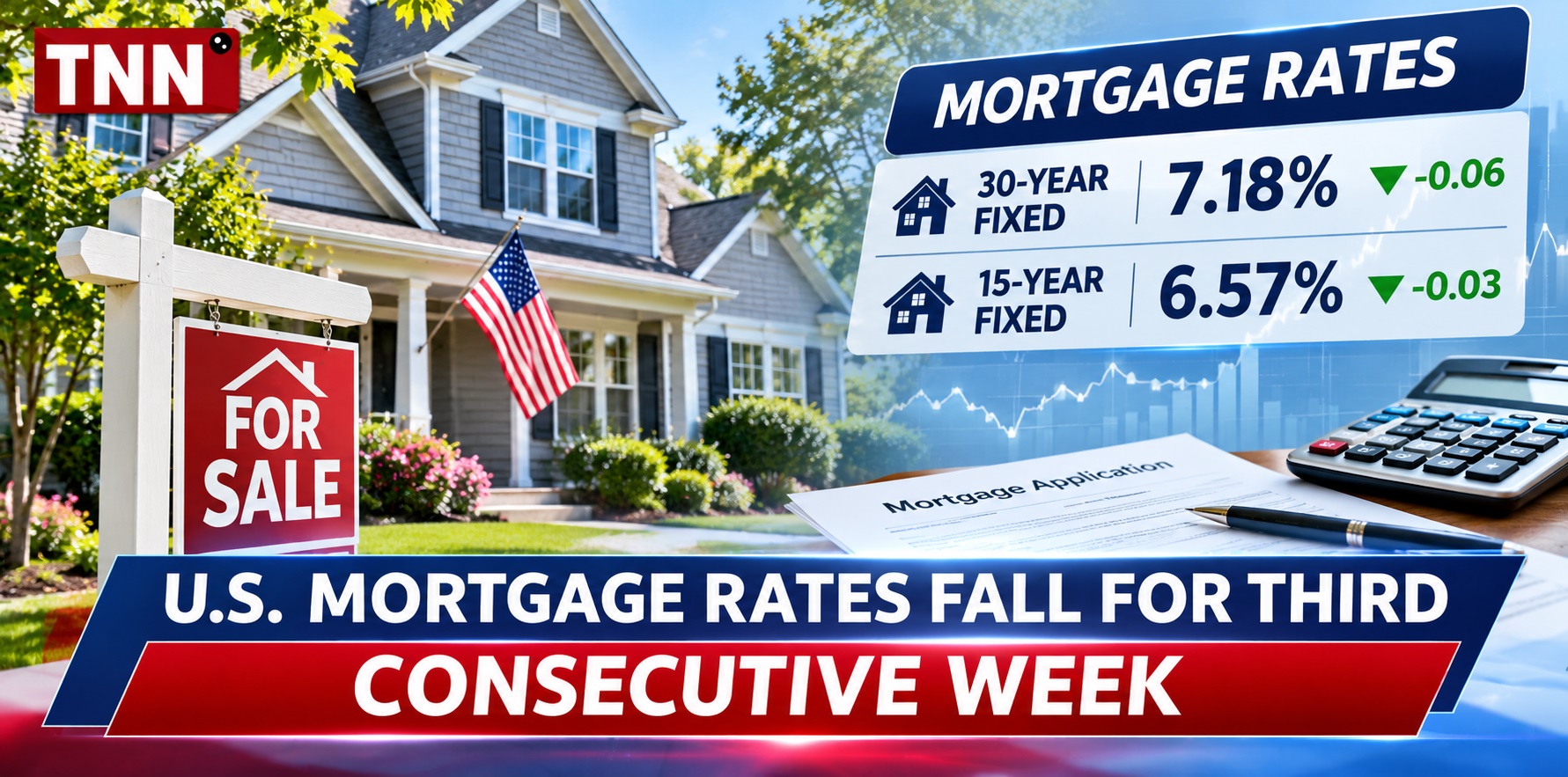
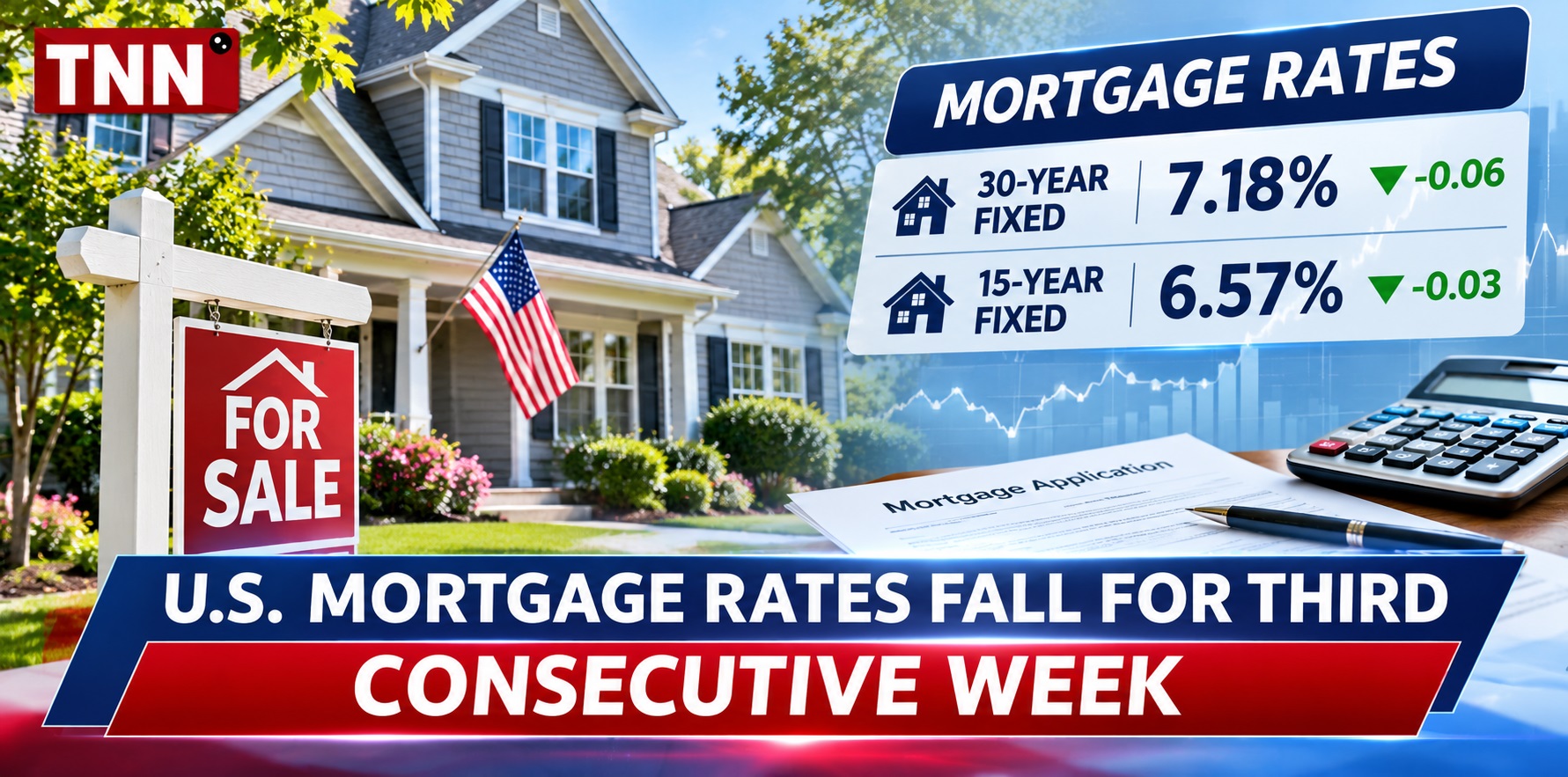
U.S. mortgage rates decline for a third consecutive week, with 30-year loans averaging 7.18%, although elevated borrowing costs and housing prices continue to challenge affordability.

U.S. Mortgage Rates Extend Three-Week Decline, but Housing Affordability Remains Under Pressure
The U.S. housing market is receiving another modest signal of relief as mortgage borrowing costs decline for a third consecutive week. However, the improvement remains limited compared with the substantial increase in financing expenses that has reshaped homebuying decisions across the country.
Data released by Freddie Mac on Thursday showed that the average interest rate on a 30-year fixed-rate mortgage fell to 7.18%, compared with 7.24% a week earlier. The average rate on a 15-year fixed mortgage also edged lower, reaching 6.57%, down from 6.60%.
Although the latest figures indicate a gradual easing in borrowing costs, they remain considerably above levels recorded a year earlier. In the corresponding period of 2025, average rates stood at 6.22% for 30-year mortgages and 5.50% for 15-year loans.
The gap highlights the scale of the financing challenge facing American households, particularly those attempting to enter the housing market for the first time.
Bond Market Movements Drive Mortgage Financing Costs
The recent decline in mortgage rates reflects developments in the U.S. bond market, where Treasury yields play an important role in determining the cost of long-term home loans.
The yield on the 10-year U.S. Treasury note, a closely watched benchmark for mortgage lenders, declined to approximately 4.84% on Thursday. This represented its lowest level since early September, following a period of significant increases that pushed the yield above 5.30% in early October.
Mortgage rates had also climbed to approximately 7.4% early last month, reaching their highest point in nearly three years before beginning their latest downward movement.
This relationship illustrates how housing finance responds to broader financial market conditions. Mortgage rates are not determined directly by the Federal Reserve's short-term policy rate. Instead, lenders consider longer-term borrowing costs, market expectations, inflation risks and the additional compensation required for mortgage lending.
Consequently, changes in Treasury yields can influence the direction of mortgage pricing even when the Federal Reserve has not made an equivalent adjustment to its benchmark rate.
For lenders, the cost of funding and the risks associated with long-term loans remain central considerations. For households, these market movements determine how much income must be allocated to monthly housing payments.
Lower Rates Can Make a Significant Difference to Household Budgets
The financial implications of mortgage rate movements become particularly important when applied to large property loans.
According to the reported figures, the increase in borrowing costs from the brief average of 5.98% recorded in late February has added an estimated $300 to $350 to monthly payments on a $400,000 mortgage.
That difference illustrates why even relatively small changes in interest rates can influence purchasing decisions. A reduction in the monthly payment may improve a household's ability to qualify for financing, preserve disposable income and manage other financial commitments.
However, the latest decline does not eliminate the affordability problem. Buyers continue to face a combination of elevated home prices and financing costs that remain substantially higher than those available during the pandemic-era housing boom.
First-time purchasers are particularly exposed because they often have less accumulated housing equity and must meet down-payment requirements while managing rising living expenses.
The result is a market in which some households may remain financially capable of purchasing a home but choose to delay their decisions until borrowing conditions become more favorable.
Housing Market Weakness Reflects a Longer Structural Challenge
The current slowdown in the U.S. housing market has developed over several years. Mortgage rates began rising sharply in 2022 as the financing environment moved away from the exceptionally low borrowing costs that had supported housing demand during the pandemic.
The adjustment affected both buyers and existing homeowners.
Prospective purchasers faced increasingly expensive mortgages, while homeowners who had secured low fixed-rate financing became less willing to sell and replace their existing loans with new mortgages carrying substantially higher interest rates.
This dynamic contributed to weaker housing transactions and reduced the movement of properties through the market.
Existing-home sales have remained subdued, reflecting the combined influence of financing costs, property prices and limited incentives for some homeowners to relocate.
For real estate companies, mortgage lenders, property developers and related businesses, weaker transaction activity can create pressure across several parts of the industry.
Lower sales volumes may affect brokerage revenues, mortgage origination activity and demand for services associated with property purchases. Developers may also need to account for financing conditions when assessing new projects and potential demand.
The market therefore requires more than a short-term decline in interest rates to achieve a sustained recovery.
Implications for Lenders, Developers and the Wider Economy
Mortgage financing is closely connected to broader economic activity because residential property transactions generate demand across multiple industries.
When borrowing costs remain elevated, households may postpone purchases, reduce their property budgets or direct a larger share of their income toward housing expenses.
These decisions can influence spending on furniture, appliances, renovations, construction materials and other household goods.
Banks and mortgage lenders may also experience changes in demand for new loans as potential buyers reassess the cost of financing.
A sustained reduction in rates could gradually improve lending activity and support property transactions. However, lenders must also consider credit quality, employment conditions and borrowers' ability to meet long-term payment obligations.
For developers, the key issue is whether lower financing costs translate into stronger demand. A reduction in mortgage rates may improve purchasing capacity, but high property prices and limited household income growth can continue to restrict the number of qualified buyers.
The relationship between borrowing costs and property values will therefore remain important in determining the direction of the housing market.
Three Weeks of Declines Are Not Yet a Recovery Signal
The latest movement provides a positive development for prospective homebuyers, but it is too early to interpret three consecutive weeks of declining mortgage rates as evidence of a lasting turnaround.
Future borrowing costs will depend on several interconnected factors, including inflation, Treasury market movements, economic growth and expectations surrounding Federal Reserve policy.
Home prices and household income levels will also determine whether lower financing costs translate into meaningful improvements in affordability.
If mortgage rates continue to decline, more buyers could reconsider postponed purchases, potentially supporting transaction volumes and activity across the property sector.
Conversely, renewed increases in bond yields could reverse some of the recent improvement and keep financing costs at levels that discourage market participation.
The coming months will therefore be important in determining whether the recent decline represents a temporary adjustment or the beginning of a broader easing cycle.
For now, American homebuyers have gained some relief, but the gap between financing costs and household purchasing power remains one of the housing market's most significant challenges.
News You Should See
Before Thanksgiving: Tips to Cut Travel Costs and Avoid Traffic and Airport Congestion in the US
Dollar Holds Steady as US Inflation Data and Federal Reserve Decision Approach
US Appeals Court Ends Justice Department Lawsuit Targeting 20,000 California Ballots
Democrats Win Historic House Majority, Reshaping Washington's Political Landscape
Thanksgiving Storm Threatens Major US East Coast Travel Routes With Flooding and 60 MPH Winds
Manchester City Prepare for Tactical Battle Against Napoli in Champions League
Latest News
About 81.5 million Americans are expected to travel for Thanksgiving, facing higher airfare, heavy road traffic and crowded airports. Discover key travel preparations and cost-saving tips.
The dollar index holds near 103.85 as investors await US inflation and GDP figures, with December rate expectations and global monetary policy shaping currency markets.
The 9th Circuit Court of Appeals approved the Justice Department's request to dismiss its lawsuit targeting approximately 20,000 California ballots, ending a dispute over federal election oversight and state authority.
Democrats secure at least 259 House seats and a 56-seat Senate majority, setting the stage for major changes in US healthcare, spending and congressional oversight.
A developing Thanksgiving storm threatens the US East Coast with heavy rain, coastal flooding and wind gusts of up to 60 mph, raising concerns about airport operations, road travel and holiday transportation in major cities.
Manchester City host Napoli in a key Champions League clash, with Haaland, Foden and Cherki expected to lead the English side's attacking efforts.
Arsenal prepare to host Borussia Dortmund in a crucial Champions League clash, with injuries and tactical decisions potentially shaping the outcome.
The Hunger Games: Sunrise on the Reaping earns $225 million worldwide in its opening weekend, strengthening the franchise's box-office position.
Harvard research estimates that 403 US hyperscale data centers consume up to 99 terawatt-hours annually, raising concerns about AI's environmental impact.