U.S. Health Department Introduces Temporary Policy for Six Unapproved Peptides
The interim measure allows licensed pharmacies and physicians to compound six peptide ingredients while the FDA considers their regulatory status, raising questions about safety, clinical evidence and oversight.

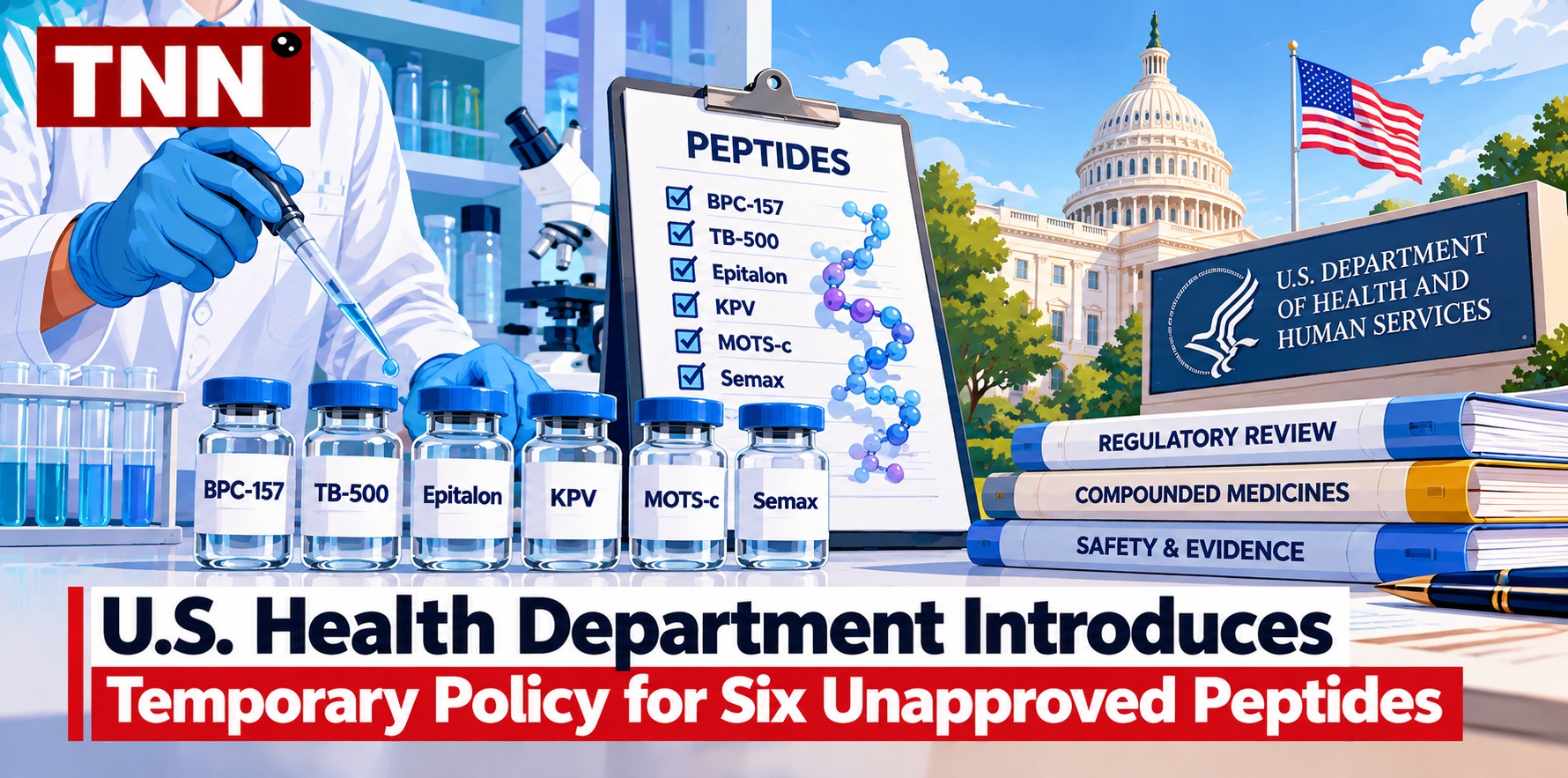
The U.S. healthcare regulatory landscape is facing a new development after the Department of Health and Human Services introduced an interim policy allowing licensed pharmacies and physicians to compound six peptide ingredients while federal regulators review their potential status in compounded medicines.
The measure covers BPC-157, TB-500, epitalon, KPV, MOTS-c and Semax, six substances that have attracted growing attention in wellness communities and online health discussions. Their popularity reflects increasing consumer interest in peptide-based products, particularly those promoted for potential applications involving tissue recovery, sleep and pain management.
However, the policy does not represent full approval of these substances as medicines by the Food and Drug Administration.
Six Peptides Enter a New Regulatory Phase
The interim policy creates a temporary regulatory pathway under which licensed pharmacies and physicians can compound the six ingredients while authorities consider their longer-term status.
The development follows an earlier recommendation from an FDA advisory committee that the agency consider allowing the substances for use in compounded medicines.
The distinction between temporary permission for compounding and formal drug approval is central to understanding the decision. Compounded medicines operate under a different regulatory framework from pharmaceutical products that have completed the FDA's standard approval process.
Consequently, the policy should not be interpreted as confirmation that the six substances have established safety and effectiveness as approved medicines.
Social Media and the Growing Peptide Market
Peptides are short chains of amino acids that perform various biological functions. Their growing visibility has been driven partly by social media discussions, wellness influencers and online communities promoting potential health and performance applications.
Some of the substances covered by the policy have been discussed in connection with tissue recovery, sleep quality and pain management. However, public interest and promotional claims do not necessarily correspond to the strength of available clinical evidence.
This gap between consumer demand and established scientific knowledge has become an important challenge for healthcare regulators.
As interest in peptide-based products expands, authorities face increasing pressure to distinguish between substances with sufficiently established evidence and those whose potential applications remain under investigation.
Safety, Quality and Regulatory Oversight
The temporary measure also highlights broader questions about the oversight of compounded medicines.
Unlike drugs that undergo the full FDA approval process, compounded products operate within a separate regulatory framework. This distinction makes it particularly important to assess the quality, consistency and safety of individual ingredients and finished preparations.
The six peptides' regulatory status therefore remains an important consideration for healthcare professionals and consumers.
Allowing compounding during a regulatory review does not eliminate the need for scientific assessment, nor does it establish that every preparation containing these ingredients is safe or effective.
What the Decision Means for the Healthcare Industry
The development reflects a wider regulatory challenge: balancing access to compounded treatments with the responsibility to protect patients and maintain appropriate pharmaceutical standards.
For pharmacies and physicians, the interim policy creates additional room to compound the specified ingredients within the applicable regulatory framework. For regulators, it provides a period in which the substances' status can be considered before a longer-term decision is reached.
For consumers, however, the distinction between regulatory flexibility and formal medical approval remains essential.
Ultimately, the future of these six peptides will depend on the regulatory review, the quality of available scientific evidence and the ability of healthcare authorities to establish clear standards for their use.
The decision underscores a broader issue facing modern healthcare: consumer demand and online popularity can move faster than the scientific and regulatory processes required to establish the safety and effectiveness of emerging treatments.
News You Should See
Man City Faces Calls for Further Premier League Investigation Over Post-2018 Finances
Apple Maps Blurs Satellite Images of Key U.S. Military and NASA Sites
Who Is Delorean Bijon Brandon? The Case of Christina Downer’s Disappearance and Suspected Murder
From Siskel and Ebert to The Beatles: Celebrating Entertainment Legends
Olive Oil Before Carbs: Could Timing Influence Blood Sugar?
Jack Hughes Leads Devils to Shootout Victory, Ending Oilers’ Winning Run
Latest News
Premier League executives are debating a possible new investigation into Manchester City's finances after 2018, while the club appeals a verdict involving 114 financial-rule breaches.
Apple Maps has blurred satellite imagery of several U.S. military and NASA sites, including Cape Canaveral and Area 51. The reason for the changes remains unclear.
Delorean Bijon Brandon, 41, has been charged in connection with Christina Downer’s suspected murder after her disappearance in September 2025.
Chicago will honor film critics Gene Siskel and Roger Ebert with life-sized bronze statues, celebrating a partnership that reshaped popular film criticism.
Researchers are examining whether taking olive oil before glucose can slow stomach emptying and influence blood sugar levels, based on promising findings in mice.
Jack Hughes scores twice and adds an assist as the New Jersey Devils defeat the Edmonton Oilers 4-3 in a shootout, ending their three-game winning streak.
Researchers found that physical contact with dogs after an initial stressful task was associated with lower stress levels during a second challenge.
Researchers analyzed genetic data from 2.8 million people and identified 48 previously unknown genomic regions associated with Alzheimer's disease risk.
Screen-free schools are gaining interest among Silicon Valley tech families, raising questions about children's digital exposure and the role of technology in education.