US and Venezuela Restore Military Ties as Washington Expands Strategic Influence in Latin America
A new military agreement covering joint training and intelligence sharing signals a major shift in US-Venezuela relations, as Washington expands its security and energy influence across Latin America.

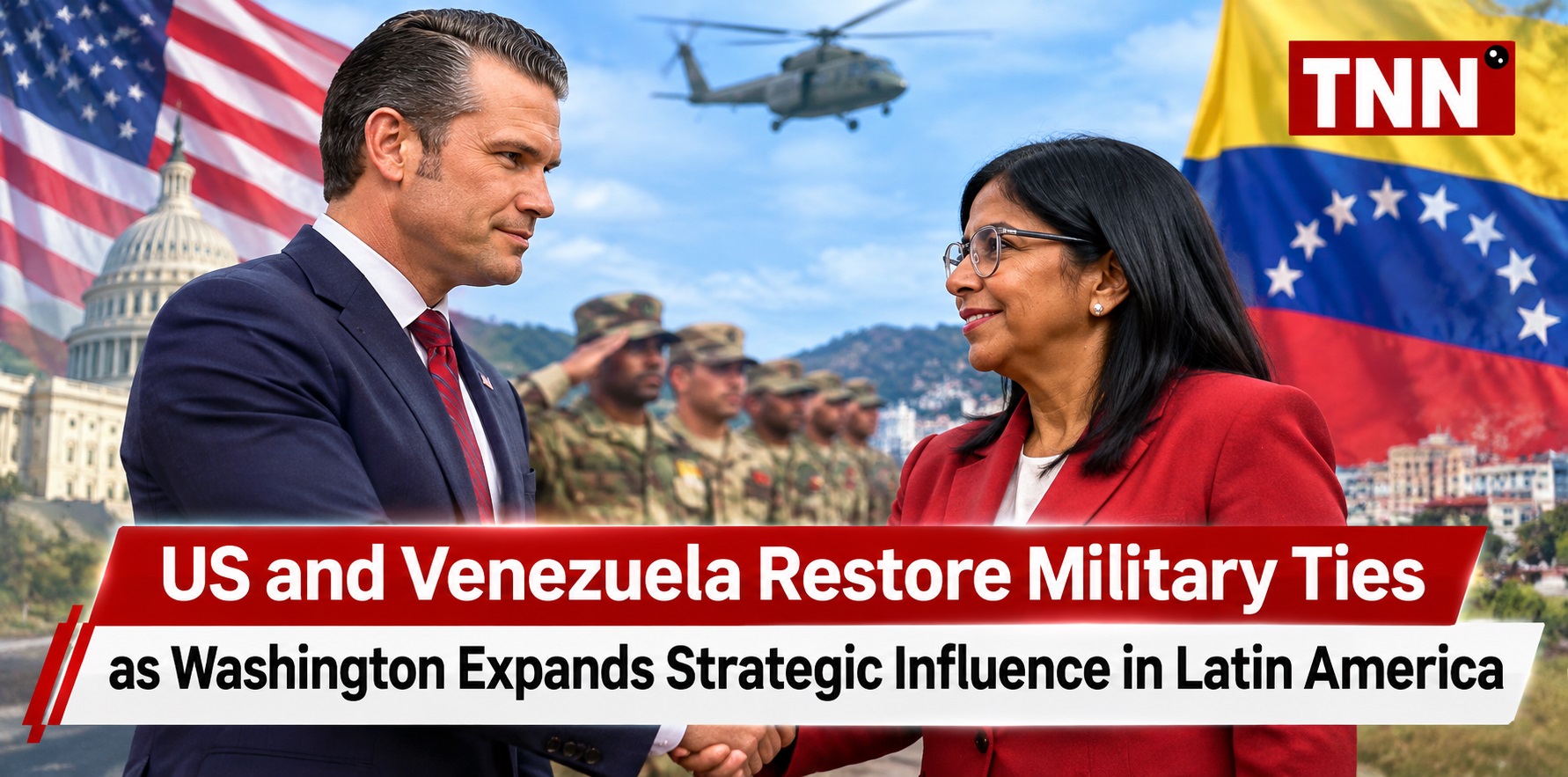
US and Venezuela Restore Military Ties as Washington Expands Its Strategic Influence in Latin America
The United States and Venezuela are entering a new phase of bilateral relations following an agreement to restore military cooperation, a development that reflects Washington's changing approach toward Caracas and its broader strategic ambitions across the Western Hemisphere.
The agreement was announced by US Defense Secretary Pete Hegseth during an unannounced visit to Caracas on November 18, 2026, where he met with Venezuela's interim President Delcy Rodríguez. The announcement represents a significant departure from years of strained relations and suspended military engagement between the two countries.
Beyond its military implications, the agreement is closely connected to Washington's growing involvement in Venezuela's political transition, energy sector and regional security arrangements.
A new defense partnership after years of confrontation
The agreement provides a framework for renewed military engagement, including joint training, intelligence sharing and potential cooperation involving defense equipment and military capabilities.
Hegseth described Venezuela as a security partner, highlighting the dramatic change in its relationship with Washington following the January 2026 operation in which US forces captured former President Nicolás Maduro.
Rodríguez welcomed the arrangement, presenting it as an opportunity to strengthen the capabilities of Venezuela's armed forces and improve coordination against shared security threats.
However, neither government has released comprehensive details about the agreement. Its duration, operational structure, financial commitments and the precise responsibilities of each side remain unclear.
This lack of transparency makes it difficult to assess how quickly the partnership will translate into practical military cooperation.
Washington's changing strategy toward Venezuela
The agreement reflects a broader transformation in American policy toward Venezuela.
Following Maduro's removal, the Trump administration has played an increasingly influential role in discussions concerning the country's political and economic future. A series of high-level American visits has also highlighted Washington's efforts to establish closer working relationships with the interim authorities.
For the United States, rebuilding military ties offers a potential mechanism to strengthen its position in a strategically important country while expanding cooperation on regional security issues.
Venezuela's geographic position, extensive coastline and proximity to major Caribbean shipping routes give it considerable strategic importance. Cooperation with Caracas could improve intelligence coordination and strengthen American security arrangements across the region.
The agreement also fits into the Trump administration's broader objective of reinforcing US influence in the Western Hemisphere, particularly at a time when regional security and access to strategic resources have become increasingly important policy priorities.
Oil and critical minerals add an economic dimension
Energy interests represent another major component of the evolving relationship.
Venezuela possesses some of the world's largest proven oil reserves, making its energy sector an important consideration for any long-term American strategy toward the country.
Discussions between the two governments have extended beyond defense cooperation to include oil and critical minerals. Hegseth suggested that a separate energy arrangement could help reduce the Western Hemisphere's dependence on transportation routes affected by the war with Iran.
Rodríguez described the proposed arrangement as mutually beneficial.
The economic significance of such cooperation could extend beyond immediate energy supplies. Greater American involvement in Venezuela's oil sector may create opportunities for investment, infrastructure development and expanded commercial activity.
However, the country's energy industry continues to face substantial challenges after years of underinvestment and deteriorating infrastructure. Any meaningful expansion in production would require considerable capital, technical expertise and a more predictable regulatory environment.
The relationship between defense cooperation and energy policy therefore deserves particular attention. Security arrangements could help establish conditions for greater economic engagement, although the extent of any direct connection between the two agreements has not been disclosed.
Regional security and the fight against drug trafficking
Military cooperation also comes as American forces continue operations targeting suspected drug-smuggling vessels in the Caribbean and eastern Pacific.
These operations have caused significant casualties and attracted scrutiny over the evidence supporting some US allegations against the targeted vessels.
The renewed partnership could provide Washington with additional opportunities for intelligence coordination and regional security operations.
For Venezuela, closer cooperation may offer access to training, military technology and equipment that could strengthen its armed forces. For Washington, the arrangement potentially provides a new partner in efforts to monitor criminal networks and address cross-border security threats.
Nevertheless, the effectiveness of the agreement will depend on how intelligence is shared, how military responsibilities are defined and whether both governments can maintain consistent cooperation.
Political uncertainty remains a major obstacle
Despite the announcement, Venezuela's political future remains unsettled.
Rodríguez continues to lead the interim government following Maduro's removal, while opposition leader María Corina Machado has returned from exile. No date has been announced for the next presidential election.
This uncertainty creates important questions about the long-term stability of the new partnership.
Military agreements typically require institutional continuity, established command structures and clear political commitments. Changes in Venezuela's leadership or the direction of its political transition could therefore influence the implementation and future scope of cooperation.
The agreement also raises questions about the balance between Washington's security and economic priorities and the expectations of Venezuelan political groups seeking a broader democratic transition.
A strategic shift with long-term implications
The restoration of military ties marks a significant change in the relationship between two countries that spent years in political confrontation.
For Washington, the agreement offers an opportunity to consolidate its regional influence while advancing security and energy objectives. For Caracas, it provides a pathway to renewed military engagement, improved capabilities and closer relations with a major international power.
Yet the announcement alone does not establish the long-term direction of the relationship. The absence of detailed implementation provisions, continuing political uncertainty and the challenges facing Venezuela's economy remain important factors.
The next phase will depend on whether the two governments translate their political understanding into practical cooperation and whether the evolving relationship can withstand changes in Venezuela's domestic political landscape.
Ultimately, the agreement is about more than restoring military contacts. It reflects a broader realignment in which defense policy, energy access and regional influence are becoming increasingly interconnected in the future of US-Venezuela relations.
News You Should See
Vivo Prepares Three New Budget Smartphones with 6,500mAh Batteries and Updated Features
Carlos Espi Delivers Late Winner as Real Madrid Overcomes Mbappé's Penalty Miss
Google Pixel 11 Introduces Faster Tensor G6 Processor and Expanded Storage
Borussia Dortmund Secure Bundesliga Victory as Felix Nmecha Delivers Key Performance
Harry Kane's Ankle Surgery Leaves Bayern Munich Facing a Major Attacking Setback
Imam Tahir Kukaj Receives 2026 Appreciation Award for Community Service
Latest News
Vivo's upcoming budget phones reportedly feature 6,500mAh batteries, 6.74-inch displays and different camera and charging specifications.
Carlos Espi scores a late winner as Real Madrid defeat Celta Vigo 2-1, despite Kylian Mbappé missing a penalty.
Google Pixel 11 reportedly features the Tensor G6 processor, 256GB storage and 25W wireless charging, alongside familiar camera and display features.
Felix Nmecha plays a crucial role as Borussia Dortmund defeat Borussia Mönchengladbach, strengthening their Bundesliga campaign.
Harry Kane undergoes left ankle ligament surgery and could miss three months, creating a major challenge for Bayern Munich and England.
Imam Tahir Kukaj receives the 2026 Appreciation Award in recognition of his commitment to community service, volunteerism, and public engagement.
Congress faces a potential partial government shutdown on December 11 as disputes over Pentagon funding, the Iran conflict and federal spending negotiations delay an agreement.
The Premier League returns on November 21, 2026, with Manchester City, Arsenal and Chelsea facing important fixtures after the international break.
The U.S. Congress honored former Egyptian President Anwar Sadat with a posthumous Gold Medal on November 18, 2026, recognizing his historic contribution to Middle East peace.