Ukraine’s Civilian Toll Signals a Dangerous New Phase in the War
A record rise in civilian casualties during June highlights the growing cost of long-range attacks and raises urgent questions about the effectiveness of international efforts to contain the conflict.

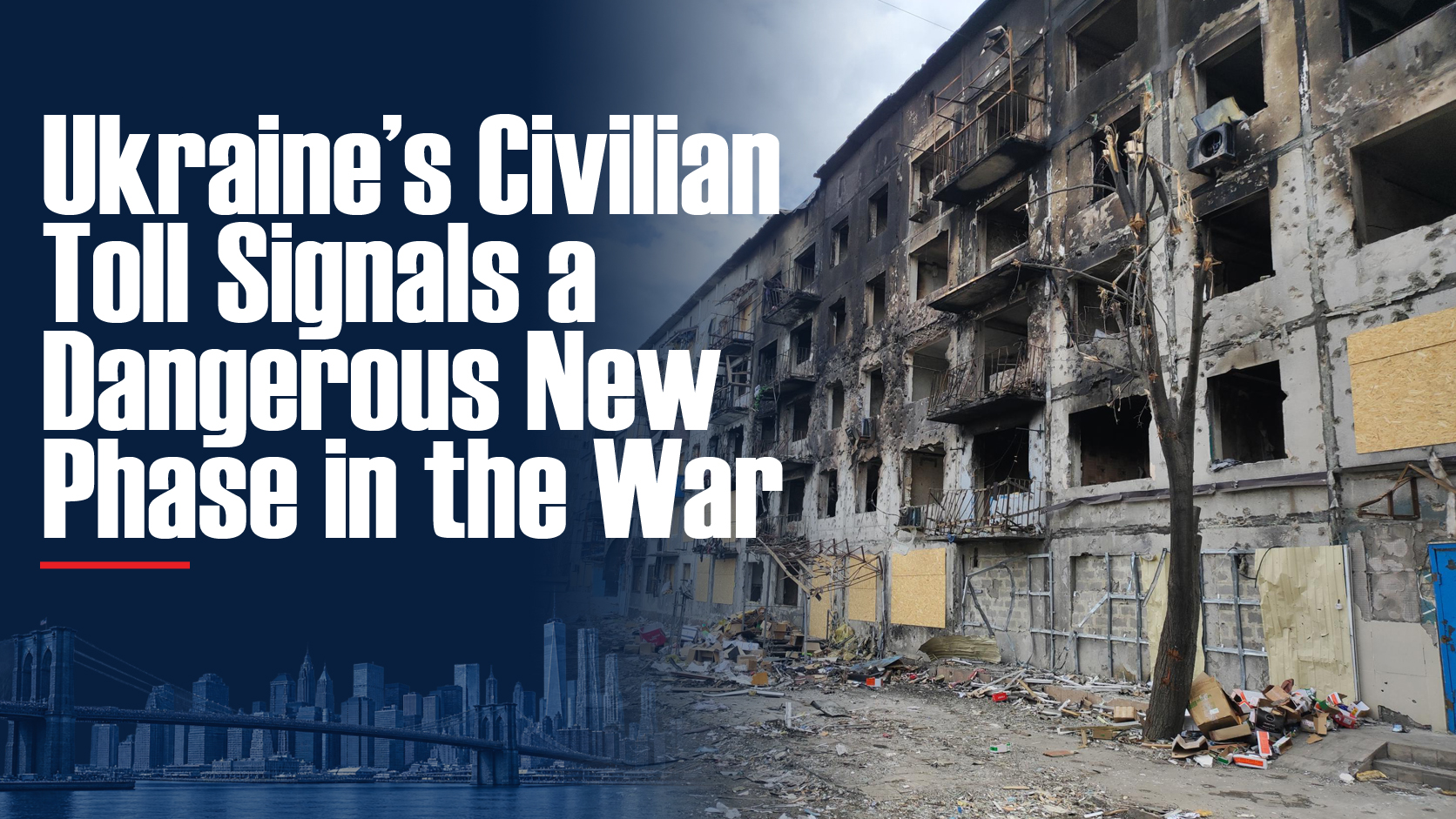
The most important message in the latest United Nations warning on Ukraine is not simply that civilian casualties are rising. It is that the pattern of the war is increasingly pushing violence deeper into populated areas, making the civilian population a central measure of how far the conflict has escalated.
Preliminary UN figures indicate that at least 265 civilians were killed and 1,816 injured in Ukraine during June 2026. Together, the figures represent the highest monthly civilian casualty toll since the early months following Russia’s full-scale invasion in February 2022. The United Nations also warned that the deteriorating trend appeared to be continuing into July.
That development matters beyond the immediate human cost. A prolonged war can gradually normalize civilian casualties as another statistic, but the scale and direction of the latest figures suggest something more consequential: the conflict is continuing to evolve in ways that make conventional assumptions about the distance between battlefields and civilian life increasingly irrelevant.
Long-range aerial attacks have become a defining feature of the war. When missiles and drones reach major urban centers, the distinction between frontline areas and supposedly safer cities becomes increasingly fragile. Kyiv and other population centers can be exposed to attacks even when they are far from the ground fighting.
This changes the strategic environment for Ukraine. Civilian protection is no longer primarily a question of safeguarding communities close to active combat zones. It increasingly depends on the country's ability to detect and intercept attacks launched from considerable distances, as well as on the resilience of critical infrastructure and emergency systems.
The numbers accumulated since the beginning of the full-scale invasion underline the scale of the challenge. The UN's human rights office has verified at least 16,402 civilian deaths in Ukraine, including 802 children, and 48,428 injuries, including 2,948 children. The UN has stressed that the actual figures are likely higher.
These figures also demonstrate why monthly casualty statistics should not be viewed in isolation. June did not simply produce another increase; it followed a deterioration already visible in May. The concern expressed by UN officials is that the upward trajectory may continue rather than represent a temporary spike.
That possibility has direct implications for international diplomacy.
For more than four years, diplomatic initiatives have repeatedly attempted to create conditions for ending or reducing the war, while military operations have continued to reshape the situation on the ground. The latest civilian casualty figures illustrate the cost of this gap between diplomatic efforts and battlefield realities.
The longer the conflict continues, the greater the risk that civilian infrastructure becomes increasingly exposed to military pressure. Residential buildings, transportation networks, energy facilities and other urban systems are not merely symbols of normal life; their disruption can produce secondary economic and social consequences that extend well beyond the immediate casualties.
There is also an important international-law dimension. UN officials have emphasized that attacks against civilians and civilian infrastructure constitute violations of international humanitarian law and must stop.
That statement is significant because the civilian casualty debate is not simply about competing narratives from Moscow and Kyiv. It is also about the responsibilities imposed by international humanitarian law regardless of the broader political dispute.
At the same time, the figures need to be interpreted carefully. The UN has verified civilian casualties through its established monitoring mechanisms, but it has acknowledged that the real toll is likely higher. Russian authorities have also reported civilian casualties inside Russia, although the UN has said it was not in a position to independently verify those figures.
This distinction matters. Reliable casualty documentation is essential not only for understanding the humanitarian situation but also for future accountability and any eventual political settlement. The credibility of such records becomes especially important when competing sides present sharply different accounts of the conflict.
The more immediate question, however, is whether the international response can keep pace with the changing character of the war.
The latest figures suggest that protecting civilians requires more than humanitarian assistance after an attack. It requires sustained diplomatic pressure, stronger protection of civilian infrastructure and effective defensive capabilities capable of reducing the impact of long-range strikes.
The strategic significance of the June numbers therefore lies in what they may signal about the months ahead. If July continues the same trajectory, the humanitarian cost of the conflict will become even harder to separate from the broader question of whether current diplomatic mechanisms are producing any meaningful reduction in violence.
For Ukraine, every additional month of elevated civilian casualties carries economic, demographic and social consequences. For Europe, it reinforces the security risks associated with a war that continues to generate instability far beyond the immediate battlefield. And for the international system, it represents another test of whether diplomatic pressure can translate into measurable protection for civilians.
The latest UN warning should therefore not be treated merely as another casualty update.
It is an indicator of the direction in which the war is moving.
If civilian casualties continue to rise despite repeated diplomatic efforts, the central international question will become increasingly difficult to avoid: not simply how to respond after civilians are killed, but what additional political and diplomatic measures are necessary to prevent the next escalation from producing an even higher toll.
News You Should See
2026 Nobel Medicine Prize Honors Scientists Behind Optogenetics Breakthrough
Oil Prices Edge Lower as Stronger Middle East Exports and G7 Reserves Ease Supply Concerns
Trump Offers U.S. Assistance to Russia After Death at Siberian Plague Research Institute
Trump Takes Economic Message to Nebraska as GOP Faces Rising Cost-of-Living Pressure
U.S. Appeals Court Weighs Trump Administration’s $2.6 Billion Harvard Funding Fight
U.S. Midterm Elections Begin With Resilient Jobs Market and Persistent Cost Pressures
Latest News
The 2026 Nobel Prize in Physiology or Medicine honors Karl Deisseroth, Peter Hegemann and Georg Nagel for pioneering research behind optogenetics and its impact on neuroscience.
Oil prices edged lower as stronger Middle Eastern exports and a planned G7 release of 100 million barrels eased immediate supply concerns, while Gulf security risks and the Strait of Hormuz kept markets alert.
President Donald Trump said the United States would help Russia if needed after a laboratory worker died at a Siberian plague research institute, as Russian authorities imposed precautionary quarantine measures.
Trump’s Nebraska campaign stop highlights rising fuel and grocery costs, beef prices and growing economic pressure on Republicans ahead of the November midterm elections.
A U.S. appeals court is reviewing the Trump administration’s effort to cut Harvard’s federal research funding, with more than $2.6 billion at stake.
The U.S. enters the 2026 midterm elections with unemployment at 4.2%, while higher living and energy costs create economic pressure for households and businesses.
US services growth eased in September as input prices climbed to their highest level since July 2022, with fuel costs, supply-chain disruptions and strong demand increasing pressure on businesses.
Rising Treasury yields are increasing U.S. borrowing costs as Washington manages record debt, persistent inflation and strong economic demand, narrowing its policy options.
A EGP 16 million corporate partnership will establish and equip a bone marrow transplant unit at Cairo’s Coptic Hospital, supporting access to specialized treatment for patients.