Trump Strikes Major Trade Deal with EU: $1.35 Trillion in Energy & Investment, 15% Tariffs on Imports
The new agreement includes massive EU energy purchases, a 15% flat tariff on EU imports, and avoids a potential trade war—at least for now.

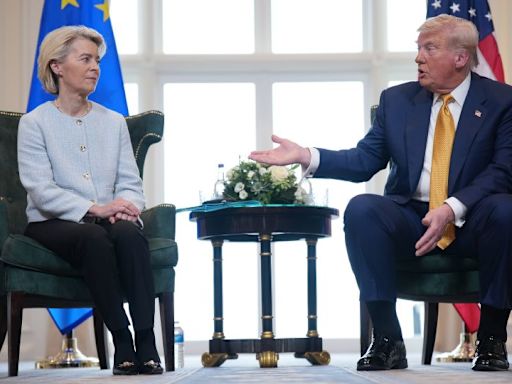
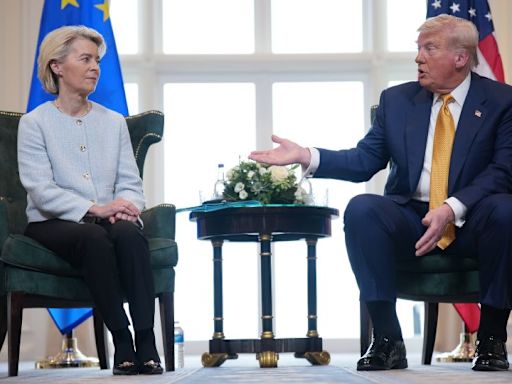
Trump Unveils Sweeping Trade Deal with EU Including $1.35 Trillion in Energy & Investment, Flat 15% Tariffs
TURNBERRY, Scotland — Former President Donald Trump on Sunday revealed a monumental trade agreement with the European Union, concluding months of high-stakes negotiations with the U.S.’s largest trading partner. The deal imposes 15% tariffs on most EU imports, including automobiles, pharmaceuticals, and semiconductors, while also securing a combined $1.35 trillion in EU energy purchases and investment into the U.S.
Trump made the announcement alongside European Commission President Ursula von der Leyen at his golf resort in Turnberry, Scotland, describing the arrangement as “the biggest deal ever made.”
In return for the tariffs, Trump said the EU committed to buying $750 billion in U.S. energy and investing $600 billion more into American infrastructure and defense, including major purchases of U.S. military equipment.
“All EU countries will open up to trade at zero tariffs in select sectors, and they’re agreeing to buy a vast amount of military gear,” Trump said.
Though specifics remain unclear, von der Leyen welcomed the deal, calling it “a new era of predictability and stability.” The EU and U.S. traded $975 billion in goods in 2024, according to the U.S. Commerce Department. With a 30% tariff deadline looming, the agreement is being seen as a crucial move to avoid a full-blown transatlantic trade war.
German Chancellor Friedrich Merz celebrated the outcome: “A trade conflict has been averted that would have severely impacted Germany’s export-driven economy.” Ireland’s Taoiseach Micheál Martin said the deal was "good for business," although he warned that higher tariffs would still pose challenges.
Tariffs & Industry Impact
Despite the agreement, Trump reaffirmed that steel and aluminum tariffs will remain at 50%, and Commerce Secretary Howard Lutnick announced that tariffs on semiconductors will be revealed within two weeks, with a likely effective date of August 1.
In particular, the new 15% tariff on pharmaceuticals—America’s top EU import—has raised alarms in Europe. Ireland, a key drug exporter, and Germany’s pharmaceutical association (vfa) warned of “drastic consequences” for both manufacturers and international patient care.
Trump defended the policy: “Pharmaceuticals are very special. We can’t rely on other countries for our health needs.”
Not all leaders were enthusiastic. France’s Prime Minister François Bayrou said the deal showed “submission” rather than unity.
Markets React & More to Come
Markets responded positively. The Stoxx Europe 600 hit a 4-month high, and France’s CAC 40 and Germany’s DAX also saw gains.
Meanwhile, other U.S. trade partners are on edge. South Korea faces 30% tariffs, and Brazil up to 50%. Trump made it clear: “August 1, the tariffs are set.”
Talks are still underway with China, with a deadline looming on August 12. Trump hinted at progress: “We’ve really sort of made a deal with China, but we’ll see how that goes.”
If the EU agreement holds, it marks one of the largest trade deals in modern U.S. history, shaping economic policy, global trade flows, and manufacturing strategies across multiple industries for years to come.
News You Should See
The Hunger Games: Sunrise on the Reaping Delivers $225 Million Global Box Office Debut
US Data Centers Consume as Much Electricity as Michigan, Harvard Study Reveals
AI Enables a 12,000-Pound John Deere Loader to Perform Two-Wheel Stunts
Kodak Launches SlideTag, a Digital Photo Frame with Built-In Bluetooth Tracking
Samsung May Shift Galaxy Watch to a Two-Year Launch Cycle Amid Sales Challenges
Barcelona Stage Stunning Comeback to Defeat Villarreal 3-2 and Extend LaLiga Lead
Latest News
The Hunger Games: Sunrise on the Reaping earns $225 million worldwide in its opening weekend, strengthening the franchise's box-office position.
Harvard research estimates that 403 US hyperscale data centers consume up to 99 terawatt-hours annually, raising concerns about AI's environmental impact.
Researchers train a 12,000-pound John Deere 332G loader using AI and reinforcement learning to balance on two wheels and perform controlled movements.
Kodak introduces SlideTag, a $34.99 digital photo accessory featuring a 1.54-inch E Ink screen, photo storage, and Bluetooth tracking support.
Samsung may skip next year's Galaxy Watch launch after disappointing sales expectations, potentially shifting to a two-year release cycle while prioritizing software improvements.
Barcelona come from two goals down to beat Villarreal 3-2 at Camp Nou, with Gerard Martín, Fermín López, and Pau Navarro's own goal securing victory.
Liverpool defeat Manchester United 4-0 at Anfield after Leny Yoro's early red card marks a difficult Premier League debut for Mauricio Pochettino.
Five Aberdeen Township police officers receive New Jersey PBA Valor Awards for their bravery during an alleged kerosene attack.
NYC hate crimes prevention director Vijah Ramjattan meets Muslim community members to discuss public safety, trust, inclusion, and hate crime prevention.