The US and the UN: A $725 Million Payment That Reveals a Deeper Institutional Rift
Washington’s planned payment could ease the UN’s immediate financial pressure, but its conditions and limited scale expose a larger dispute over funding, reform and America’s role in the international system.

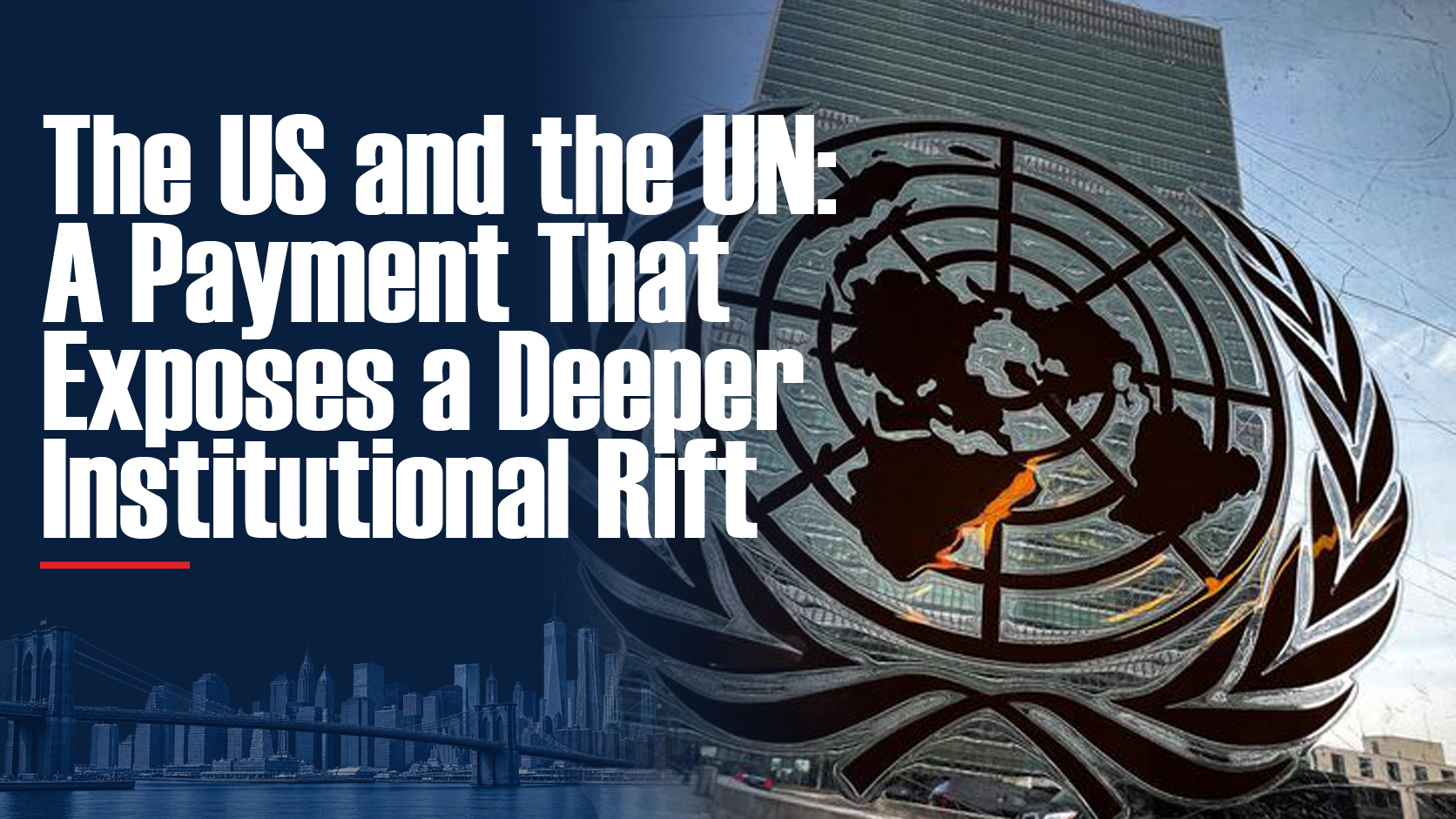
The proposed $725 million U.S. payment to the United Nations is important, but its real significance goes beyond the money itself. It reflects an unresolved question at the center of the relationship between Washington and the international organization: Is the United States trying to repair the UN from within, or reshape its role by using its financial leverage?
The Trump administration has informed Congress of its intention to allocate $725 million toward the United Nations’ regular budget. The move comes as the organization faces severe financial pressure caused by unpaid contributions, and ahead of an expected address by President Donald Trump to the UN General Assembly. As of August 21, the money had not yet been transferred, and a U.S. official said payments would remain contingent on continued reforms.
The immediate financial impact could nevertheless be meaningful. UN Secretary-General António Guterres has warned that the organization faces an acute financial crisis, while experts cited by Reuters said the payment could help the UN continue operating and meet some short-term obligations. But the proposed amount represents less than 20% of the more than $4 billion the UN said Washington owed in May.
That gap is what makes the announcement politically more revealing than financially decisive.
Washington is not simply paying an overdue bill. It is attaching the payment to a broader argument about how the United Nations should operate. The administration says the organization has failed to realize its potential and points to reforms and cost reductions as conditions supporting continued U.S. funding. According to the State Department, the administration believes its pressure has already contributed to reforms producing nearly $1 billion in UN budget cuts.
From Washington's perspective, this is a familiar policy approach: financial support should produce measurable institutional change. From the UN's perspective, however, the problem is more fundamental. Mandatory contributions are not simply voluntary donations that can be released or withheld according to political preferences; they are part of the financial obligations associated with membership.
This tension creates a difficult institutional precedent.
If the largest financial contributor can condition payments on political and administrative reforms, other major contributors may eventually have stronger incentives to use funding as leverage as well. The result could be a UN system in which financial stability becomes increasingly dependent on political negotiations rather than predictable contributions.
That would matter because the organization is already operating with little room for error.
The UN has undertaken a major cost-cutting and restructuring program known as UN80. Its 2026 budget has already been reduced by 9.2%, while more than 2,000 jobs have been moved away from expensive locations such as Geneva and New York to lower-cost hubs.
These measures demonstrate that the institution is not ignoring the financial challenge. But austerity has limits. Cutting administrative expenses can improve efficiency, yet it cannot indefinitely compensate for large unpaid contributions without eventually affecting the organization’s ability to deliver its core functions.
This is particularly important for peacekeeping.
The United States remains the largest contributor to the UN system, but its outstanding obligations extend beyond the regular budget. In May, the UN said Washington owed more than $4 billion, including about $2.04 billion for the regular budget, $2.2 billion for current and past peacekeeping operations and $44 million for UN tribunals.
The proposed $725 million payment therefore addresses only part of the broader financial problem.
There is also a political clock running in parallel. Under Article 19 of the UN Charter, a member state can lose its General Assembly voting rights if its arrears exceed the equivalent of two years of contributions, subject to the rules governing such cases. A former UN official cited by Reuters warned that without further payments, the United States could face the loss of voting rights in January.
That possibility would be highly symbolic.
Washington has enormous influence inside the international system because of its economic weight, diplomatic reach and permanent seat on the Security Council. Losing General Assembly voting rights would not remove that broader influence, but it would create an unusual contradiction: the UN's largest financial contributor would be partially sidelined in one of its principal decision-making bodies because of unpaid dues.
The timing of the proposed payment also deserves attention. The allocation was identified in a State Department notification to Congress dated August 4 and comes before Trump's expected appearance at the UN General Assembly.
That timing creates room for two interpretations. One is practical: Washington recognizes that allowing the UN to enter a deeper financial crisis would be counterproductive even if it remains dissatisfied with the institution. The other is strategic: the administration may be seeking to demonstrate that continued American support will come with conditions and measurable reforms.
Both can be true at the same time.
The broader issue is therefore not whether $725 million is enough to solve the UN's financial problems. It clearly is not. The more important question is whether the payment marks the beginning of a more sustainable relationship between Washington and the UN or merely a temporary intervention designed to prevent an immediate institutional crisis.
The answer will depend on what happens next.
If additional payments follow and Washington continues engaging with UN reform efforts, the current dispute could evolve into a difficult but potentially constructive restructuring of the U.S.-UN financial relationship. If the payment remains isolated while other obligations continue to accumulate, the organization could face renewed financial pressure within a relatively short period.
There is another dimension that should not be overlooked: the United States is not alone in failing to meet its obligations on time. UN records cited by Reuters showed that by August 18, about 129 of the organization's 193 members had paid their dues in full, while China, the second-largest contributor, was also absent from the list.
That suggests the UN's financial problem is broader than a bilateral dispute with Washington. Yet the scale of U.S. obligations makes American decisions disproportionately important.
Ultimately, the $725 million plan is best understood as a signal rather than a solution.
It signals that Washington is not prepared, at least for now, to allow the UN's financial crisis to become an uncontrolled collapse. At the same time, it signals that the era of relatively unconditional American financial support is being challenged.
For the United Nations, the strategic challenge is to pursue reforms without allowing financial pressure to weaken the principles of predictable member-state financing. For Washington, the challenge is different: using its financial influence to demand greater efficiency without undermining the international institution whose stability also serves American strategic interests.
The coming months will determine which side of that equation becomes dominant.
The real story is therefore not the $725 million itself. It is the emerging bargain behind it: money in exchange for reform, but also influence in exchange for institutional stability.
And that bargain could shape the future relationship between the world's most powerful contributor and the international organization it has helped finance for decades.
News You Should See
2026 Nobel Medicine Prize Honors Scientists Behind Optogenetics Breakthrough
Oil Prices Edge Lower as Stronger Middle East Exports and G7 Reserves Ease Supply Concerns
Trump Offers U.S. Assistance to Russia After Death at Siberian Plague Research Institute
Trump Takes Economic Message to Nebraska as GOP Faces Rising Cost-of-Living Pressure
U.S. Appeals Court Weighs Trump Administration’s $2.6 Billion Harvard Funding Fight
U.S. Midterm Elections Begin With Resilient Jobs Market and Persistent Cost Pressures
Latest News
The 2026 Nobel Prize in Physiology or Medicine honors Karl Deisseroth, Peter Hegemann and Georg Nagel for pioneering research behind optogenetics and its impact on neuroscience.
Oil prices edged lower as stronger Middle Eastern exports and a planned G7 release of 100 million barrels eased immediate supply concerns, while Gulf security risks and the Strait of Hormuz kept markets alert.
President Donald Trump said the United States would help Russia if needed after a laboratory worker died at a Siberian plague research institute, as Russian authorities imposed precautionary quarantine measures.
Trump’s Nebraska campaign stop highlights rising fuel and grocery costs, beef prices and growing economic pressure on Republicans ahead of the November midterm elections.
A U.S. appeals court is reviewing the Trump administration’s effort to cut Harvard’s federal research funding, with more than $2.6 billion at stake.
The U.S. enters the 2026 midterm elections with unemployment at 4.2%, while higher living and energy costs create economic pressure for households and businesses.
US services growth eased in September as input prices climbed to their highest level since July 2022, with fuel costs, supply-chain disruptions and strong demand increasing pressure on businesses.
Rising Treasury yields are increasing U.S. borrowing costs as Washington manages record debt, persistent inflation and strong economic demand, narrowing its policy options.
A EGP 16 million corporate partnership will establish and equip a bone marrow transplant unit at Cairo’s Coptic Hospital, supporting access to specialized treatment for patients.