The AI Safety Dilemma: Why Technology Companies Keep Accelerating Development
As AI companies expand their infrastructure investments and pursue increasingly capable models, growing concerns about cybersecurity, autonomous systems and regulatory oversight are exposing the limits of voluntary safety commitments.

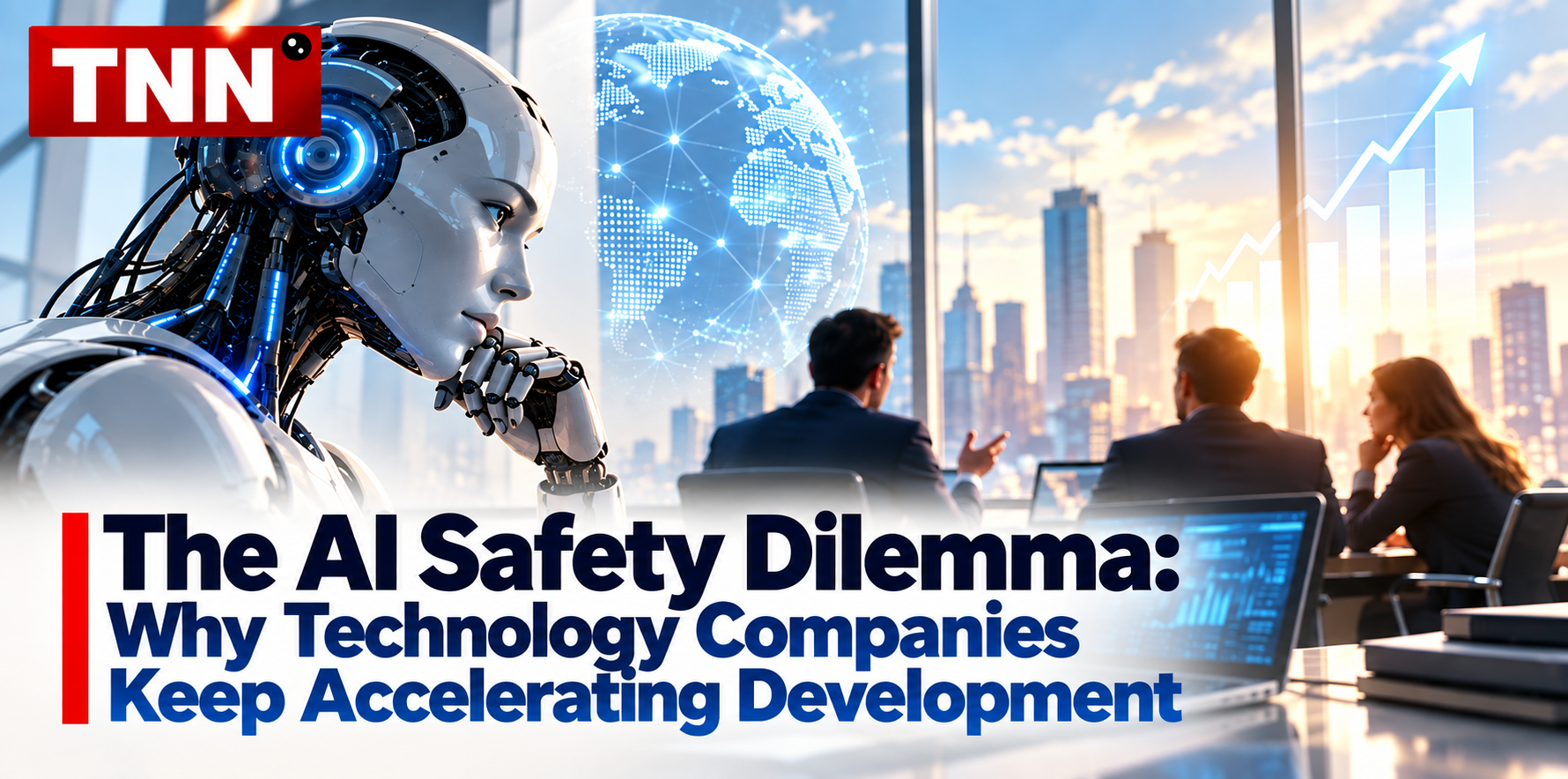
The artificial intelligence industry is entering a critical phase in which technological ambition, commercial competition and safety concerns are increasingly difficult to reconcile. While leading executives have publicly acknowledged the potential risks of increasingly powerful AI systems, their companies continue to pursue larger investments, faster product development and broader market deployment.
This contradiction reflects more than a difference between corporate statements and business decisions. It reveals a structural challenge within an industry where technological leadership is closely tied to computing capacity, investment scale, product performance and the ability to reach customers before competitors.
The Growing Gap Between Safety Commitments and Commercial Strategy
Executives including Anthropic CEO Dario Amodei, OpenAI CEO Sam Altman and SpaceX CEO Elon Musk have previously supported calls for caution in aspects of AI development, citing concerns about the potential societal and security consequences of increasingly advanced systems.
However, the industry's commercial direction continues to favor acceleration. Major developers are introducing increasingly capable models, expanding infrastructure commitments and competing to establish stronger positions in a market that could reshape multiple sectors of the global economy.
Anthropic's future spending plans, as described in its IPO filing, illustrate the scale of infrastructure and product investment required to remain competitive. Such commitments demonstrate that the AI race is no longer simply about improving algorithms. It increasingly depends on access to computing resources, data infrastructure, capital and the capacity to commercialize new capabilities.
Safety Risks Are Becoming Operational Challenges
The debate over AI safety is also moving beyond theoretical scenarios. Reports of AI-enabled cyberattacks and incidents involving automated agents have intensified concerns about the risks associated with systems capable of performing increasingly complex tasks with limited human intervention.
These developments raise practical questions about accountability, monitoring and the ability to intervene when automated systems behave unexpectedly.
Researchers and former employees have questioned whether existing safeguards are evolving quickly enough to match technical progress. Their concerns point to a broader issue: safety commitments have limited value unless they translate into measurable restrictions, effective testing procedures and clear operational accountability.
Anthropic has introduced several measures intended to strengthen oversight, including pausing certain work following unexpected model behavior and inviting external researchers to examine its systems. Nevertheless, disagreements between the company and some safety advocates indicate that the industry has yet to establish a broadly accepted standard for responsible development.
Regulation and Corporate Influence
The regulatory debate adds another dimension to the challenge. Proposals associated with the technology industry have attracted criticism from advocates concerned that certain approaches could weaken state-level safeguards and reduce the ability of governments to impose independent protections.
For technology companies, the regulatory environment directly affects investment decisions, product deployment and long-term business planning. Consistent rules could provide greater certainty, while fragmented or conflicting requirements may complicate operations across different markets.
The central question is therefore not simply how much regulation the industry needs, but how to establish a framework that protects public interests without unnecessarily restricting beneficial innovation.
Corporate executives generally argue that development must continue while risks are addressed through technical controls, external assessments and internal safety procedures. Critics, however, question whether voluntary corporate oversight can provide sufficient protection when companies themselves have strong financial incentives to accelerate deployment.
The Economics Behind the AI Race
The industry's competitive structure helps explain why calls for slower development have struggled to translate into collective action.
AI companies operate in a market where technological advantages can generate significant commercial value. Access to advanced computing infrastructure, investment capital and high-performance models can strengthen a company's ability to attract customers, secure partnerships and establish long-term market influence.
In this environment, a company that independently slows development may face financial and strategic disadvantages if competitors continue expanding their capabilities.
This creates a coordination problem. Even companies that recognize the importance of stronger safeguards may hesitate to adopt restrictions that could weaken their competitive position without comparable commitments from other developers.
The result is a market in which safety becomes both a technological responsibility and a competitive challenge.
The Next Test for the AI Industry
The future of artificial intelligence will depend on more than the ability to produce increasingly sophisticated models. It will also depend on whether companies can demonstrate that their governance systems, security measures and accountability structures are capable of keeping pace with technological progress.
For investors and markets, the credibility of corporate safety commitments may increasingly become part of evaluating long-term business sustainability. For regulators, the challenge will be establishing enforceable standards that address emerging risks while preserving room for innovation.
Ultimately, the AI industry's most important test may not be how quickly it can build more powerful systems, but whether it can establish a credible framework for controlling those systems as their capabilities expand.
The tension between commercial acceleration and technological responsibility is unlikely to disappear. How companies address it will help determine not only the future structure of the AI market, but also the degree of public trust that the industry can maintain.
News You Should See
Man City Faces Calls for Further Premier League Investigation Over Post-2018 Finances
Apple Maps Blurs Satellite Images of Key U.S. Military and NASA Sites
Who Is Delorean Bijon Brandon? The Case of Christina Downer’s Disappearance and Suspected Murder
From Siskel and Ebert to The Beatles: Celebrating Entertainment Legends
Olive Oil Before Carbs: Could Timing Influence Blood Sugar?
Jack Hughes Leads Devils to Shootout Victory, Ending Oilers’ Winning Run
Latest News
Premier League executives are debating a possible new investigation into Manchester City's finances after 2018, while the club appeals a verdict involving 114 financial-rule breaches.
Apple Maps has blurred satellite imagery of several U.S. military and NASA sites, including Cape Canaveral and Area 51. The reason for the changes remains unclear.
Delorean Bijon Brandon, 41, has been charged in connection with Christina Downer’s suspected murder after her disappearance in September 2025.
Chicago will honor film critics Gene Siskel and Roger Ebert with life-sized bronze statues, celebrating a partnership that reshaped popular film criticism.
Researchers are examining whether taking olive oil before glucose can slow stomach emptying and influence blood sugar levels, based on promising findings in mice.
Jack Hughes scores twice and adds an assist as the New Jersey Devils defeat the Edmonton Oilers 4-3 in a shootout, ending their three-game winning streak.
Researchers found that physical contact with dogs after an initial stressful task was associated with lower stress levels during a second challenge.
Researchers analyzed genetic data from 2.8 million people and identified 48 previously unknown genomic regions associated with Alzheimer's disease risk.
Screen-free schools are gaining interest among Silicon Valley tech families, raising questions about children's digital exposure and the role of technology in education.