The 1.5°C Promise Has Failed. Climate Policy Now Enters the Age of Overshoot
The U.N.’s latest assessment marks a turning point: limiting warming is no longer enough, as governments must also confront the consequences of crossing the 1.5°C threshold.

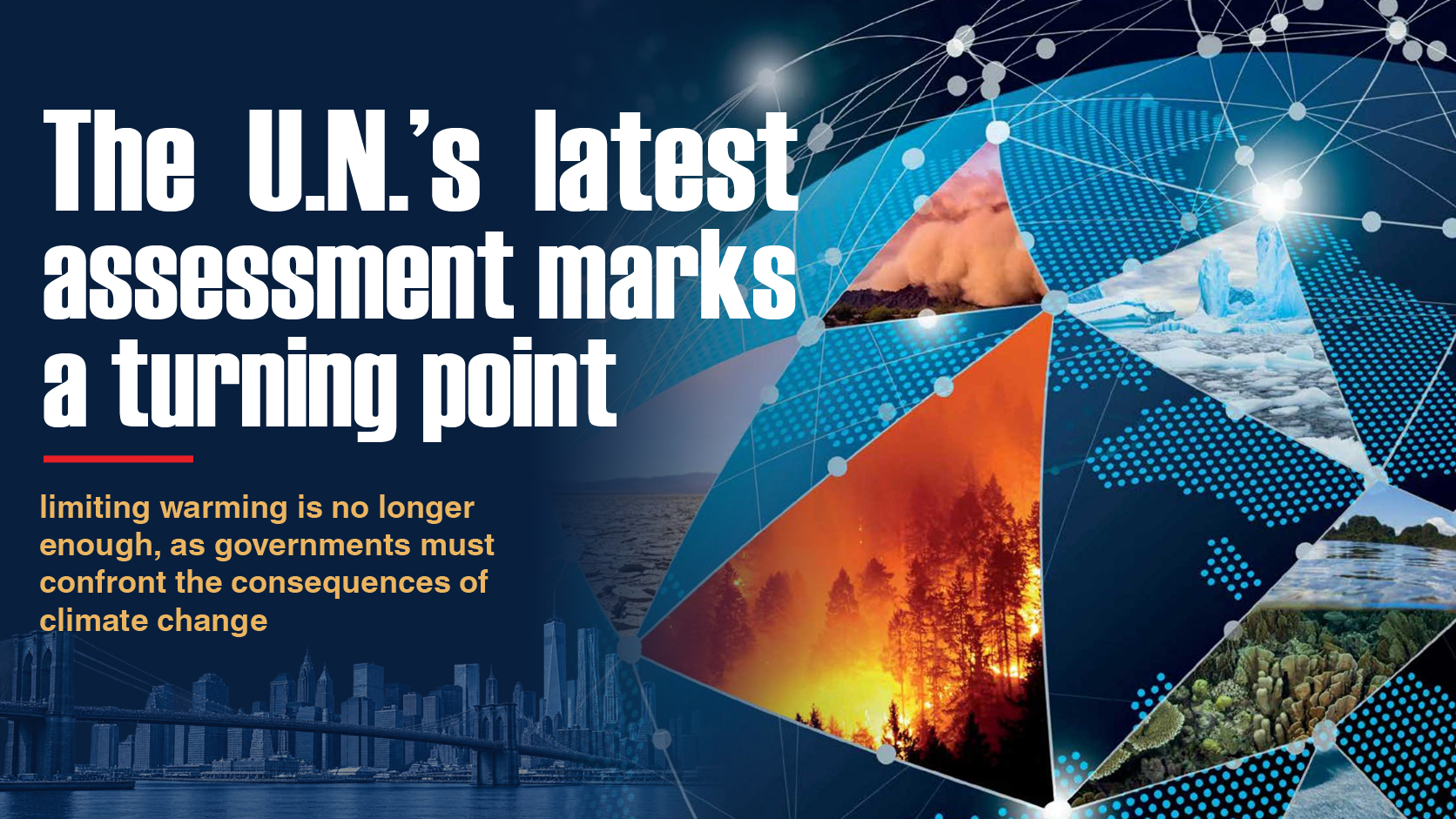
The most consequential message in the United Nations’ latest climate assessment is not simply that the world is approaching a temperature threshold once treated as the central objective of global climate policy. It is that the political conversation is being forced to move beyond the assumption that 1.5°C can still be preserved at all costs.
For years, the 1.5°C objective represented the dividing line between an increasingly dangerous climate future and one in which the most severe risks could still be contained. The new U.N. assessment effectively closes that chapter. Global temperatures are expected to exceed the threshold within the next few years, while current policies point toward approximately 2.6°C of warming by the end of the century.
That does not make the Paris Agreement irrelevant. Instead, it changes the nature of the challenge. Climate policy is moving from a strategy centered on preventing a threshold breach to one that must also manage the consequences of crossing it.
This distinction matters because every fraction of additional warming carries consequences. Heat waves, floods, droughts, wildfires, glacier loss, rising seas and ecosystem damage are not abstract future scenarios. The U.N. assessment warns that the risks will intensify as warming increases, while some changes could become effectively irreversible.
The emerging concept of “overshoot” therefore represents both a scientific strategy and a political warning. The idea is to limit how far temperatures rise above 1.5°C and, eventually, bring them back down. But the proposed route is extraordinarily demanding. It would require deep and rapid reductions in greenhouse-gas emissions alongside carbon dioxide removal on a scale that the world has not demonstrated it can achieve.
That exposes the central contradiction in the current climate debate. Carbon removal may become increasingly important, but it cannot serve as a convenient substitute for cutting fossil-fuel emissions. Existing carbon-removal capacity remains far too limited for the scale implied by the problem, while large-scale nature-based solutions would compete for land with agriculture and face their own vulnerabilities, including wildfire and rising temperatures.
The economics of delay are equally important. Under current policies, the projected 2.6°C trajectory suggests that the world is not merely missing a symbolic target; it is accumulating a larger future bill for adaptation, resilience and technological intervention. The longer emissions remain high, the greater the amount of carbon that would theoretically have to be removed later and the more difficult it becomes to reverse the resulting warming.
This is why the new U.N. assessment should not be interpreted as permission to abandon ambition. If anything, the opposite is true. A smaller overshoot is materially different from a larger one, and a shorter period above 1.5°C is preferable to decades of sustained warming beyond the threshold.
The political challenge, however, remains the hardest part. Climate policy requires governments to make investments whose benefits are global and often delayed, while the costs of transforming energy systems can be immediate and politically sensitive. The continued dependence on oil, gas and coal demonstrates how difficult it has been to translate international commitments into sufficiently rapid reductions in emissions.
The United States’ retreat from international climate action adds another layer of uncertainty. As the world’s largest historical emitter, U.S. policy has consequences far beyond its borders, particularly when other governments use American policy as a reference point for the political feasibility of their own climate measures.
There is also a strategic lesson for businesses and investors. The climate transition is no longer simply about preparing for a future in which temperatures remain below a predetermined line. Companies must increasingly plan for physical climate risks while simultaneously navigating the transition toward lower-carbon energy. Infrastructure, insurance, agriculture, transportation, energy and real estate will all face different versions of this dual pressure.
The most important shift, therefore, is psychological as much as scientific. The world is losing the luxury of treating 1.5°C as the only scenario worth discussing. The relevant questions are becoming more difficult: How high will temperatures rise? How long will the overshoot last? Which damages can still be prevented? How much carbon can realistically be removed? And who will pay for the transition and the adaptation that follows?
There is no attractive answer in the U.N. assessment. Even the pathway that eventually returns warming toward 1.5°C would involve decades of effort and technologies that remain limited in scale. The report itself describes this not as an acceptable or preferred route, but as the best remaining option.
That may be the clearest measure of how far the climate debate has moved. The objective is no longer simply to keep the world from crossing a line. It is to make the crossing as limited, as brief and as reversible as possible.
The failure to preserve 1.5°C should therefore be understood neither as the end of climate policy nor as evidence that targets no longer matter. It is a warning about the price of delayed action. The next stage of the climate fight will be judged not only by whether governments meet promises made in the past, but by how quickly they can reduce emissions, protect vulnerable communities and prevent an overshoot from becoming a permanent new climate reality.
News You Should See
2026 Nobel Medicine Prize Honors Scientists Behind Optogenetics Breakthrough
Oil Prices Edge Lower as Stronger Middle East Exports and G7 Reserves Ease Supply Concerns
Trump Offers U.S. Assistance to Russia After Death at Siberian Plague Research Institute
Trump Takes Economic Message to Nebraska as GOP Faces Rising Cost-of-Living Pressure
U.S. Appeals Court Weighs Trump Administration’s $2.6 Billion Harvard Funding Fight
U.S. Midterm Elections Begin With Resilient Jobs Market and Persistent Cost Pressures
Latest News
The 2026 Nobel Prize in Physiology or Medicine honors Karl Deisseroth, Peter Hegemann and Georg Nagel for pioneering research behind optogenetics and its impact on neuroscience.
Oil prices edged lower as stronger Middle Eastern exports and a planned G7 release of 100 million barrels eased immediate supply concerns, while Gulf security risks and the Strait of Hormuz kept markets alert.
President Donald Trump said the United States would help Russia if needed after a laboratory worker died at a Siberian plague research institute, as Russian authorities imposed precautionary quarantine measures.
Trump’s Nebraska campaign stop highlights rising fuel and grocery costs, beef prices and growing economic pressure on Republicans ahead of the November midterm elections.
A U.S. appeals court is reviewing the Trump administration’s effort to cut Harvard’s federal research funding, with more than $2.6 billion at stake.
The U.S. enters the 2026 midterm elections with unemployment at 4.2%, while higher living and energy costs create economic pressure for households and businesses.
US services growth eased in September as input prices climbed to their highest level since July 2022, with fuel costs, supply-chain disruptions and strong demand increasing pressure on businesses.
Rising Treasury yields are increasing U.S. borrowing costs as Washington manages record debt, persistent inflation and strong economic demand, narrowing its policy options.
A EGP 16 million corporate partnership will establish and equip a bone marrow transplant unit at Cairo’s Coptic Hospital, supporting access to specialized treatment for patients.