Thailand-Cambodia Maritime Dispute Tests the Limits of UN Mediation
A new UNCLOS process offers a diplomatic exit from a dispute where energy resources, sovereignty and regional stability intersect

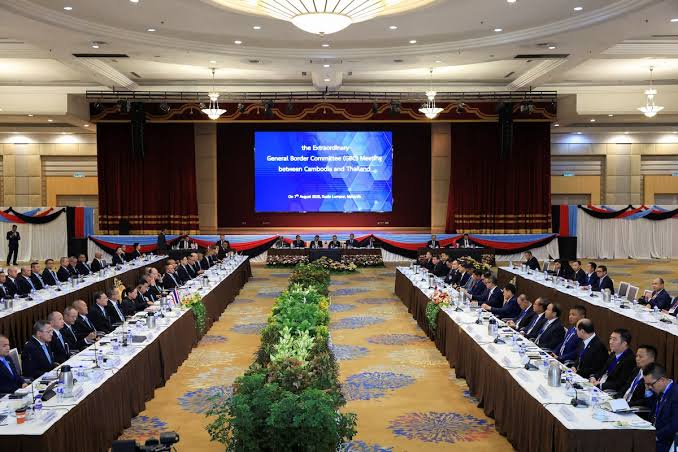
The most important feature of the Thailand-Cambodia maritime dispute is not simply the existence of competing territorial claims. It is the fact that a disagreement carrying potential energy value is now being transferred into a formal international conciliation process at a moment when bilateral trust is already severely weakened.
The first meeting of the conciliation commission under the U.N. Convention on the Law of the Sea, held in Singapore, therefore represents more than another diplomatic encounter. It creates a structured channel for dialogue between two neighbors whose relations have deteriorated sharply and whose recent history includes armed clashes, civilian casualties, displacement and a fragile ceasefire.
At the center of the dispute is maritime territory believed to contain exploitable quantities of natural gas and other hydrocarbons. That element changes the strategic weight of the disagreement. Maritime boundaries are rarely only lines on a map when they overlap with potentially valuable natural resources. The question becomes one of sovereignty, future economic opportunity and control over the conditions under which those resources could eventually be developed.
This is also why the collapse of the previous framework matters. Thailand unilaterally terminated a 25-year-old memorandum of understanding that had been designed to address overlapping maritime claims. Bangkok argues that the arrangement failed to deliver concrete progress, noting that only two meetings were held during those 25 years. Cambodia, meanwhile, chose to initiate the UNCLOS process after the agreement was terminated.
The two positions reveal a fundamental difference in negotiating philosophy. Thailand has historically preferred territorial questions to remain within bilateral negotiations and has been reluctant to have them determined through third-party mechanisms. Cambodia has opted for an international legal framework as a peaceful route when the bilateral track failed to produce a solution.
Neither approach automatically guarantees success. The value of the current process lies instead in its ability to prevent a difficult maritime dispute from becoming another source of escalation between two countries already burdened by unresolved land-border tensions.
That distinction is crucial. The UNCLOS conciliation process does not erase the political history between Thailand and Cambodia, nor does it remove the sensitivity surrounding sovereignty. Any outcome under the process is not binding on the parties. Its real significance is therefore diplomatic: it creates space for negotiation at a time when direct political trust is limited.
Thailand's willingness to participate constructively is particularly important because Bangkok's earlier opposition to third-party involvement has been shaped by its experience with territorial disputes. The 1962 International Court of Justice ruling concerning the Preah Vihear temple remains part of the political memory surrounding Thai-Cambodian relations, with Thailand having long viewed that ruling as unfair. That history helps explain why sovereignty questions are exceptionally sensitive in bilateral relations.
The economic dimension should not be underestimated either. Potential hydrocarbon resources give both sides an incentive to protect their claims, but they can also provide a reason to search for a negotiated arrangement. In principle, a stable legal and diplomatic framework is more useful for resource development than a prolonged dispute accompanied by military tension. But that opportunity depends first on political stability and an agreement capable of surviving domestic pressure on both sides.
The recent armed confrontations make the challenge more complicated. A ceasefire agreed in late December has remained fragile, with sporadic incidents and substantial military deployments continuing. Under these conditions, the maritime dispute cannot be viewed in isolation from the broader security relationship.
For the United Nations process to produce meaningful progress, the immediate achievement may therefore be less about drawing a final maritime boundary and more about maintaining a diplomatic mechanism that keeps disagreement from returning to the battlefield. The fact that both governments are presenting their positions in the language of international law and peaceful settlement is significant, even if their interpretations of the best route toward an agreement remain different.
There is also a wider regional lesson. Southeast Asia depends heavily on political stability, cross-border commerce and predictable relations among neighboring states. A dispute involving potential energy resources between two countries that have recently experienced armed confrontation carries consequences beyond the specific maritime zone in question. Any sustained escalation would make economic cooperation more difficult, while a credible negotiating process could help restore confidence.
The strategic test now is whether the two governments can separate the immediate political pressures surrounding sovereignty from the longer-term economic and security interests of both countries. If they can, the maritime dispute could eventually become an example of how a difficult resource and boundary disagreement can be managed through law and negotiation.
If they cannot, the UNCLOS process risks becoming another diplomatic stage without a substantive breakthrough.
For Thailand and Cambodia, the central issue is therefore not simply who has the stronger claim. It is whether both sides can build enough confidence in the negotiating process to make compromise politically possible. The current talks offer that possibility, but they do not guarantee it.
The real measure of success will be whether diplomacy can create a durable alternative to confrontation. In a dispute where sovereignty, energy resources and recent military tensions overlap, that may be the most consequential outcome available.
News You Should See
2026 Nobel Medicine Prize Honors Scientists Behind Optogenetics Breakthrough
Oil Prices Edge Lower as Stronger Middle East Exports and G7 Reserves Ease Supply Concerns
Trump Offers U.S. Assistance to Russia After Death at Siberian Plague Research Institute
Trump Takes Economic Message to Nebraska as GOP Faces Rising Cost-of-Living Pressure
U.S. Appeals Court Weighs Trump Administration’s $2.6 Billion Harvard Funding Fight
U.S. Midterm Elections Begin With Resilient Jobs Market and Persistent Cost Pressures
Latest News
The 2026 Nobel Prize in Physiology or Medicine honors Karl Deisseroth, Peter Hegemann and Georg Nagel for pioneering research behind optogenetics and its impact on neuroscience.
Oil prices edged lower as stronger Middle Eastern exports and a planned G7 release of 100 million barrels eased immediate supply concerns, while Gulf security risks and the Strait of Hormuz kept markets alert.
President Donald Trump said the United States would help Russia if needed after a laboratory worker died at a Siberian plague research institute, as Russian authorities imposed precautionary quarantine measures.
Trump’s Nebraska campaign stop highlights rising fuel and grocery costs, beef prices and growing economic pressure on Republicans ahead of the November midterm elections.
A U.S. appeals court is reviewing the Trump administration’s effort to cut Harvard’s federal research funding, with more than $2.6 billion at stake.
The U.S. enters the 2026 midterm elections with unemployment at 4.2%, while higher living and energy costs create economic pressure for households and businesses.
US services growth eased in September as input prices climbed to their highest level since July 2022, with fuel costs, supply-chain disruptions and strong demand increasing pressure on businesses.
Rising Treasury yields are increasing U.S. borrowing costs as Washington manages record debt, persistent inflation and strong economic demand, narrowing its policy options.
A EGP 16 million corporate partnership will establish and equip a bone marrow transplant unit at Cairo’s Coptic Hospital, supporting access to specialized treatment for patients.