Tesla’s Cybercab Turns Minimalist Engineering Into a High-Stakes Robotaxi Strategy
From child-seat restrictions and emergency systems to brake-by-wire and 90W USB-C power, Cybercab’s latest specifications reveal how Tesla is balancing cost, autonomy and brand identity.

Tesla’s Cybercab is emerging as more than a new vehicle in the company’s product portfolio. Its design reflects a broader strategic decision to make autonomous transportation the central purpose of the vehicle rather than an additional feature layered onto a conventional car. The latest documentation surrounding the Cybercab provides a clearer picture of how Tesla is translating that philosophy into physical design, safety procedures and cost controls.
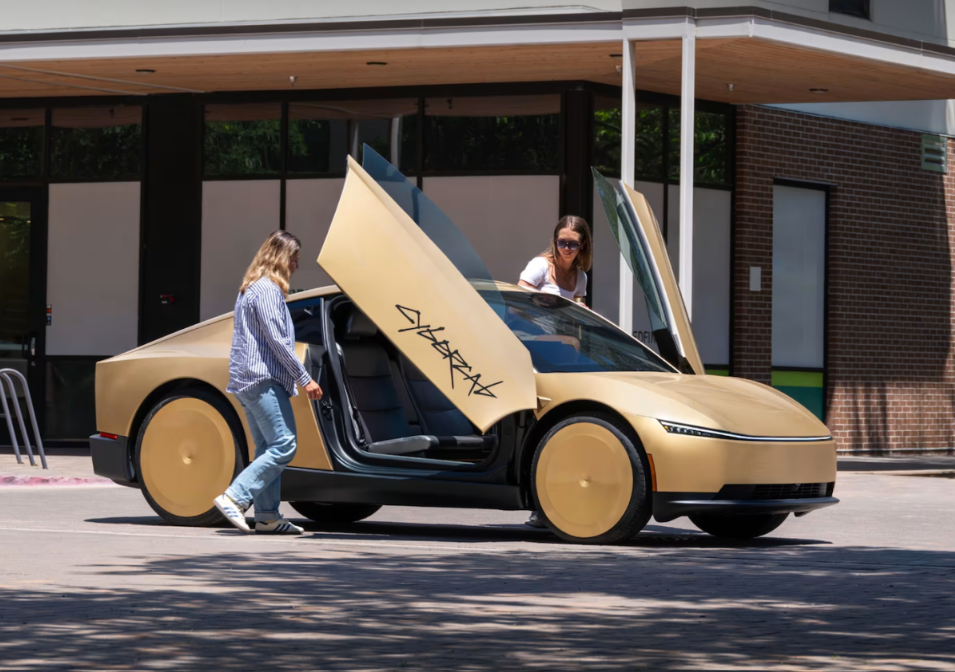
The vehicle is a purpose-built, two-seat autonomous car that operates without a conventional steering wheel or pedals. Tesla’s broader autonomous-driving strategy is based on cameras and artificial intelligence rather than the combination of cameras, radar and lidar used by competitors such as Waymo. That approach is important not only from a technology perspective but also from an economic one: reducing the number of sensors, mechanical systems and components can potentially lower manufacturing complexity and allow Tesla to build a much larger fleet at a lower cost.
The Cybercab’s cost-focused philosophy is visible in several details that would normally receive little attention in a traditional vehicle launch. One of the most notable restrictions concerns passengers under the age of 13. Tesla currently does not permit children younger than 13 to ride in the Cybercab. By comparison, children between 8 and 17 can ride in Tesla’s Robotaxi Model Y vehicles, subject to Tesla’s rules, while passengers under 18 must be accompanied by an adult.
The child-seat system also reveals the extent to which Tesla has redesigned the vehicle around simplicity. The Cybercab does not include the standard LATCH anchors commonly used for child seats. Instead, compatible child seats can be secured using the vehicle’s seat belts. The omission is significant because Tesla executives have repeatedly emphasized reducing unnecessary components as part of the company’s effort to control manufacturing costs. In the Cybercab, that philosophy appears to extend into areas that traditionally form part of a conventional family vehicle.
The vehicle’s crash-response behavior provides another important view of Tesla’s engineering priorities. Although an autonomous vehicle is designed to prevent collisions, Tesla’s documentation accounts for the possibility that a Cybercab may still be involved in an accident. In such a situation, the vehicle is designed to deploy its airbags, unlock its doors, activate hazard warning lights and interior lighting, disable the high-voltage battery, move the windows into a ventilation position, apply the brakes and bring the vehicle to a stop and park.
At the same time, the infotainment system is designed to establish a two-way communication link with Tesla’s rider-support team. This means that the vehicle’s safety architecture is not limited to passive protection. It also connects the physical response of the car to Tesla’s remote support infrastructure, creating a mechanism through which passengers can communicate with the company after an incident.
The automatic unlocking of the doors is particularly important because Tesla has faced criticism over its use of electronic door latches. In a serious collision, electronic systems can become a safety concern if passengers or rescuers cannot easily open the doors. Tesla’s latest Cybercab specifications therefore make automatic door unlocking part of the vehicle’s crash response. The issue is especially relevant given regulatory and consumer scrutiny surrounding electronic door mechanisms in Tesla vehicles, including a recent recall involving millions of Tesla vehicles in China related to electronic door latches.
The Cybercab nevertheless retains manual interior door releases. Unlike some earlier Tesla designs where emergency releases have been criticized for being difficult to locate, the Cybercab places the manual release in a highly visible position on the armrest of each door. The arrangement suggests an attempt to preserve Tesla’s electronically controlled door architecture while making emergency access more intuitive.
Another major engineering decision is the adoption of brake-by-wire technology. Traditional braking systems use hydraulics to transmit pressure through brake lines to the braking components. The Cybercab instead uses electronic actuators to control the brake calipers. Tesla CEO Elon Musk has argued that electric braking eliminates the complexity associated with routing hydraulic plumbing throughout the vehicle.
The brake system fits into a larger Tesla design philosophy that separates electronic control from traditional mechanical connections. The company previously introduced steer-by-wire technology on the Cybertruck, removing the conventional physical connection between the steering wheel and the front wheels. The Cybercab takes this electronic approach further because it eliminates the steering wheel entirely and makes autonomous software the primary mechanism through which the vehicle is operated.
The cabin design also includes a limitation that Tesla has not fully explained: the Cybercab’s windows cannot currently be completely opened. The available documentation does not provide a clear reason for the restriction. From an engineering perspective, the limitation could reflect the way Tesla has integrated the vehicle’s doors, climate system, safety architecture or autonomous operating environment, but the company has not publicly provided a definitive explanation.
A smaller but notable specification concerns the vehicle’s USB-C power outlets. According to information shared by Tesla-focused influencer Jeremy Judkins, the outlets can provide up to 90 watts of power. That is substantially higher than the charging capability normally found in many vehicles and positions the Cybercab as a more capable mobile power environment for passenger devices.
Taken together, these specifications show that Tesla is not simply removing the steering wheel and pedals from an existing vehicle. The company is developing the Cybercab around a different set of assumptions about what a car needs to be. Traditional automotive features are being evaluated according to their relevance to an autonomous passenger service, while electronic systems, software and fleet-level support become increasingly important.
That strategy also has a direct economic dimension. Tesla has designed the Cybercab to be smaller and lighter than its other vehicles and to use a relatively small battery. Lower material requirements, particularly for the battery, can reduce production costs. If Tesla succeeds in manufacturing the vehicle at scale, the economics could become one of its strongest competitive advantages in the robotaxi market.
The logic is straightforward: a cheaper autonomous vehicle can potentially be produced in greater numbers, deployed across more locations and operated at a lower cost per ride. This is particularly significant when compared with competitors that rely on more expensive sensor packages and vehicles supplied by external manufacturers. Waymo, for example, uses a combination of cameras, radar and lidar and operates a large fleet of autonomous vehicles across multiple U.S. cities.
Tesla’s strategy therefore connects vehicle architecture directly to business-model ambition. The company is not merely trying to create an autonomous car; it is attempting to create a scalable transportation platform whose economics depend on producing large numbers of relatively inexpensive autonomous vehicles.
That ambition makes the Cybercab’s minimalist design part of Tesla’s brand identity. The gold-colored two-seat vehicle is visually distinctive, while the absence of traditional controls reinforces the idea that it belongs to a future in which the passenger no longer needs to participate in driving. The physical product, the autonomous software and the robotaxi service are consequently being presented as components of a single Tesla identity centered on automation.
However, the same strategy increases the pressure on Tesla to demonstrate reliability. A conventional driver can compensate for limitations in driver-assistance software, but a fully autonomous vehicle must manage the complete driving task itself. Tesla therefore needs to demonstrate not only that its camera-and-AI approach works under controlled conditions, but that it can remain dependable across a wide range of real-world situations.
The timing is especially important because Tesla has already spent years promising autonomous transportation. Its existing Robotaxi program has operated using modified Model Y vehicles in selected areas, while Cybercab represents the company’s attempt to move from an adapted conventional vehicle to a purpose-built autonomous platform.
The Cybercab therefore represents a critical test of whether Tesla can convert its long-standing autonomy narrative into a repeatable commercial system. Its engineering choices show a company attempting to remove mechanical complexity, reduce material requirements and place software at the center of the transportation experience. Its economic strategy depends on producing that architecture cheaply enough to make a large robotaxi fleet commercially attractive.
At the same time, every cost-saving decision carries a corresponding responsibility. Restrictions on young passengers, the absence of conventional child-seat anchors, electronic door mechanisms, electronically controlled braking and limited window operation demonstrate how far the Cybercab departs from conventional automotive design. These decisions may help Tesla simplify production, but they also place greater importance on safety validation, regulatory approval and the reliability of the vehicle’s software and electronic systems.
The result is a product whose significance extends beyond its specifications. The Cybercab is effectively a physical expression of Tesla’s belief that the future of transportation can be built around autonomous software, simplified hardware and fleet-scale economics. Whether that formula ultimately produces a safer, cheaper and more efficient transportation model will depend less on the novelty of the vehicle and more on Tesla’s ability to operate it reliably at scale.
News You Should See
2026 Nobel Medicine Prize Honors Scientists Behind Optogenetics Breakthrough
Oil Prices Edge Lower as Stronger Middle East Exports and G7 Reserves Ease Supply Concerns
Trump Offers U.S. Assistance to Russia After Death at Siberian Plague Research Institute
Trump Takes Economic Message to Nebraska as GOP Faces Rising Cost-of-Living Pressure
U.S. Appeals Court Weighs Trump Administration’s $2.6 Billion Harvard Funding Fight
U.S. Midterm Elections Begin With Resilient Jobs Market and Persistent Cost Pressures
Latest News
The 2026 Nobel Prize in Physiology or Medicine honors Karl Deisseroth, Peter Hegemann and Georg Nagel for pioneering research behind optogenetics and its impact on neuroscience.
Oil prices edged lower as stronger Middle Eastern exports and a planned G7 release of 100 million barrels eased immediate supply concerns, while Gulf security risks and the Strait of Hormuz kept markets alert.
President Donald Trump said the United States would help Russia if needed after a laboratory worker died at a Siberian plague research institute, as Russian authorities imposed precautionary quarantine measures.
Trump’s Nebraska campaign stop highlights rising fuel and grocery costs, beef prices and growing economic pressure on Republicans ahead of the November midterm elections.
A U.S. appeals court is reviewing the Trump administration’s effort to cut Harvard’s federal research funding, with more than $2.6 billion at stake.
The U.S. enters the 2026 midterm elections with unemployment at 4.2%, while higher living and energy costs create economic pressure for households and businesses.
US services growth eased in September as input prices climbed to their highest level since July 2022, with fuel costs, supply-chain disruptions and strong demand increasing pressure on businesses.
Rising Treasury yields are increasing U.S. borrowing costs as Washington manages record debt, persistent inflation and strong economic demand, narrowing its policy options.
A EGP 16 million corporate partnership will establish and equip a bone marrow transplant unit at Cairo’s Coptic Hospital, supporting access to specialized treatment for patients.