Supreme Court to Review State Bans on AR-15-Style Rifles in Major Second Amendment Case
The Supreme Court's review of state restrictions on AR-15-style rifles could reshape firearms regulation across the United States, with a landmark ruling expected by June 2027.

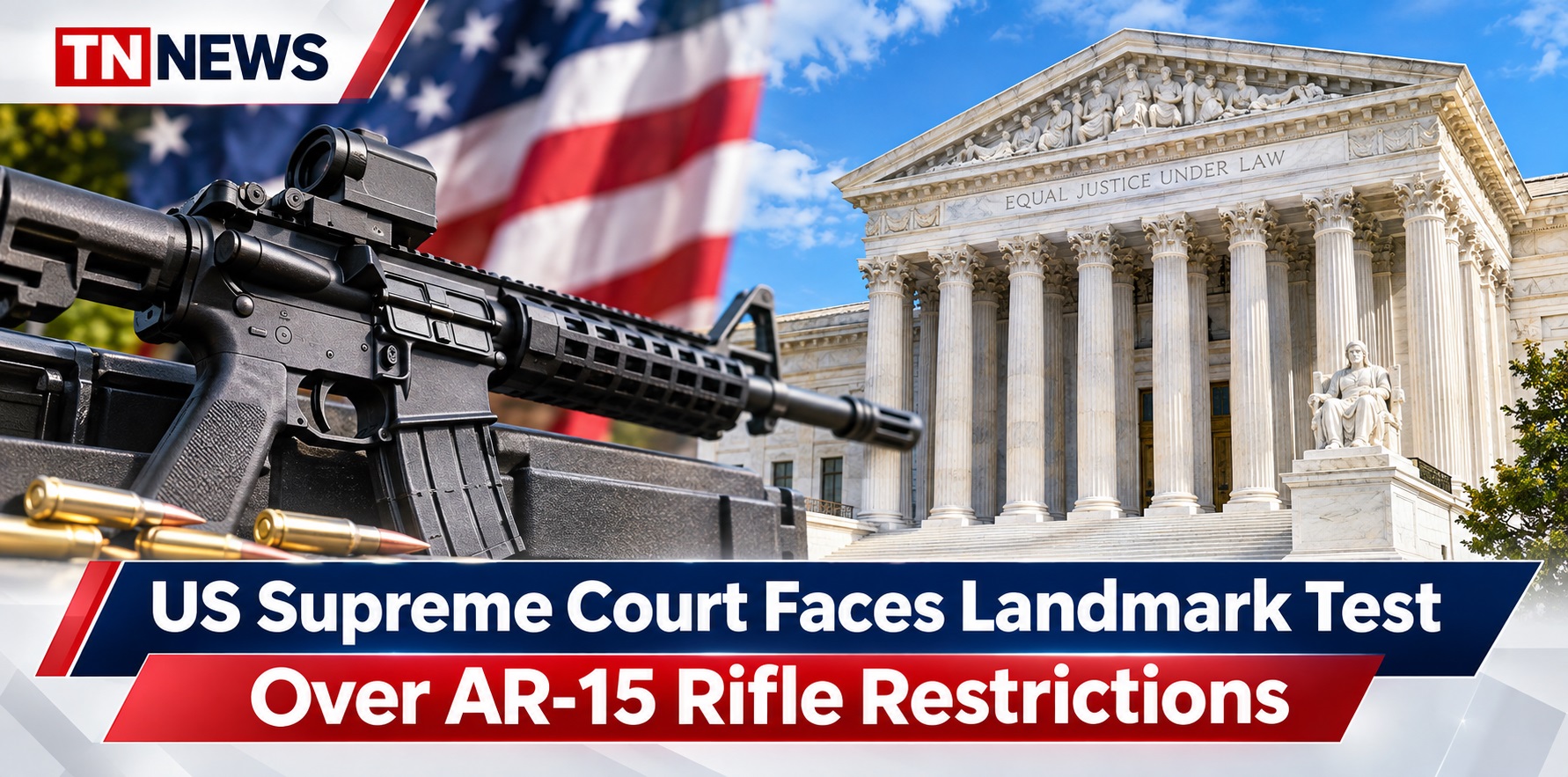
US Supreme Court Faces Landmark Test Over AR-15 Rifle Restrictions
The future of firearms regulation in the United States is approaching a critical judicial turning point as the Supreme Court prepares to examine whether state and local governments can constitutionally prohibit AR-15-style semiautomatic rifles. The case places competing interpretations of the Second Amendment at the center of a broader debate over individual rights, government authority and public safety.
Arguments are scheduled for Wednesday, with restrictions adopted by Connecticut and Illinois among the measures under scrutiny. Although the dispute concerns specific state laws, its implications could extend considerably further, potentially influencing how legislatures and courts across the country approach restrictions on commonly owned firearms.
A constitutional dispute with nationwide implications
The challenge is being advanced by gun-rights organizations with support from the Trump administration. Their central argument is that the government cannot prohibit firearms commonly possessed by Americans without demonstrating that such restrictions are consistent with the historical tradition of gun regulation in the United States.
A key element of their position is the widespread ownership of these rifles. A 2026 survey cited by the challengers estimates that Americans possess approximately 40 million AR-15-type firearms. They argue that this level of ownership makes it difficult to classify the weapons as outside the scope of constitutional protection.
State authorities, however, approach the issue from a different perspective. Defending the restrictions, they maintain that AR-15-style rifles create particular public-safety risks because of their potential impact in mass shootings. In their view, widespread commercial availability does not automatically prevent legislatures from imposing restrictions when significant safety concerns exist.
The disagreement therefore extends beyond the characteristics of a particular firearm. It concerns the extent to which elected governments can balance constitutional protections against the risks associated with specific categories of weapons.
The legal framework behind the challenge
The Supreme Court's 2022 decision on gun rights established that firearm regulations must remain consistent with the nation's historical tradition of gun regulation. This framework has since become a central reference point in litigation challenging restrictions at both state and local levels.
However, applying a historical standard to modern firearms legislation has proved difficult. Lower courts have faced questions about which historical laws provide relevant comparisons, how closely older regulations must resemble contemporary restrictions, and whether modern public-safety concerns can justify measures that have no direct historical equivalent.
The pending case offers the justices an opportunity to clarify how this constitutional test should apply to restrictions on semiautomatic rifles that have a substantial civilian ownership base.
For state governments, the outcome could determine how much legislative flexibility remains available when regulating particular firearm categories. For gun-rights organizations, it represents an opportunity to establish stronger constitutional protections against restrictions on widely owned weapons.
The economic and regulatory dimensions
Beyond its constitutional significance, the case carries consequences for the American firearms industry and the wider regulatory environment surrounding it.
Manufacturers, distributors and retailers operate within a market shaped by differing state-level requirements. Restrictions on specific firearm models can affect product availability, distribution strategies, inventory management and compliance costs.
A Supreme Court decision invalidating the restrictions could create opportunities for manufacturers and retailers in states where similar prohibitions are currently enforced. It could also encourage a reassessment of existing regulations in other jurisdictions.
Conversely, a ruling that upholds the states' authority could reinforce the ability of individual states to maintain different regulatory frameworks. Businesses would consequently continue operating in a fragmented market, with product offerings and compliance obligations varying across state borders.
The scale of civilian ownership also makes the dispute commercially significant. With approximately 40 million AR-15-type rifles estimated to be in American hands, the legal status of this category has implications extending beyond new sales to existing ownership, transfers and the broader firearms supply chain.
Nevertheless, the precise commercial consequences will depend on the scope of the court's reasoning and how lower courts and state authorities subsequently implement it.
Public safety versus constitutional protection
The case also reflects a deeply divided public debate. Survivors of mass shootings and families supporting tighter firearm restrictions argue that governments must retain meaningful tools to address weapons they consider particularly dangerous.
Gun-rights advocates, meanwhile, maintain that constitutional protections should not depend solely on contemporary assessments of a firearm's potential risks. They emphasize the importance of historical precedent and the rights of individuals to possess commonly owned weapons.
This disagreement presents the justices with a difficult institutional question: how should constitutional protections be interpreted when modern technology, patterns of ownership and public-safety concerns differ significantly from the conditions in which historical regulations were established?
Legal experts remain divided over whether the eventual ruling will have a measurable effect on overall gun violence. However, the broader importance of the case lies in its potential to define the legal boundaries within which future firearms policies can be developed.
What comes next?
The Supreme Court's decision, expected around the end of June 2027, could establish an important precedent for firearms regulation beyond Connecticut and Illinois.
A ruling against the restrictions may weaken comparable laws in other states and strengthen legal challenges to existing prohibitions. A decision supporting the states could preserve broader regulatory authority for legislatures seeking to restrict certain types of firearms.
The outcome will also influence the relationship between federal constitutional standards and state-level policymaking, an issue that has become increasingly significant following the court's 2022 ruling.
For the firearms industry, policymakers and gun-rights organizations, the case represents more than a dispute over two states' legislation. It is a defining test of how the United States interprets the balance between constitutional freedoms and collective safety in a changing legal and commercial environment.
News You Should See
CBT-I: How Behavioral Therapy Can Help Treat Chronic Insomnia Without Relying on Sleeping Pills
Moneymaxxing: How Social Media Is Turning Financial Discipline Into a Lifestyle Trend
AI Data Center Expansion Creates New Supply Chain Challenges for US Aerospace and Defense Industries
Supreme Court to Review State Bans on AR-15-Style Rifles in Major Second Amendment Case
Let Go of Their Harm and Trust Allah: Friday Sermon Explores Healing from Past Wounds and Finding Peace Without Abandoning Justice
Misr El-Kheir International to Launch in the United States with Inaugural New York Gala on December 12
Latest News
CBT-I is a behavioral treatment for chronic insomnia that targets sleep habits and anxiety. Research suggests it improves sleep for 70% to 80% of patients.
Moneymaxxing is gaining attention as a social media trend promoting smarter spending, debt reduction, emergency savings and realistic financial goals through practical budgeting habits.
The AI data center boom is intensifying competition for chips, electricity, skilled workers and factory capacity, creating new supply chain challenges for US aerospace and defense manufacturers.
The US Supreme Court will examine state bans on AR-15-style rifles, a landmark Second Amendment case that could reshape firearms regulations nationwide by June 2027.
A Friday khutbah by Detective Mohamed Amen explores how faith, forgiveness, acceptance, and trust in Allah can help individuals overcome emotional pain while preserving their rights and seeking justice.
Misr El-Kheir International will launch in the United States with an inaugural gala on December 12, 2026, at 583 Park Avenue in New York, featuring humanitarian initiatives and fundraising activities.
Kevin Durant became the fifth NBA player to reach 33,000 career points as the Houston Rockets defeated the Phoenix Suns 116-104. Alperen Sengun recorded a triple-double.
Andy Taylor, original Duran Duran guitarist, has died at 65 following prostate cancer. His guitar work helped define the band's iconic 1980s sound.
A cybersecurity investigation raises concerns after confidential links submitted to Chinese AI company MiniMax were reportedly accessed by unidentified parties, highlighting data privacy and third-party security risks.