Snapchat Turns Event Planning Into a New Layer of Its Social Experience
With Snapchat Plans, Snap redesigns the path from digital conversations to real-world gatherings, challenging dedicated invitation platforms such as Partiful.

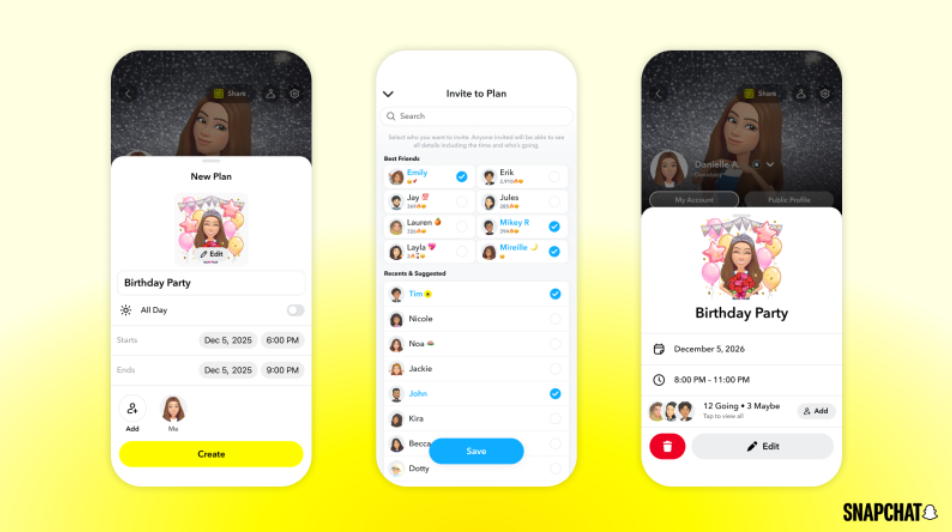
Snapchat is expanding its role beyond instant messaging and digital interaction with the launch of Snapchat Plans, a new set of event-planning features designed to help users organize, share, and manage real-world gatherings directly inside the social platform.
The move represents more than the addition of another utility feature. From a product-design perspective, Snapchat Plans reflects a broader strategic effort to transform the platform from a space primarily centered on communication and content sharing into a service that also supports the social experiences taking place beyond the screen.
The new feature suite enables users to create events, send invitations, manage attendance, and keep important details such as dates, times, locations, and guest information organized in one place. Snapchat says the system can be used for a wide range of occasions, including birthday celebrations, sporting events, study sessions, and informal weekend gatherings.
At the center of the experience is a simple event-creation flow designed around the existing social relationships already established inside Snapchat. Users can create what the company calls a “Snapchat Plan” by entering an event title, selecting a date and time, and inviting up to 200 friends.
Rather than moving users to a separate application or requiring them to share an external invitation link, Snapchat delivers invitations directly through one-on-one chats with invited friends. This design decision allows the company to build event planning into an existing communication behavior, reducing the number of steps between discussing a gathering and actually organizing it.
Invitees can respond using three attendance options: “Going,” “Maybe,” or “Can’t Go.” While this interaction model is straightforward, it introduces a structured coordination layer to conversations that might otherwise become difficult to manage inside group chats.
The launch places Snapchat in increasingly direct competition with dedicated event-planning and digital invitation platforms, particularly Partiful, which has become popular among younger users organizing social gatherings.
The competitive landscape is also becoming more active. Apple entered the digital invitation market last year with its Invites application, allowing users to create customized invitations for different occasions. Snapchat’s strategy, however, is built around a different advantage: it already operates inside an established social network where users communicate with many of the people they are likely to invite.
From an economic and product-strategy perspective, this reduces the friction associated with acquiring users for a standalone event application. Instead of asking consumers to download a new service, create another account, build a contact network, and convince friends to join a separate platform, Snapchat can introduce event planning directly to an existing user base.
This integration model also strengthens Snapchat’s broader ecosystem. Every additional activity that users can complete without leaving the application increases the platform's potential relevance in their daily digital lives. Event planning therefore becomes not just an isolated feature but another reason for users to remain engaged with Snapchat.
The design of Snapchat Plans also introduces a dedicated organizational layer inside the application. A new “My Plans” section on users’ profiles allows them to browse their current, upcoming, and previous events from one central location.
This interface decision is particularly important from a usability perspective. Social plans often begin across multiple conversations, where event details can become scattered between individual chats, group messages, images, and temporary posts. By creating a persistent destination for plans, Snapchat is attempting to convert fragmented social coordination into a structured and retrievable experience.
Users can also visit a friend's profile to see the events they share with that person. This feature adds another relational dimension to the product's design, connecting events directly to the social graph already established within the application.
Once a Snapchat Plan has been created, hosts can monitor attendance, invite additional friends, and update event details when necessary. Guests can view the complete guest list, change their RSVP status at any time, and receive a reminder one hour before the event begins.
These functions position Snapchat Plans as more than a digital invitation card. The feature is designed to support the entire lifecycle of an event, beginning with its creation and invitation process, continuing through attendance management and information updates, and ending with reminders that help participants move from online coordination to physical participation.
Snapchat says the new planning experience is intended to solve a common problem in modern digital communication: social plans can easily disappear inside crowded conversations, while important details may be forgotten, buried in message threads, or never formally organized.
The company's solution is to introduce a more deliberate information architecture around real-world gatherings. Instead of treating an event as a temporary conversation topic, Snapchat Plans gives it a dedicated structure with identifiable participants, scheduling information, attendance status, and ongoing updates.
This reflects a broader shift in social product design. For many years, major social platforms focused primarily on maximizing online interaction through feeds, messages, stories, and content distribution. Increasingly, technology companies are exploring how digital platforms can also facilitate offline relationships and real-world activities.
Snapchat's latest move comes as younger users increasingly seek opportunities for in-person connection after years in which digital communication became a dominant part of social life. Dedicated event platforms have benefited from this shift by offering more structured alternatives to relying entirely on group chats and traditional social networks when organizing gatherings.
For Snapchat, the strategic opportunity lies in connecting its established communication infrastructure with this growing demand for real-world coordination.
The company has been a major player in social media for more than a decade, but Snapchat Plans signals an expansion in how the platform defines its purpose. Instead of focusing only on how users communicate online, Snapchat is positioning itself as a tool that can also help determine when, where, and with whom users spend time offline.
This transition is also significant for the Snapchat brand identity.
Snapchat has historically built its identity around immediacy, private communication, visual interaction, and temporary content. Snapchat Plans introduces a more structured and persistent experience without completely abandoning those core characteristics.
The events remain connected to the user's existing friendships and private communication environment, while the invitation system continues to operate through direct interactions rather than a fully public event marketplace.
According to Snapchat, all Snapchat Plans are private and invite-only.
This privacy-first positioning is important to the product's brand strategy. Unlike open social event platforms that may emphasize discovery and public participation, Snapchat is designing its planning experience around existing relationships. The event is not intended to become a public broadcast but rather an organized extension of conversations between friends.
From a design perspective, this creates continuity between Snapchat's traditional identity and its new functionality. The company is adding organizational capabilities while maintaining a social environment centered on personal networks.
The private nature of the feature may also help Snapchat differentiate its approach in an increasingly competitive market. Event planning can involve sensitive information such as locations, guest lists, and personal schedules. Keeping these plans restricted to invited participants reinforces the idea that Snapchat is not simply building another event-discovery platform but rather developing infrastructure for private social coordination.
The launch of Snapchat Plans also demonstrates how competition in consumer technology increasingly takes place at the level of integrated experiences rather than individual features.
A standalone event-planning application may offer sophisticated invitation tools, but a large social platform has the advantage of owning existing communication channels and social connections. Conversely, dedicated applications may focus more deeply on a specific user experience and build strong identities around a single task.
Snapchat's challenge will therefore be to combine convenience with a compelling design experience. The new feature must feel useful enough to replace the habit of organizing gatherings through group chats while also offering enough simplicity to avoid turning casual social planning into a complicated process.
The company's choice to limit the core creation process to a title, date, time, and invitation list suggests an effort to maintain a lightweight experience. Additional management tools, guest lists, RSVP updates, profile integration, and reminders are then layered around this simple starting point.
This approach reflects a common principle in successful consumer product design: reduce the barrier to beginning a task while providing deeper functionality once the user has already entered the experience.
Economically, the feature also has the potential to support Snapchat's long-term engagement strategy. While the company has developed new revenue opportunities across subscriptions, advertising, creator tools, artificial intelligence, and other services, sustained user engagement remains fundamental to the value of the overall platform.
Features that become embedded in users' real-world routines can strengthen that engagement. If Snapchat becomes a place where users not only communicate with friends but also coordinate birthdays, study sessions, sports activities, and weekend gatherings, the platform gains a more practical role in their social lives.
The value of Snapchat Plans therefore extends beyond event management itself. It creates another connection point between the company's digital ecosystem and users' everyday behavior.
The launch also highlights a wider trend in the technology industry: social platforms are increasingly competing to become operational layers for everyday life.
Messaging applications have added payments, shopping, communities, location sharing, and business tools. Social networks have integrated creator economies, artificial intelligence, commerce, and private communication. Event planning now represents another category where platforms can attempt to centralize activities that previously required separate applications.
For Snapchat, this strategy carries both opportunities and risks.
The opportunity is clear: the company can use its existing network of friends and communication tools to make event planning more convenient and potentially more natural than using a separate service.
The challenge is equally important. Users may already have strong habits around other invitation platforms, group chats, and social applications. Snapchat will need to demonstrate that its integrated experience provides enough value to change those habits.
The competitive pressure from platforms such as Partiful and Apple's Invites also means that event planning is becoming an increasingly important area for product innovation. The next stage of competition may not be determined solely by who can create the most visually attractive invitation, but by which platform can build the most seamless connection between planning, communication, attendance, reminders, and the real-world experience itself.
With Snapchat Plans, Snap is making a clear strategic bet on that direction.
The company is attempting to transform a common social problem—lost messages, scattered details, forgotten invitations, and unclear attendance—into a structured product experience built directly into an existing social network.
The result is a feature that combines communication design, social infrastructure, and real-world coordination.
Whether Snapchat Plans can significantly challenge specialized event-planning platforms will depend on adoption and execution. However, the strategic direction is already clear: Snapchat wants its role in users' lives to extend beyond the moments they share on their phones.
It now wants to become part of the process that helps create the moments users experience together in the real world.

News You Should See
2026 Nobel Medicine Prize Honors Scientists Behind Optogenetics Breakthrough
Oil Prices Edge Lower as Stronger Middle East Exports and G7 Reserves Ease Supply Concerns
Trump Offers U.S. Assistance to Russia After Death at Siberian Plague Research Institute
Trump Takes Economic Message to Nebraska as GOP Faces Rising Cost-of-Living Pressure
U.S. Appeals Court Weighs Trump Administration’s $2.6 Billion Harvard Funding Fight
U.S. Midterm Elections Begin With Resilient Jobs Market and Persistent Cost Pressures
Latest News
The 2026 Nobel Prize in Physiology or Medicine honors Karl Deisseroth, Peter Hegemann and Georg Nagel for pioneering research behind optogenetics and its impact on neuroscience.
Oil prices edged lower as stronger Middle Eastern exports and a planned G7 release of 100 million barrels eased immediate supply concerns, while Gulf security risks and the Strait of Hormuz kept markets alert.
President Donald Trump said the United States would help Russia if needed after a laboratory worker died at a Siberian plague research institute, as Russian authorities imposed precautionary quarantine measures.
Trump’s Nebraska campaign stop highlights rising fuel and grocery costs, beef prices and growing economic pressure on Republicans ahead of the November midterm elections.
A U.S. appeals court is reviewing the Trump administration’s effort to cut Harvard’s federal research funding, with more than $2.6 billion at stake.
The U.S. enters the 2026 midterm elections with unemployment at 4.2%, while higher living and energy costs create economic pressure for households and businesses.
US services growth eased in September as input prices climbed to their highest level since July 2022, with fuel costs, supply-chain disruptions and strong demand increasing pressure on businesses.
Rising Treasury yields are increasing U.S. borrowing costs as Washington manages record debt, persistent inflation and strong economic demand, narrowing its policy options.
A EGP 16 million corporate partnership will establish and equip a bone marrow transplant unit at Cairo’s Coptic Hospital, supporting access to specialized treatment for patients.