SK Hynix Shatters Foreign U.S. IPO Records as AI Memory Boom Reshapes Global Chip Competition
The South Korean memory leader secures $26.5 billion in a historic Nasdaq debut while growing pressure mounts to expand semiconductor manufacturing inside the United States.

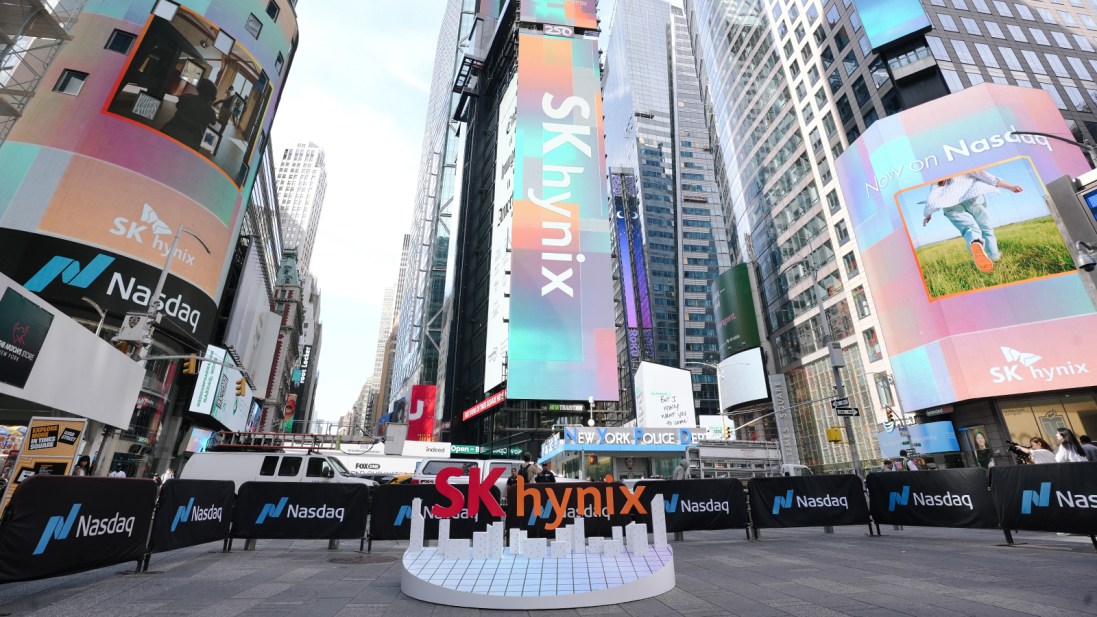
The global race to dominate artificial intelligence infrastructure has entered a new phase after SK Hynix completed the largest U.S. public offering ever achieved by a foreign company. By raising $26.5 billion through its Nasdaq debut, the South Korean semiconductor manufacturer has demonstrated how strategic AI-related technologies continue to reshape capital markets and investor priorities.
The company offered 177.9 million American Depositary Shares priced at $149 each, allowing U.S. investors to access the stock at roughly one-tenth of the value of an ordinary share listed in Seoul. The transaction surpassed Alibaba's landmark 2014 listing, establishing a new benchmark for international companies seeking capital in the United States.
Investor enthusiasm reflected more than the size of the offering. Shares began trading above their issue price despite being sold at a premium relative to the company's recent valuation in South Korea. Reports indicating demand exceeded the available shares by more than seven times highlight the confidence investors have in companies positioned at the center of the AI supply chain.
Unlike many South Korean corporations that have historically traded below global valuation multiples because of governance concerns, regulatory uncertainty, and geopolitical risks, SK Hynix has largely escaped what markets often describe as the "Korea Discount." The company's strategic importance within the AI ecosystem has significantly altered investor perception.
That advantage is closely linked to its leadership in high-bandwidth memory (HBM), one of the most critical components used in advanced AI accelerators. As demand for increasingly powerful AI infrastructure continues to expand, memory suppliers capable of delivering cutting-edge HBM products have become indispensable partners for major GPU manufacturers, strengthening SK Hynix's long-term competitive position.
The capital raised from the offering will primarily support manufacturing expansion in South Korea. Investments are planned for a new semiconductor fabrication facility, additional advanced packaging capacity, and the acquisition of extreme ultraviolet lithography equipment needed for next-generation chip production. These projects are intended to address persistent global shortages driven by accelerating AI deployment.
At the same time, the listing has become part of a broader geopolitical discussion surrounding semiconductor manufacturing. U.S. officials have intensified efforts to encourage major Asian chipmakers to establish more production capacity inside the United States as Washington seeks greater resilience across critical technology supply chains.
This policy direction aligns with broader industrial initiatives already underway in the U.S., where domestic manufacturers are committing hundreds of billions of dollars to expand local semiconductor production. The objective extends beyond economic development, encompassing supply chain security, technological leadership, and reduced dependence on overseas manufacturing.
The timing is particularly significant because South Korea's leading memory producers have simultaneously announced substantial long-term investments in domestic manufacturing, reinforcing the country's determination to preserve its leadership in advanced memory technologies even as international partners seek greater geographic diversification.
For global investors, SK Hynix's successful debut illustrates how artificial intelligence has fundamentally changed semiconductor economics. Companies supplying essential AI infrastructure are increasingly viewed as strategic assets capable of attracting premium valuations regardless of traditional regional market discounts.
As AI adoption accelerates across industries, competition is expected to intensify not only between semiconductor manufacturers but also among governments seeking to secure future production capacity. SK Hynix's record-breaking market debut therefore represents more than a financial milestone—it reflects the growing convergence of technology, industrial policy, and global capital markets.
News You Should See
2026 Nobel Medicine Prize Honors Scientists Behind Optogenetics Breakthrough
Oil Prices Edge Lower as Stronger Middle East Exports and G7 Reserves Ease Supply Concerns
Trump Offers U.S. Assistance to Russia After Death at Siberian Plague Research Institute
Trump Takes Economic Message to Nebraska as GOP Faces Rising Cost-of-Living Pressure
U.S. Appeals Court Weighs Trump Administration’s $2.6 Billion Harvard Funding Fight
U.S. Midterm Elections Begin With Resilient Jobs Market and Persistent Cost Pressures
Latest News
The 2026 Nobel Prize in Physiology or Medicine honors Karl Deisseroth, Peter Hegemann and Georg Nagel for pioneering research behind optogenetics and its impact on neuroscience.
Oil prices edged lower as stronger Middle Eastern exports and a planned G7 release of 100 million barrels eased immediate supply concerns, while Gulf security risks and the Strait of Hormuz kept markets alert.
President Donald Trump said the United States would help Russia if needed after a laboratory worker died at a Siberian plague research institute, as Russian authorities imposed precautionary quarantine measures.
Trump’s Nebraska campaign stop highlights rising fuel and grocery costs, beef prices and growing economic pressure on Republicans ahead of the November midterm elections.
A U.S. appeals court is reviewing the Trump administration’s effort to cut Harvard’s federal research funding, with more than $2.6 billion at stake.
The U.S. enters the 2026 midterm elections with unemployment at 4.2%, while higher living and energy costs create economic pressure for households and businesses.
US services growth eased in September as input prices climbed to their highest level since July 2022, with fuel costs, supply-chain disruptions and strong demand increasing pressure on businesses.
Rising Treasury yields are increasing U.S. borrowing costs as Washington manages record debt, persistent inflation and strong economic demand, narrowing its policy options.
A EGP 16 million corporate partnership will establish and equip a bone marrow transplant unit at Cairo’s Coptic Hospital, supporting access to specialized treatment for patients.