Sila’s $1.4 Billion Pentagon Loan Signals a New Race for Domestic Battery Supply
The financing could accelerate Sila’s silicon-carbon battery expansion while strengthening the U.S. push to reduce dependence on China for critical battery materials

Sila Nanotechnologies is emerging as a strategic beneficiary of a major shift in how the United States views battery technology. The company has secured a $1.4 billion loan from the U.S. Department of Defense to expand production of its silicon-carbon battery material, turning what was once primarily a commercial battery technology bet into an increasingly important part of the country's industrial and defense strategy.
The financing comes as American automakers, battery manufacturers and defense contractors face a common problem: securing critical battery materials without relying heavily on Chinese supply chains.
Graphite remains the dominant material used in lithium-ion battery anodes, and Chinese companies control a substantial share of the global graphite supply chain. That dependence creates a vulnerability for industries where batteries are becoming strategically important, from electric vehicles and drones to military electronics and autonomous systems.
Sila's proposition is built around replacing graphite with a silicon-carbon material.
Silicon can store considerably more energy than graphite, potentially allowing battery manufacturers to build cells with higher energy density without completely redesigning the underlying battery architecture. Sila says its technology can deliver an improvement of roughly 20% in energy density compared with leading graphite-based cells, while also supporting faster charging in certain configurations.
For the market, the attraction is straightforward. Higher energy density can translate into longer operating times, smaller battery packs or lower weight.
Those advantages are particularly valuable in applications where every additional gram matters.
An electric vehicle can potentially gain range from a more energy-dense battery. A drone can remain airborne longer or carry additional equipment. A military system can allocate less weight to energy storage and more to sensors, communications equipment or payload.
This is why the Pentagon's involvement changes the strategic significance of Sila's technology.
The U.S. government is not simply financing another battery startup. It is helping establish domestic manufacturing capacity for a material that could become important across several strategic industries.
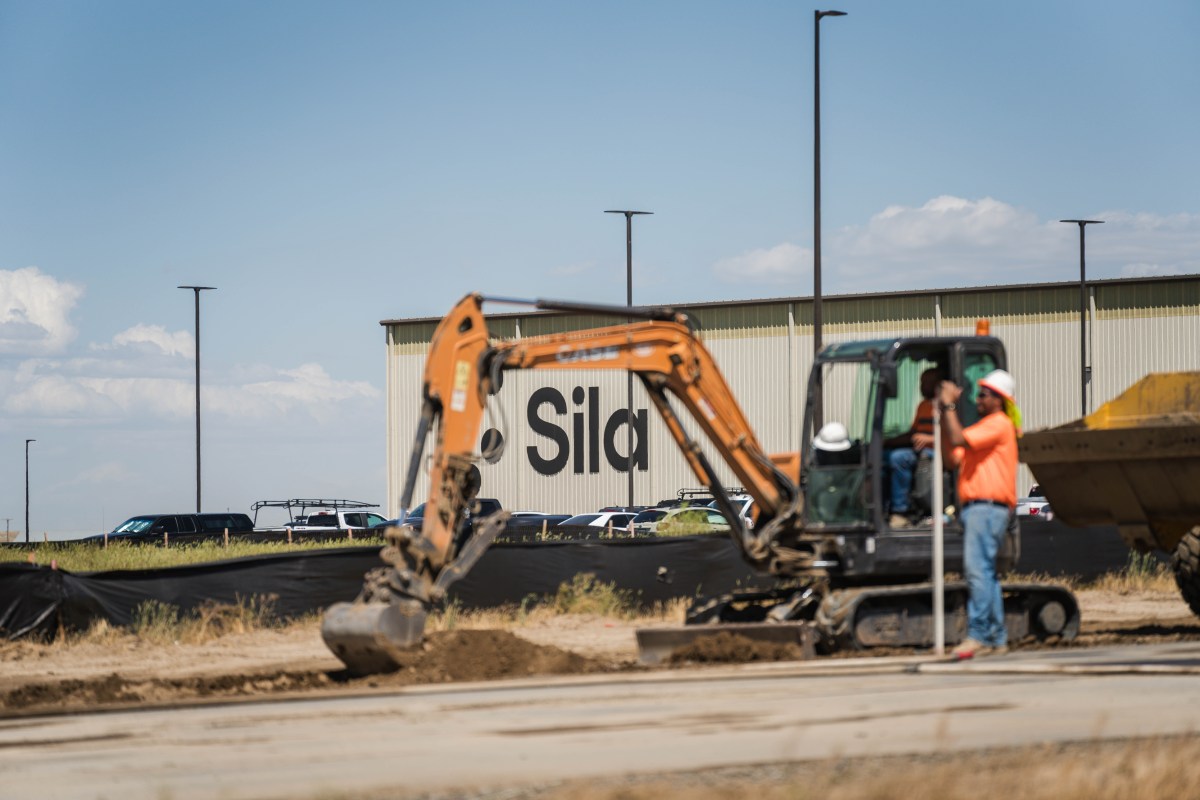
Sila's Moses Lake, Washington, facility is central to that strategy. The factory began operating in September and currently has approximately 2 gigawatt-hours of annual anode-material capacity. The company is working to expand the facility fivefold, with the eventual production scale expected to provide enough material for more than 100,000 electric vehicles.
That expansion represents a major transition for Sila.
Battery-material companies often face a difficult gap between laboratory performance and industrial production. Demonstrating that a new material works is only the first stage. The much harder challenge is manufacturing it consistently, economically and at a scale that major customers can depend on.
Sila has already moved beyond the laboratory phase.
The company has secured commercial relationships with Mercedes-Benz and Panasonic, providing evidence that its technology has attracted major industry players. It has also raised more than $1.5 billion from private investors, according to PitchBook, including a $300 million financing round announced in July to support factory expansion.
The Pentagon loan adds a different kind of capital to that equation.
Private investment is generally designed to finance growth in anticipation of future commercial returns. Government-backed financing can serve a broader strategic objective, particularly when an industrial project requires enormous upfront investment but also has national-security implications.
That distinction is important.
The $1.4 billion loan is not merely a vote of confidence in Sila's business model. It reflects Washington's growing willingness to treat battery materials as strategic infrastructure.
The move also forms part of a wider package aimed at strengthening U.S. access to critical industrial materials.
Alongside Sila, the Defense Department announced a $400 million loan for Australia's Sunrise Energy Metals to develop scandium resources, a $150 million loan for Minnesota-based Niron Magnetics to manufacture rare-earth-free magnets, and an $85 million government equity investment in Strategic Bauxite.
The pattern is significant.
The U.S. is attempting to build domestic or allied alternatives across several stages of the advanced manufacturing supply chain rather than concentrating exclusively on finished products.
That approach recognizes a fundamental weakness in the clean-energy and defense technology sectors: advanced products are only as resilient as the materials and components behind them.
A drone manufacturer may be based in the United States, but if the critical battery materials come from a highly concentrated overseas supply chain, the final product remains exposed to geopolitical and trade risks.
The same logic applies to electric vehicles.
The competition in batteries is therefore moving upstream.
Instead of asking only which company produces the best battery cell, governments and investors are increasingly asking who controls the materials required to manufacture those cells.
This creates a strategic opening for companies such as Sila, Group14 and Amprius, all of which are pursuing silicon-based alternatives to graphite.
But Sila's biggest competitive challenge may not be the underlying chemistry.
It may be manufacturing economics.
A material can outperform graphite in laboratory testing and still struggle commercially if it is too expensive, difficult to manufacture or inconsistent at scale.
Sila's investment in Moses Lake is therefore arguably more important than the headline performance figures of its technology.
The factory becomes the mechanism through which the company can convert intellectual property into a defensible industrial position.
If Sila succeeds in scaling production, its competitive advantage could shift from chemistry alone to a combination of technology, manufacturing expertise, customer relationships and domestic supply-chain positioning.
That would create a much stronger barrier to entry.
The company is also benefiting from a convergence between two rapidly expanding markets: electric mobility and defense technology.
For years, the economic case for advanced battery materials was driven largely by electric vehicles and consumer electronics.
Defense is now adding another source of demand.
Military drones, autonomous systems, satellites, portable electronics and other platforms increasingly require batteries that provide more energy without adding significant weight.
This changes the potential customer base for Sila.
The company no longer needs to rely exclusively on automakers to justify the scale of its manufacturing investment.
Defense contractors could become another major channel for growth, particularly as governments increase spending on autonomous systems and unmanned platforms.
That diversification could also reduce commercial risk.
The electric-vehicle market is highly competitive and sensitive to pricing, consumer demand, interest rates and charging infrastructure.
Defense procurement operates differently.
Government contracts tend to be shaped by strategic requirements, mission performance and supply security as well as price.
For a battery-material producer, having access to both markets could create a more resilient demand profile.
The relationship with Mercedes-Benz and Panasonic provides another important advantage.
Major industrial customers can help validate a technology in ways that venture funding alone cannot.
If Sila can demonstrate that its silicon-carbon material performs reliably across automotive and defense applications, the company could position itself as a strategic supplier rather than simply another battery technology startup.
That distinction matters for its corporate identity.
Sila's brand is increasingly moving from "battery innovation" toward "strategic energy infrastructure."
Its value proposition is not limited to producing a better battery material.
It is becoming connected to energy density, manufacturing localization, supply-chain security and national resilience.
That broader positioning could increase the company's importance to governments and industrial customers.
It also explains why the Pentagon loan could have implications beyond the immediate financing.
The government is effectively helping create an industrial asset that can support multiple markets.
If the Moses Lake expansion succeeds, the facility could become part of a broader U.S. battery ecosystem in which domestic material production reduces exposure to external supply disruptions.
This is especially relevant as geopolitical competition increasingly intersects with technology supply chains.
China's position in graphite processing illustrates the problem.
Even when raw materials are available globally, processing capacity can remain concentrated in a small number of countries.
Developing alternative materials such as silicon-carbon can therefore provide two benefits at once: improving battery performance while diversifying the supply chain.
That combination makes the technology strategically attractive.
However, the financing should not be interpreted as proof that Sila has eliminated the risks facing advanced battery materials.
Scaling a factory fivefold is a complex industrial undertaking.
Production yields, equipment performance, raw-material costs, customer qualification and manufacturing consistency can all affect the economics of the expansion.
Sila will also have to demonstrate that its technology can compete with improving graphite-based batteries and rival silicon-anode technologies.
The next phase of competition will therefore be less about scientific promise and more about execution.
The companies that can move from pilot production to reliable, high-volume manufacturing are likely to capture the largest share of the emerging market.
For Sila, the $1.4 billion Pentagon loan provides an unusually powerful financial foundation for that transition.
It also sends a signal to private investors and industrial partners that the U.S. government considers the company's technology strategically relevant.
That could make it easier for Sila to attract additional capital, customers and partnerships.
More broadly, the deal illustrates how the battery industry is becoming intertwined with national-security policy.
As batteries become essential to electric transportation, drones, robotics, satellites and military systems, control over battery materials becomes a strategic issue rather than simply an industrial one.
The winners in this market may therefore be determined by more than energy density or charging speed.
They will also be judged by where materials are produced, how resilient their supply chains are, whether factories can scale, and whether their customers can depend on them during periods of geopolitical disruption.
Sila is now positioned at the intersection of those priorities.
Its technology began as a long-term attempt to improve lithium-ion batteries by replacing graphite with silicon.
It is increasingly becoming part of a much larger industrial strategy aimed at building a more secure battery supply chain.
The Pentagon's $1.4 billion commitment does not guarantee that Sila will become a dominant battery-material supplier.
But it gives the company something that many advanced-material startups struggle to obtain: the financial capacity and strategic backing required to cross the difficult gap between technological innovation and industrial scale.
If Sila can execute that expansion successfully, the company could emerge not only as an important battery technology developer, but as a critical supplier in the emerging U.S. ecosystem for electric mobility and defense technology.
News You Should See
2026 Nobel Medicine Prize Honors Scientists Behind Optogenetics Breakthrough
Oil Prices Edge Lower as Stronger Middle East Exports and G7 Reserves Ease Supply Concerns
Trump Offers U.S. Assistance to Russia After Death at Siberian Plague Research Institute
Trump Takes Economic Message to Nebraska as GOP Faces Rising Cost-of-Living Pressure
U.S. Appeals Court Weighs Trump Administration’s $2.6 Billion Harvard Funding Fight
U.S. Midterm Elections Begin With Resilient Jobs Market and Persistent Cost Pressures
Latest News
The 2026 Nobel Prize in Physiology or Medicine honors Karl Deisseroth, Peter Hegemann and Georg Nagel for pioneering research behind optogenetics and its impact on neuroscience.
Oil prices edged lower as stronger Middle Eastern exports and a planned G7 release of 100 million barrels eased immediate supply concerns, while Gulf security risks and the Strait of Hormuz kept markets alert.
President Donald Trump said the United States would help Russia if needed after a laboratory worker died at a Siberian plague research institute, as Russian authorities imposed precautionary quarantine measures.
Trump’s Nebraska campaign stop highlights rising fuel and grocery costs, beef prices and growing economic pressure on Republicans ahead of the November midterm elections.
A U.S. appeals court is reviewing the Trump administration’s effort to cut Harvard’s federal research funding, with more than $2.6 billion at stake.
The U.S. enters the 2026 midterm elections with unemployment at 4.2%, while higher living and energy costs create economic pressure for households and businesses.
US services growth eased in September as input prices climbed to their highest level since July 2022, with fuel costs, supply-chain disruptions and strong demand increasing pressure on businesses.
Rising Treasury yields are increasing U.S. borrowing costs as Washington manages record debt, persistent inflation and strong economic demand, narrowing its policy options.
A EGP 16 million corporate partnership will establish and equip a bone marrow transplant unit at Cairo’s Coptic Hospital, supporting access to specialized treatment for patients.