Sardinia Beyond the Beaches: A Journey Into the Island’s Culture and Wild Interior
From ancient nuraghe villages and mountain canyons to rare cuisine, traditional festivals and secluded coves, Sardinia offers a deeper Mediterranean experience

Sardinia has long been marketed as one of the Mediterranean’s great beach destinations, but that image captures only a fraction of what makes the Italian island distinctive.
Beyond the turquoise water and famous coastal resorts lies a destination shaped by thousands of years of history, mountain communities, traditional food, archaeological landscapes and deeply rooted local identities.
For travelers willing to move inland, Sardinia becomes less a conventional beach holiday and more an immersive journey through a living culture.
That distinction is increasingly important for the island’s tourism strategy.
Coastal tourism remains a major attraction, but expanding the visitor experience beyond the shoreline can help distribute tourism geographically and seasonally. Inland villages, archaeological sites, hiking routes, food traditions and cultural festivals offer reasons to travel outside the busiest summer months.
One of the strongest examples is the Supramonte, a mountainous region where dramatic geology and ancient human settlements coexist.
The Gola Su Gorropu, one of Europe’s most spectacular natural formations, cuts deeply into the limestone landscape with walls reaching around 500 meters. Hiking into the gorge transforms the attraction from a scenic viewpoint into an active experience, with visitors moving directly through one of the island’s most dramatic geological environments.
Nearby, the ancient nuraghe village of Tiscali provides another dimension.
Hidden within a mountain setting, the Bronze Age archaeological site reflects the civilization that developed across Sardinia long before the island became part of modern Italy.
The surrounding Valle di Lanaittu adds further depth, combining archaeological remains with karst landscapes, Mediterranean vegetation and underground water systems.
This combination of nature and history is one of Sardinia’s strongest tourism assets.
Instead of separating cultural tourism from outdoor tourism, the island can offer both within the same itinerary.
A traveler can hike through a mountain landscape, visit an archaeological site and then experience local food in a nearby village.
Food itself is another major part of Sardinia’s identity.
Among the island’s most distinctive culinary traditions is su filindeu, an exceptionally labor-intensive pasta traditionally made by stretching semolina dough into extremely thin strands.
Its survival has become a cultural issue because the tradition is now maintained by only a small number of people in Nuoro.
The story illustrates a broader characteristic of Sardinian tourism: some of its most valuable attractions are not mass-market products.
They are traditions that depend on local knowledge and community participation.
That makes cultural tourism particularly important.
Visitors are not simply consuming a finished product; they are encountering practices that have been passed through generations.
The same principle appears in Sardinia’s festivals.
In Barbagia, the Autunno in Barbagia festival brings villages to life through food, music, traditional clothing, crafts and demonstrations of rural production.
The event is spread across dozens of towns between September and December, creating a cultural tourism calendar that extends well beyond the traditional summer season.
For local communities, this type of event can generate economic activity while strengthening the visibility of regional traditions.
It also provides travelers with a reason to visit places that might otherwise receive fewer international visitors.
Sardinia’s cultural identity is particularly visible in its relationship with food, agriculture and village life.
In the mountainous Ogliastra region, the island’s reputation for longevity has become another point of interest.
The area is associated with unusually high numbers of centenarians, and researchers have linked aspects of traditional Sardinian life with longevity, including regular physical activity, communal meals, strong family relationships and a relatively simple dietary culture.
This has helped transform the concept of the “Blue Zone” into a tourism experience centered not simply on wellness services, but on understanding the social environment behind the lifestyle.
Staying in a traditional village can therefore offer something different from a conventional wellness retreat.
The attraction becomes the rhythm of daily life itself: local food, family connections, physical activity, agricultural traditions and communal interaction.
This reflects a wider shift in tourism toward experiences that allow visitors to understand how people live rather than simply what they see.
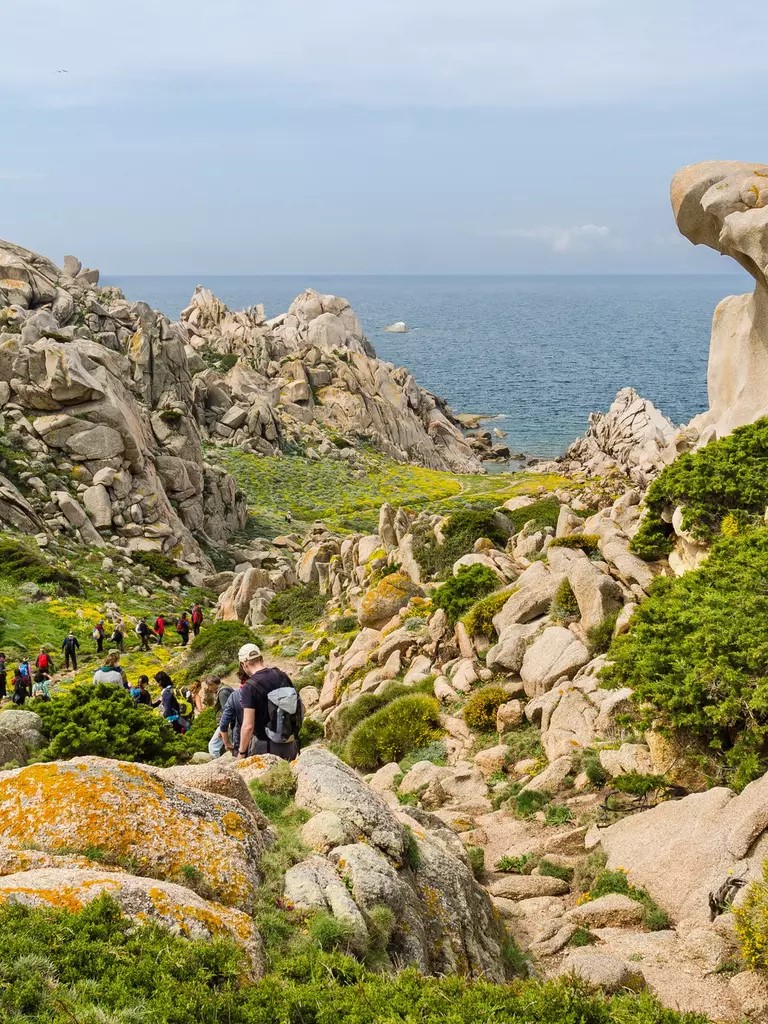
Sardinia also offers a striking contrast between its mountainous interior and its coastline.
The Golfo di Orosei is one of the island’s most dramatic coastal landscapes, where limestone cliffs meet exceptionally clear water and secluded beaches.
Several coves, including Cala Goloritzè, Cala Mariolu, Cala Biriola and Cala Luna, are accessible primarily by boat or on foot.
Their relative inaccessibility is part of their appeal.
The journey itself becomes part of the attraction, while restricted access can help protect the character of places that would otherwise be vulnerable to mass tourism.
Further south, the Costa Verde offers another version of Sardinia’s wild landscape.
The dunes at Piscinas can rise to around 70 meters or more, creating one of Europe’s most remarkable coastal dune environments.
The area’s remoteness and shifting landscape provide a sharp contrast with the resort-oriented image commonly associated with Mediterranean beaches.
Together, these landscapes reveal the diversity of Sardinia as a destination.
The island can offer hiking, archaeology, culinary tourism, cultural festivals, marine experiences and wellness-oriented travel without requiring visitors to leave the same broader region.
This creates an important competitive advantage.
Many Mediterranean destinations compete primarily through beaches, climate and accommodation. Sardinia can differentiate itself by selling a more complete cultural and environmental experience.
That positioning could also help address the pressures associated with peak-season tourism.
Traveling in July and August brings the highest concentration of visitors, while spring and autumn can provide better conditions for hiking and cultural exploration, along with lower accommodation prices in some areas.
Events such as Autunno in Barbagia create additional reasons to travel outside the peak beach season.
The result is a potential shift from seasonal beach tourism toward a more balanced year-round model.
Transportation remains an important consideration in achieving that goal.
Sardinia is relatively compact, but its mountainous terrain and limited public transportation make independent mobility particularly valuable for travelers who want to reach rural villages, archaeological sites and remote natural attractions.
A rental car can therefore become more than a convenience; it can determine how much of the island a visitor is able to experience.
That is particularly relevant for an itinerary built around multiple small destinations rather than a single resort.
The island’s tourism proposition is ultimately based on discovery.
Its most compelling experiences are often found away from the places that first appear in international advertising.
The visitor who moves beyond the beaches can encounter a Sardinia defined by ancient civilizations, shepherding traditions, local wines, handmade foods, mountain trails, village festivals and landscapes that remain remarkably wild.
For the tourism industry, this creates an opportunity to move from destination promotion toward destination storytelling.
The product is not simply a beach in the Mediterranean.
It is the relationship between the coast and the mountains, the archaeological past and contemporary village life, traditional food and modern travel, and natural landscapes and local communities.
That broader identity can make Sardinia more resilient as a tourism destination.
It can encourage longer stays, distribute visitor spending more widely and create demand for experiences throughout the year.
Most importantly, it gives travelers a reason to return.
A first visit may revolve around the coastline, while a later journey can focus on hiking, archaeology, food, festivals or the island’s interior.
Sardinia’s greatest tourism opportunity may therefore lie in changing the question travelers ask.
Instead of asking where the island’s best beach is, visitors can ask what kind of Sardinia they want to discover.
The answer could lead them into a canyon, an ancient settlement, a village kitchen, a mountain festival or a secluded cove.
That is the Sardinia that exists beyond the postcard.
News You Should See
2026 Nobel Medicine Prize Honors Scientists Behind Optogenetics Breakthrough
Oil Prices Edge Lower as Stronger Middle East Exports and G7 Reserves Ease Supply Concerns
Trump Offers U.S. Assistance to Russia After Death at Siberian Plague Research Institute
Trump Takes Economic Message to Nebraska as GOP Faces Rising Cost-of-Living Pressure
U.S. Appeals Court Weighs Trump Administration’s $2.6 Billion Harvard Funding Fight
U.S. Midterm Elections Begin With Resilient Jobs Market and Persistent Cost Pressures
Latest News
The 2026 Nobel Prize in Physiology or Medicine honors Karl Deisseroth, Peter Hegemann and Georg Nagel for pioneering research behind optogenetics and its impact on neuroscience.
Oil prices edged lower as stronger Middle Eastern exports and a planned G7 release of 100 million barrels eased immediate supply concerns, while Gulf security risks and the Strait of Hormuz kept markets alert.
President Donald Trump said the United States would help Russia if needed after a laboratory worker died at a Siberian plague research institute, as Russian authorities imposed precautionary quarantine measures.
Trump’s Nebraska campaign stop highlights rising fuel and grocery costs, beef prices and growing economic pressure on Republicans ahead of the November midterm elections.
A U.S. appeals court is reviewing the Trump administration’s effort to cut Harvard’s federal research funding, with more than $2.6 billion at stake.
The U.S. enters the 2026 midterm elections with unemployment at 4.2%, while higher living and energy costs create economic pressure for households and businesses.
US services growth eased in September as input prices climbed to their highest level since July 2022, with fuel costs, supply-chain disruptions and strong demand increasing pressure on businesses.
Rising Treasury yields are increasing U.S. borrowing costs as Washington manages record debt, persistent inflation and strong economic demand, narrowing its policy options.
A EGP 16 million corporate partnership will establish and equip a bone marrow transplant unit at Cairo’s Coptic Hospital, supporting access to specialized treatment for patients.