Roblox Redefines Game Creation by Taking AI Development Beyond Its Platform
From prompt-based creation to standalone apps and new creator financial tools, Roblox is turning its game engine into a broader ecosystem for building, distributing and monetizing interactive experiences.

At its annual Roblox Developer Conference, the company presented a broader strategy for the future of its gaming ecosystem, combining artificial intelligence, easier development tools, cross-platform distribution and new financial services for creators. Rather than limiting the value of its technology to experiences played exclusively inside Roblox, the company is increasingly positioning its underlying game engine as infrastructure that can help developers create, distribute and monetize interactive products across a wider range of environments. The shift reflects a significant change in platform strategy: Roblox is not only trying to attract players to its own environment, but is also seeking to increase the reach and commercial potential of what creators build with its technology.
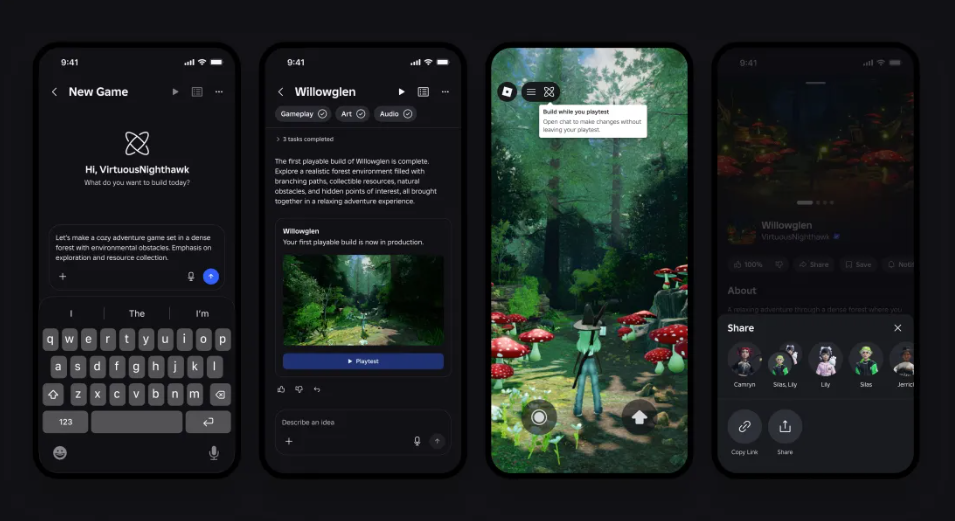
Artificial intelligence is at the center of this expansion. Roblox is broadening access to its generative AI game-creation system, Build, which was first introduced in July. The feature allows users to describe the type of game they want through natural-language prompts and then generate an initial playable experience without requiring traditional programming workflows. After initially being limited to users in New Zealand, Build is expanding to Serbia and Singapore. Roblox is also adding desktop access, giving creators a larger interface for developing games, alongside a new asset library and greater iterative control over generated content. Later this year, the company plans to introduce prompt-based scene generation, with the capability also being extended to Roblox Studio. From a product-design perspective, these changes move AI creation away from a one-shot generation model toward a more controllable creative process in which users can progressively shape and refine the result.
The strategic importance of this approach goes beyond reducing the technical barrier to entry. By making creation easier, Roblox can potentially increase the number of people producing content for its ecosystem, while also creating more opportunities for experimentation and new forms of interactive entertainment. At the same time, the company is addressing the distribution problem that naturally follows a larger creator base. Roblox says creators will soon be able to release their games as separate applications for mobile devices, PCs and consoles, with Roblox serving as the underlying game engine. By the end of the year, players will also be able to enter games through browser-based links. This effectively separates the creation technology from the traditional requirement that every experience must remain inside the Roblox application, giving developers a broader route to reach audiences.
That expansion is also reflected in the way Roblox is developing gameplay and testing capabilities. The company is introducing new NPC functionality, including NPCs that can playtest games later this year, while also allowing creators to add offline functionality so players can continue using games in locations with weak network connectivity. These features point toward a design philosophy in which the platform is attempting to make experiences more resilient and easier to operate across different user conditions. Roblox is also updating its social layer through a Friends chat tab that follows players between games and supports voice typing. Meanwhile, its discovery algorithm is being adjusted to recommend shorter games to younger users and longer-play experiences to older users, demonstrating how personalization is becoming part of the platform's broader product-design strategy.
Roblox is simultaneously widening the technical range of experiences that can be developed through its engine. The company is introducing support for 2D games through an orthographic camera, animated image containers and direct sprite-sheet imports for animation. Within its vertical Moments feed, Roblox is also preparing a feature that will allow players to tap avatars appearing in clips and purchase items. This creates a closer relationship between entertainment, discovery and commerce, potentially turning gameplay and short-form content into additional pathways for digital purchases. The move reinforces the idea that Roblox is designing an ecosystem in which content is not simply consumed, but can also function as a discovery mechanism for products and creator-generated assets.
The economic dimension of Roblox's strategy becomes even clearer through its new financial products for creators. The company said developers have earned more than $5 billion on the platform since 2013, while creator earnings over the most recent 12-month period reached $1.7 billion. To build on this economic activity, Roblox is introducing a Roblox Wallet that will allow creators to receive real-money payments by the end of each business day and transfer funds to other bank accounts. The wallet is being developed in partnership with Airwallex for U.S. users aged 18 and above, with Roblox planning to expand the service internationally in the future. The company has also previewed a Roblox Card planned for next year, which would allow creators to spend their earnings at locations that accept the card.
These financial tools represent more than an additional feature for creators. They strengthen the economic identity of Roblox as a creator marketplace and give the company another mechanism for keeping professional and semi-professional developers engaged with its ecosystem. Faster access to earnings and more flexible ways to use creator income can make the platform more attractive to people who increasingly view game development as an economic activity rather than simply a hobby. In that sense, Roblox is attempting to connect the complete creator journey, from the initial AI-assisted idea and production process to distribution, audience discovery and eventually monetization.
The company's scale provides a strong foundation for this strategy. Roblox CEO and founder David Baszucki said players spent more than 29 billion hours on the platform during the last quarter across 180 countries. That level of engagement gives Roblox a substantial audience base, but the company's latest announcements suggest that maximizing time spent inside the platform is no longer the only objective. By allowing games to travel across mobile, PC, console and web environments, Roblox can potentially increase the total number of interactions generated by its creator ecosystem while maintaining the game engine as the technological layer connecting those experiences.
Taken together, the announcements illustrate a deliberate repositioning of Roblox from a destination for user-generated games into a broader technology and creator ecosystem. AI reduces the complexity of production, new development tools expand the creative possibilities, cross-platform distribution increases audience access, personalized discovery improves the relationship between players and content, and financial products strengthen the commercial infrastructure available to creators. The strategic challenge will be maintaining quality and a recognizable Roblox identity while opening the ecosystem to more formats, platforms and creators. If the company succeeds, its competitive advantage may increasingly come not only from the games available on Roblox, but from the underlying tools and economic infrastructure that allow creators to build and distribute interactive experiences wherever their audiences are.
News You Should See
2026 Nobel Medicine Prize Honors Scientists Behind Optogenetics Breakthrough
Oil Prices Edge Lower as Stronger Middle East Exports and G7 Reserves Ease Supply Concerns
Trump Offers U.S. Assistance to Russia After Death at Siberian Plague Research Institute
Trump Takes Economic Message to Nebraska as GOP Faces Rising Cost-of-Living Pressure
U.S. Appeals Court Weighs Trump Administration’s $2.6 Billion Harvard Funding Fight
U.S. Midterm Elections Begin With Resilient Jobs Market and Persistent Cost Pressures
Latest News
The 2026 Nobel Prize in Physiology or Medicine honors Karl Deisseroth, Peter Hegemann and Georg Nagel for pioneering research behind optogenetics and its impact on neuroscience.
Oil prices edged lower as stronger Middle Eastern exports and a planned G7 release of 100 million barrels eased immediate supply concerns, while Gulf security risks and the Strait of Hormuz kept markets alert.
President Donald Trump said the United States would help Russia if needed after a laboratory worker died at a Siberian plague research institute, as Russian authorities imposed precautionary quarantine measures.
Trump’s Nebraska campaign stop highlights rising fuel and grocery costs, beef prices and growing economic pressure on Republicans ahead of the November midterm elections.
A U.S. appeals court is reviewing the Trump administration’s effort to cut Harvard’s federal research funding, with more than $2.6 billion at stake.
The U.S. enters the 2026 midterm elections with unemployment at 4.2%, while higher living and energy costs create economic pressure for households and businesses.
US services growth eased in September as input prices climbed to their highest level since July 2022, with fuel costs, supply-chain disruptions and strong demand increasing pressure on businesses.
Rising Treasury yields are increasing U.S. borrowing costs as Washington manages record debt, persistent inflation and strong economic demand, narrowing its policy options.
A EGP 16 million corporate partnership will establish and equip a bone marrow transplant unit at Cairo’s Coptic Hospital, supporting access to specialized treatment for patients.