Rising Debt Risks Challenge the Financial Sustainability of the AI Infrastructure Boom
Rising borrowing costs and credit risks are putting pressure on AI infrastructure companies, as investors question whether massive investments in data centers, advanced chips and computing capacity can deliver sustainable financial returns.

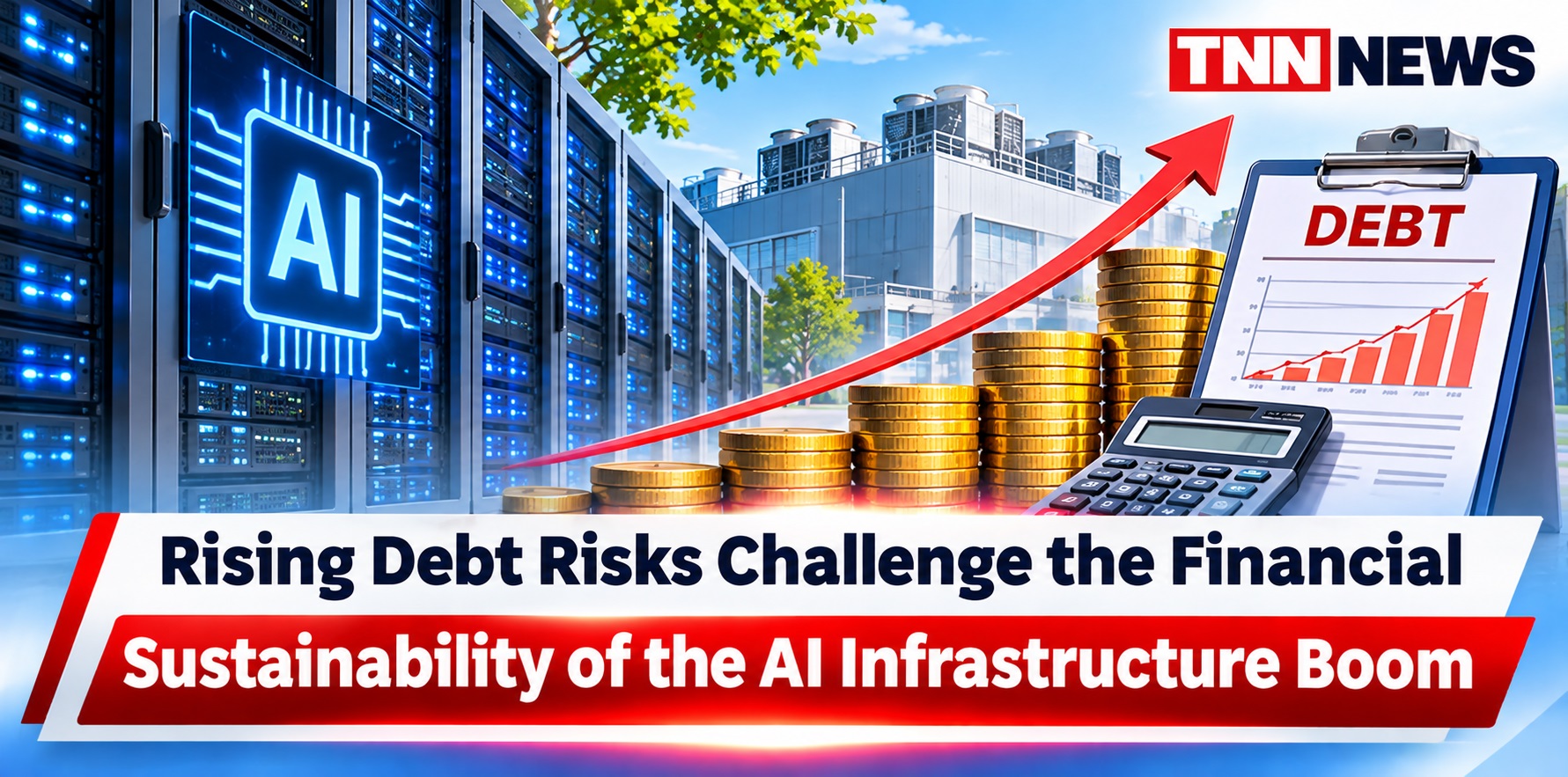
AI Infrastructure Boom Faces a Debt Test as Financing Risks Alarm Investors
The global expansion of artificial intelligence infrastructure is entering a more demanding financial phase, as investors increasingly question whether the companies financing the technology boom can generate sufficient returns to support their growing debt obligations.
The pressure is becoming visible across credit markets, where borrowing costs and indicators of default risk are rising for several businesses closely associated with the expansion of computing capacity. The developments suggest that technological leadership and revenue growth are no longer the only factors shaping investor confidence. The financial structure behind the AI investment cycle is receiving closer scrutiny.
A market analysis published by Reuters on Wednesday highlighted the widening gap between enthusiasm for artificial intelligence and concerns about the debt required to support its development. Even developments involving Nvidia Chief Executive Jensen Huang, which initially contributed to positive sentiment in equity markets, did little to ease concerns about the financial exposure accumulating across the infrastructure sector.
Credit Markets Reveal Growing Financial Pressure
One of the clearest indicators of the changing investment environment is the movement in credit default swaps, financial contracts that provide protection against the possibility of a borrower failing to meet its debt obligations.
When the cost of these instruments rises, it generally reflects greater investor concern about the borrower's creditworthiness and ability to service its debt.
SoftBank has become a prominent example of this pressure. The company's five-year credit default swap spread reached 501 basis points, its highest level since 2022. Its shares also declined 14% on Wednesday, bringing their monthly losses to nearly 40%.
The combination of declining equity value and increasing credit protection costs reflects the growing attention investors are paying to the financial risks associated with large-scale technology investments.
For SoftBank, whose investment strategy is closely connected to the future of artificial intelligence and advanced technology, the cost of financing and the ability to sustain long-term capital commitments have become increasingly important considerations.
CoreWeave Faces Particularly High Borrowing Costs
The pressure is even more pronounced at CoreWeave, a company whose business is closely tied to providing computing infrastructure for artificial intelligence applications.
Its bonds fell to record lows, while yields on its debt maturing in 2031 approached 18%. At the same time, its credit default swap spread climbed to 1,314 basis points.
These indicators point to elevated concerns about the company's financial position and the cost of maintaining access to capital.
CoreWeave operates in a segment where demand for computing resources has expanded rapidly, driven by the growing need for specialized processors, cloud infrastructure and data center capacity.
However, the capital-intensive nature of this business creates a challenging financial equation. Companies must invest heavily in equipment, facilities and computing resources before the full economic benefits of that capacity are necessarily reflected in recurring cash flows.
High borrowing costs can therefore reduce the financial flexibility required to maintain expansion plans, particularly when infrastructure investments depend on continued access to external financing.
Major Technology Companies Face Different Levels of Exposure
The credit market concerns are not limited to smaller or more heavily leveraged businesses.
Investors have also increased the cost of credit protection associated with Oracle, Alphabet and SpaceX, according to the Reuters analysis.
Nevertheless, the financial exposure of large technology companies with substantial operating profits remains more manageable than that of businesses relying more heavily on debt to finance expansion.
This distinction is important because the AI infrastructure market includes companies with fundamentally different financial structures.
Some technology groups can finance a significant portion of their investments through existing cash flows and established business operations. Others depend more heavily on borrowing, external investors and continued capital market access.
Consequently, similar levels of infrastructure spending do not necessarily create similar financial risks.
The ability to generate recurring revenue, maintain liquidity and service outstanding debt is becoming an increasingly important competitive factor across the sector.
The Return on AI Infrastructure Spending Comes Under Scrutiny
The central question facing investors is whether the enormous sums committed to artificial intelligence infrastructure will produce sufficient economic returns.
Building data centers, acquiring advanced processors and expanding computing capacity require substantial upfront investment. These projects also involve ongoing expenses related to energy consumption, equipment maintenance, networking and operations.
The commercial case depends on whether demand for AI services can translate into sustainable revenues that exceed the total cost of developing and operating the infrastructure.
Although AI adoption continues to create opportunities across software, cloud computing and enterprise services, the financial benefits may not emerge at the same speed as infrastructure spending.
This creates a potential mismatch between investment commitments and revenue realization.
Companies that expand capacity too aggressively could face pressure if demand develops more slowly than anticipated or if competition pushes prices and profit margins lower.
The challenge is particularly relevant for infrastructure providers whose business models depend on maintaining high utilization rates and securing long-term customer commitments.
Hidden Financial Commitments Add Another Layer of Risk
Another concern identified in the market analysis involves financing arrangements that may make corporate obligations less visible in conventional financial statements.
Off-balance-sheet commitments and transactions involving related businesses can complicate the assessment of a company's actual financial exposure.
Such arrangements do not automatically indicate financial distress or misconduct. However, they can make it more difficult for investors to evaluate the full scale of future payment obligations, financing dependencies and potential liabilities.
As AI infrastructure projects become larger and more interconnected, transparency around funding structures is becoming increasingly important.
Investors are likely to place greater emphasis on cash flow disclosures, debt maturity schedules, contractual commitments and the financial relationships between companies participating in the same infrastructure ecosystem.
What the Changing Investment Cycle Means for the AI Industry
The rising cost of credit does not necessarily signal an immediate collapse in AI investment or widespread corporate defaults. The financial position of major technology companies varies considerably, and businesses with strong profitability and diversified revenue sources have greater capacity to absorb higher financing costs.
However, the changing credit environment could influence the next stage of infrastructure development.
Companies may become more selective about new projects, prioritize investments with clearer revenue prospects and reconsider expansion plans that depend heavily on borrowing.
Financing conditions could also influence the competitive structure of the market. Businesses with stronger balance sheets and access to lower-cost capital may be better positioned to expand, while highly leveraged infrastructure providers could face greater pressure to secure funding on sustainable terms.
For investors, the evaluation of AI companies is gradually extending beyond technological capabilities and growth expectations to include capital efficiency, debt sustainability and the quality of underlying cash flows.
The broader implication is that the long-term success of the AI industry will depend not only on developing more powerful systems and expanding computing capacity, but also on building financial models capable of supporting those investments.
The next phase of the AI boom may therefore be determined as much by the economics of infrastructure financing as by the pace of technological innovation.
News You Should See
Let Go of Their Harm and Trust Allah: Friday Sermon Explores Healing from Past Wounds and Finding Peace Without Abandoning Justice
Misr El-Kheir International to Launch in the United States with Inaugural New York Gala on December 12
Kevin Durant Reaches 33,000 Career Points as Houston Rockets Defeat Phoenix Suns
Duran Duran's Original Guitarist Andy Taylor Dies at 65 After Cancer Battle
MiniMax Faces Data Security Questions After Confidential AI Links Were Reportedly Accessed
SAP Reportedly Weighs 10,000 Job Cuts as AI Reshapes Its Business Strategy
Latest News
A Friday khutbah by Detective Mohamed Amen explores how faith, forgiveness, acceptance, and trust in Allah can help individuals overcome emotional pain while preserving their rights and seeking justice.
Misr El-Kheir International will launch in the United States with an inaugural gala on December 12, 2026, at 583 Park Avenue in New York, featuring humanitarian initiatives and fundraising activities.
Kevin Durant became the fifth NBA player to reach 33,000 career points as the Houston Rockets defeated the Phoenix Suns 116-104. Alperen Sengun recorded a triple-double.
Andy Taylor, original Duran Duran guitarist, has died at 65 following prostate cancer. His guitar work helped define the band's iconic 1980s sound.
A cybersecurity investigation raises concerns after confidential links submitted to Chinese AI company MiniMax were reportedly accessed by unidentified parties, highlighting data privacy and third-party security risks.
SAP is reportedly considering cutting at least 10,000 jobs in an AI-driven restructuring that could affect around 9% of its global workforce.
Growing GLP-1 use is changing Thanksgiving meals in the US, with smaller portions, reduced appetites and new dietary considerations for families and medication users.
Rising debt costs and credit risks are challenging the AI infrastructure boom, with SoftBank and CoreWeave facing growing investor concerns over financing and returns.
A Georgia judge temporarily suspends an order requiring Fulton County to hand over digital copies of 2020 election ballots and records to the State Election Board pending an appeal.