Power Bills and Data Centers Reshape the U.S. Midterm Debate
Rising household electricity costs and massive grid investment plans are turning utility policy into a major economic and political issue ahead of the 2026 midterms.

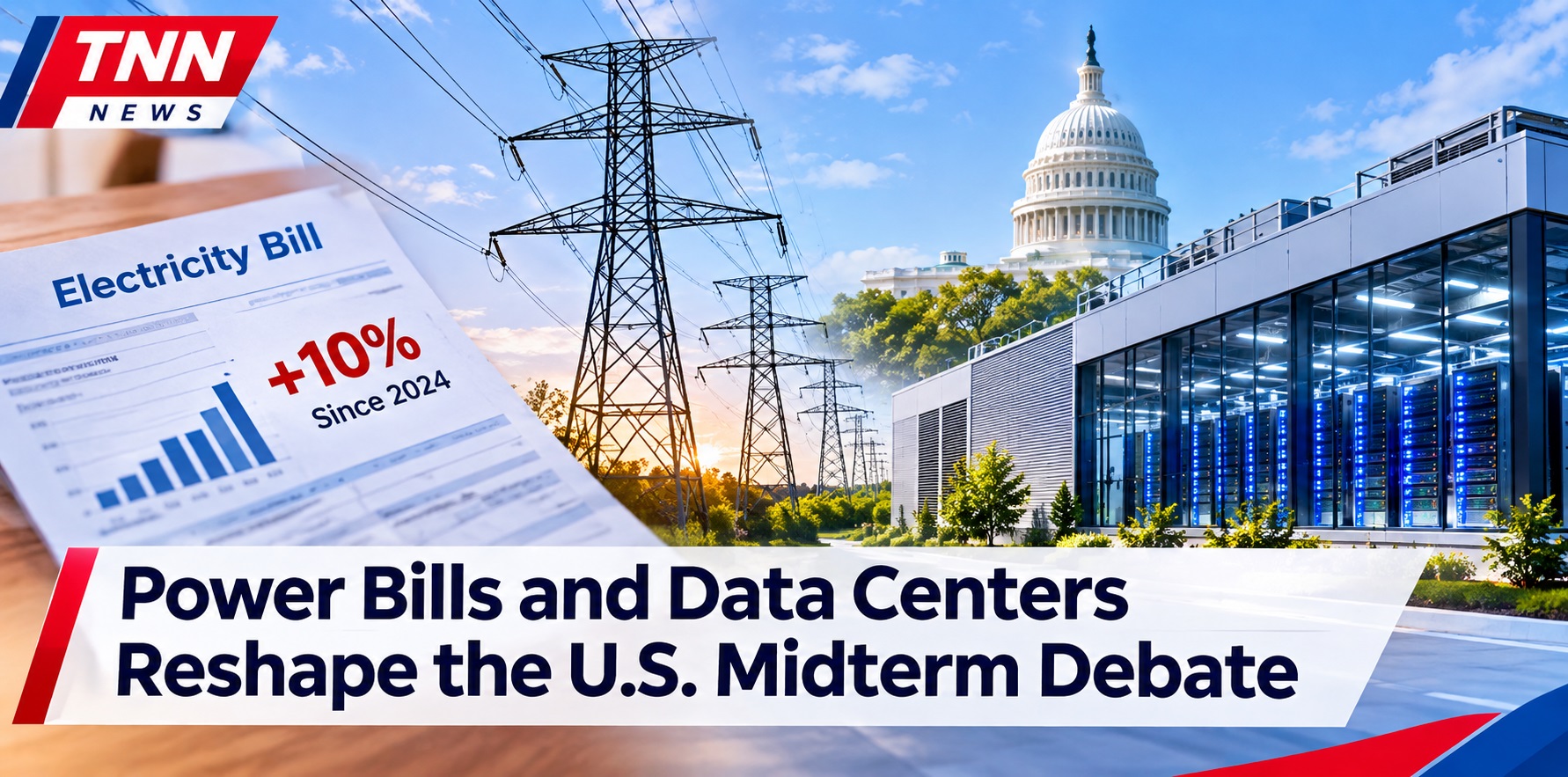
The American electricity industry is moving from the background of economic policy to the center of the political arena. Ahead of the 2026 U.S. midterm elections, rising household power bills and the rapid growth of energy-intensive data centers are transforming utility regulation into an issue with direct consequences for voters, companies and state governments.
Residential electricity prices across the United States have increased by more than 10% since 2024, according to figures cited by Reuters. The pressure has been particularly noticeable in politically competitive states including Ohio, Michigan and Pennsylvania, where expanding data-center development has added a new dimension to concerns about energy demand and consumer costs.
At the heart of the debate is a fundamental question: who should pay for the next generation of America's power infrastructure?
Utilities are facing a period of unusually large capital requirements. As electricity demand rises, the industry is preparing to expand and modernize transmission networks, distribution systems and other essential infrastructure. Investor-owned utilities are expected to undertake nearly $1.3 trillion in capital investment over the next five years, highlighting the scale of the transformation now confronting the sector.
For utility companies, the challenge is both financial and strategic. Large infrastructure programs require regulatory approval and long-term revenue visibility. Companies typically seek to recover investment costs through regulated rates, making proposed increases in customer bills an important part of their business model. But the political environment is becoming less predictable as voters focus more closely on monthly household expenses.
This creates a growing tension between two competing priorities. Utilities argue that limiting revenue too aggressively could weaken their ability to finance the modernization of an aging grid at a time when demand is accelerating. Consumer advocates and political leaders, however, argue that households need stronger protection against rapidly rising electricity costs.
The expansion of data centers has intensified that conflict.
Artificial intelligence, cloud computing and digital services are driving demand for large-scale computing facilities, many of which consume substantial amounts of electricity. For technology companies, access to reliable power is becoming a strategic factor in deciding where to build and expand. For utilities, these facilities represent a major source of new demand and potentially significant long-term revenue.
Yet the commercial opportunity also creates a public-policy problem. Communities hosting large data centers increasingly want assurances that the infrastructure required to serve those facilities will not shift an unfair share of costs onto residential customers. That concern is helping turn decisions once largely confined to utility regulators into highly visible political issues.
The consequences could extend well beyond the 2026 election cycle.
Candidates and policymakers are now debating stronger limits on utility rate increases and possible changes to the way regulated companies earn returns on infrastructure investments. Such proposals could reshape the competitive and financial environment for the utility sector, particularly for companies whose growth strategies depend on large-scale capital spending.
The industry's institutional identity is also evolving. Utilities have traditionally been viewed primarily as providers of essential public services operating under regulated business models. The rise of artificial intelligence and data-center infrastructure is pushing them into a more prominent role within the broader technology economy. Their ability to deliver reliable, affordable and increasingly large volumes of electricity is becoming central to industrial development and digital competitiveness.
That shift creates new opportunities but also new reputational risks. Utility companies must persuade regulators, investors and customers that major infrastructure spending is necessary while demonstrating that the costs are being allocated fairly. The way companies communicate those investments could become increasingly important to their public standing and regulatory relationships.
For technology companies, meanwhile, electricity availability is becoming a commercial constraint rather than simply an operating expense. The competition to develop artificial intelligence infrastructure may increasingly depend on which regions can provide sufficient power capacity and how quickly new facilities can be connected to the grid.
This could strengthen competition among states seeking to attract technology investment. States with reliable energy systems, available capacity and predictable regulatory frameworks may gain an advantage in attracting major data-center projects. At the same time, political resistance could grow in areas where residents believe that economic development is contributing to higher household bills.
The emerging debate therefore reflects a broader change in the American economy. The growth of digital infrastructure is no longer only a technology story. It is becoming an energy story, an investment story and, increasingly, an electoral story.
As the United States prepares for the 2026 midterms, electricity policy is likely to remain closely tied to questions about affordability, corporate investment and industrial growth. The outcome of that debate could influence not only how utilities finance the next generation of the power grid, but also how the country balances its ambitions in artificial intelligence with the economic pressures facing ordinary consumers.
News You Should See
Man City Faces Calls for Further Premier League Investigation Over Post-2018 Finances
Apple Maps Blurs Satellite Images of Key U.S. Military and NASA Sites
Who Is Delorean Bijon Brandon? The Case of Christina Downer’s Disappearance and Suspected Murder
From Siskel and Ebert to The Beatles: Celebrating Entertainment Legends
Olive Oil Before Carbs: Could Timing Influence Blood Sugar?
Jack Hughes Leads Devils to Shootout Victory, Ending Oilers’ Winning Run
Latest News
Premier League executives are debating a possible new investigation into Manchester City's finances after 2018, while the club appeals a verdict involving 114 financial-rule breaches.
Apple Maps has blurred satellite imagery of several U.S. military and NASA sites, including Cape Canaveral and Area 51. The reason for the changes remains unclear.
Delorean Bijon Brandon, 41, has been charged in connection with Christina Downer’s suspected murder after her disappearance in September 2025.
Chicago will honor film critics Gene Siskel and Roger Ebert with life-sized bronze statues, celebrating a partnership that reshaped popular film criticism.
Researchers are examining whether taking olive oil before glucose can slow stomach emptying and influence blood sugar levels, based on promising findings in mice.
Jack Hughes scores twice and adds an assist as the New Jersey Devils defeat the Edmonton Oilers 4-3 in a shootout, ending their three-game winning streak.
Researchers found that physical contact with dogs after an initial stressful task was associated with lower stress levels during a second challenge.
Researchers analyzed genetic data from 2.8 million people and identified 48 previously unknown genomic regions associated with Alzheimer's disease risk.
Screen-free schools are gaining interest among Silicon Valley tech families, raising questions about children's digital exposure and the role of technology in education.