Portugal in 10 Days: A Cultural Road Trip from Lisbon to Porto
A carefully curated route connects Lisbon, Sintra, Évora, Tomar and Porto through historic towns, coastal landscapes, wine, food and local traditions

Explore Portugal in 10 days from Lisbon to Porto, combining historic cities, coastal resorts, UNESCO heritage, regional cuisine, wine and immersive cultural experiences.
SEO Description (Arabic)
اكتشف البرتغال خلال 10 أيام من لشبونة إلى بورتو، في رحلة تجمع المدن التاريخية والتراث العالمي والسواحل والطعام والنبيذ والتجارب الثقافية.
Article (English)
Portugal offers an unusually efficient combination of history, coastal scenery, food and wine within a relatively compact geographic area. A 10-day itinerary connecting Lisbon, Sintra, Cascais, Évora, Tomar and Porto demonstrates how travelers can experience several distinct sides of the country without turning the journey into a race between major tourist attractions.
The route begins in Lisbon and ends in Porto, using a combination of guided excursions, a rental car and locally focused experiences. The itinerary spans 10 days and nine nights, with accommodation divided between Lisbon, Évora, Tomar and Porto. Its published starting price is $3,120 per person.
The structure is significant because Portugal's appeal is not concentrated in a single destination.
Lisbon provides the urban foundation, while the surrounding coastal towns introduce a different version of Portuguese life. Évora shifts the journey toward inland heritage and wine. Tomar adds religious and medieval history, while the northern section leads through historic towns and food destinations before reaching Porto and the Douro wine culture.
This creates a journey based on contrast rather than repetition.
Lisbon serves as the natural starting point because it combines Portugal's historical identity with the energy of a modern European capital.
The itinerary's Lisbon experience includes walking through the historic city and a sunset cruise on the Tagus River. That combination allows travelers to experience the capital from both its streets and its waterfront, reinforcing the importance of Lisbon's relationship with the river.
The surrounding region becomes the next layer of the journey.
Cascais and Estoril introduce Portugal's Atlantic resort culture. Once associated strongly with European aristocracy and royal visitors, the coastal towns now combine beaches, architecture, restaurants and leisure infrastructure.
Sintra provides a sharper contrast. Its mountains, forests, palaces and historic estates create an environment very different from Lisbon's dense urban landscape. The itinerary also includes Cabo da Roca, the westernmost point of mainland Europe, making the excursion as much about geography as architecture and heritage.
The route then turns inland toward Évora.
This transition is important from a tourism perspective because it moves the traveler away from the Atlantic-facing capital and into the cultural landscape of the Alentejo.
Évora is known for its preserved historic character and monuments, while the surrounding region is strongly connected with agriculture and wine. The itinerary incorporates a winery visit, giving the traveler an opportunity to understand the economic and cultural role of wine beyond simply tasting it.
Wine is particularly important to Portugal's tourism proposition.
The country has developed a global reputation around distinctive wine regions, and incorporating producers into travel programs creates a direct connection between landscape, agriculture, local business and gastronomy.
Tomar provides another change of pace.
The town's identity is closely connected to the Knights Templar and the Convent of Christ, creating a historical dimension that differs from both Lisbon's cosmopolitan character and Évora's Roman and medieval heritage.
The route continues through Óbidos, Batalha and Nazaré, introducing smaller communities and coastal landscapes.
These stops are strategically useful because they prevent the itinerary from becoming dominated by Portugal's two largest tourism brands, Lisbon and Porto. They also demonstrate the economic value of secondary destinations that can attract visitors through architecture, food, religious heritage and local traditions.
Óbidos, for example, is associated with its medieval character and ginjinha, the sour-cherry liqueur traditionally served in the region. Batalha adds monumental religious architecture, while Nazaré contributes a strong connection to the Atlantic coast.
The journey then moves through Coimbra and Aveiro before reaching Porto.
Coimbra adds an academic and historical dimension through its university heritage, while Aveiro offers a different visual and culinary identity, including its characteristic canals and ovos moles sweets.
By the time the traveler reaches Porto, the itinerary has already established a broad understanding of Portugal's regional diversity.
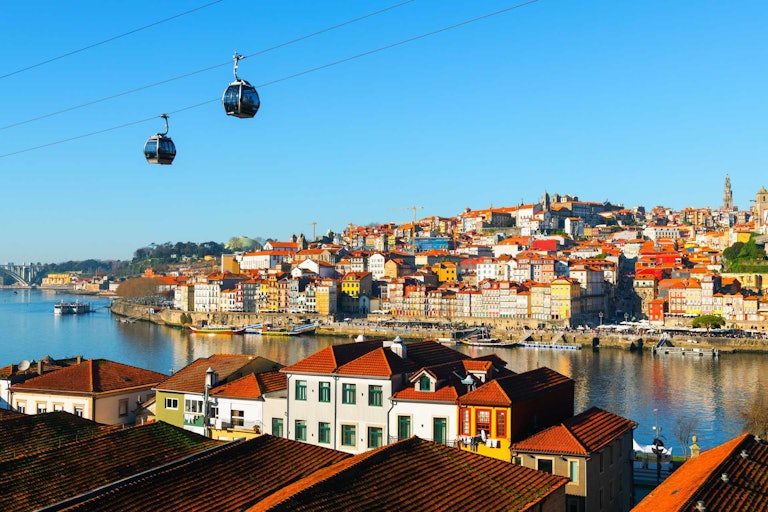
Porto functions as the final major destination and provides a strong conclusion because its identity is deeply connected to architecture, the Douro River and Port wine.
The program includes a walking tour of Porto and a winery experience, allowing the final stage of the journey to combine urban exploration with one of Portugal's most internationally recognized products.
From a tourism-business perspective, this route illustrates the growing importance of experiential travel.
The package does not simply sell hotel rooms and transportation. It bundles accommodation with guided tours, a sunset cruise, winery visits, a rental car, local support and a roadbook containing recommendations.
The package includes three nights in Lisbon, two nights in Évora, two nights in Tomar and two nights in Porto. It also includes a full-day Lisbon tour with a car and driver-guide, a full-day excursion to Cascais and Sintra, a half-day walking tour in Porto, a five-day compact rental car, a Lisbon sunset cruise, a winery visit in Évora and ongoing on-the-ground support.
International flights, insurance, personal expenses, gratuities, unlisted meals and drinks, visas and certain transfers are excluded.
This distinction highlights the product's positioning.
At $3,120 per person starting price, the journey is not designed as a bare-bones budget itinerary. Its value proposition is based on convenience, curation and access to organized experiences.
That model reflects a broader change in the travel industry.
Many international travelers can find hotels, train tickets and attractions independently. The more difficult problem is integrating them into a coherent journey while managing transportation, timing and local experiences.
Travel companies can therefore create value by removing friction rather than simply selling individual travel components.
Portugal is particularly suitable for this model because its major destinations are close enough to be connected by road while still offering markedly different experiences.
The use of a rental car for five days is another important element.
It provides flexibility during the sections where smaller towns and regional attractions are central to the experience. Instead of forcing travelers to depend entirely on fixed public transportation schedules, the road-trip format allows the itinerary to connect destinations that might otherwise require more complicated planning.
At the same time, the journey retains guided elements in Lisbon, Sintra and Porto.
This hybrid structure combines independence with local expertise.
That balance is increasingly relevant to premium tourism. Travelers often want freedom to explore but still value local knowledge when navigating unfamiliar destinations or understanding cultural sites.
The itinerary also demonstrates how regional tourism can strengthen a national tourism economy.
Instead of concentrating spending in Lisbon and Porto, the route directs visitors toward Évora, Tomar, Óbidos, Batalha, Nazaré, Coimbra and Aveiro.
This creates opportunities for hotels, restaurants, wineries, guides, transportation providers, cultural attractions and small businesses in secondary destinations.
For Portugal, this distribution matters because the country's tourism competitiveness is not based solely on the recognition of its largest cities.
Its broader advantage lies in the density of experiences available between those cities.
There is also a clear branding dimension.
Portugal's international tourism identity is often built around several recognizable themes: historic architecture, Atlantic landscapes, food, wine, traditional neighborhoods and a relaxed lifestyle.
This itinerary effectively combines those themes into a single narrative.
Lisbon represents the country's contemporary urban face.
Sintra and Cascais introduce heritage and coastal elegance.
Évora represents inland culture and wine.
Tomar adds medieval and religious history.
Óbidos and Nazaré reinforce the small-town and Atlantic dimensions.
Coimbra and Aveiro add regional character.
Porto completes the story through architecture, river culture and wine.
The result is a tourism product that sells Portugal as a multidimensional destination rather than a collection of isolated cities.
The itinerary also offers a useful lesson for travelers.
Trying to see every famous attraction can produce a fragmented experience. A more effective approach is to choose a route where each destination adds something different.
This 10-day structure works because the experiences evolve.
The traveler begins with urban culture, moves through coastal landscapes, transitions into rural and wine-producing areas, encounters medieval and religious heritage, and ends in one of Europe's best-known wine cities.
That progression gives the trip a narrative.
Portugal's future tourism growth may increasingly depend on this type of travel design.
The country's strongest opportunity is not necessarily to attract more visitors to the same famous streets and landmarks, but to encourage longer stays and broader regional exploration.
A traveler who spends several days moving through smaller cities and communities generates a wider economic impact than one who remains concentrated in a single urban center.
For visitors, that also produces a more complete understanding of the country.
The 10-day route therefore works not because it attempts to include everything Portugal has to offer, but because it selects destinations that complement one another.
It turns geography into a tourism asset, connecting the capital with the countryside, historic towns, Atlantic resorts, wine-producing regions and Porto.
That combination makes the journey particularly attractive for travelers seeking a first introduction to Portugal that goes beyond the standard city break.
News You Should See
2026 Nobel Medicine Prize Honors Scientists Behind Optogenetics Breakthrough
Oil Prices Edge Lower as Stronger Middle East Exports and G7 Reserves Ease Supply Concerns
Trump Offers U.S. Assistance to Russia After Death at Siberian Plague Research Institute
Trump Takes Economic Message to Nebraska as GOP Faces Rising Cost-of-Living Pressure
U.S. Appeals Court Weighs Trump Administration’s $2.6 Billion Harvard Funding Fight
U.S. Midterm Elections Begin With Resilient Jobs Market and Persistent Cost Pressures
Latest News
The 2026 Nobel Prize in Physiology or Medicine honors Karl Deisseroth, Peter Hegemann and Georg Nagel for pioneering research behind optogenetics and its impact on neuroscience.
Oil prices edged lower as stronger Middle Eastern exports and a planned G7 release of 100 million barrels eased immediate supply concerns, while Gulf security risks and the Strait of Hormuz kept markets alert.
President Donald Trump said the United States would help Russia if needed after a laboratory worker died at a Siberian plague research institute, as Russian authorities imposed precautionary quarantine measures.
Trump’s Nebraska campaign stop highlights rising fuel and grocery costs, beef prices and growing economic pressure on Republicans ahead of the November midterm elections.
A U.S. appeals court is reviewing the Trump administration’s effort to cut Harvard’s federal research funding, with more than $2.6 billion at stake.
The U.S. enters the 2026 midterm elections with unemployment at 4.2%, while higher living and energy costs create economic pressure for households and businesses.
US services growth eased in September as input prices climbed to their highest level since July 2022, with fuel costs, supply-chain disruptions and strong demand increasing pressure on businesses.
Rising Treasury yields are increasing U.S. borrowing costs as Washington manages record debt, persistent inflation and strong economic demand, narrowing its policy options.
A EGP 16 million corporate partnership will establish and equip a bone marrow transplant unit at Cairo’s Coptic Hospital, supporting access to specialized treatment for patients.