Oreo Turns Flavor Design Into a Growth Engine for a 114-Year-Old Brand
Mondelēz is using limited-edition flavors, cultural signals and consumer trend mapping to refresh Oreo’s identity, attract new audiences and expand the cookie beyond its traditional snacking territory.

For a consumer brand that has been part of the global market for more than a century, staying relevant is not simply a matter of protecting a familiar recipe. It is a continuous exercise in redesigning how consumers experience the brand without weakening the identity that made it successful in the first place.
That is increasingly the strategic role played by flavor innovation at Oreo, the iconic cookie brand owned by Mondelēz International. Rather than treating new flavors as isolated product experiments, Mondelēz has built limited-edition innovation into Oreo’s broader brand architecture, using unusual combinations, cultural references and emerging consumer preferences as mechanisms for keeping the brand visible and culturally connected.
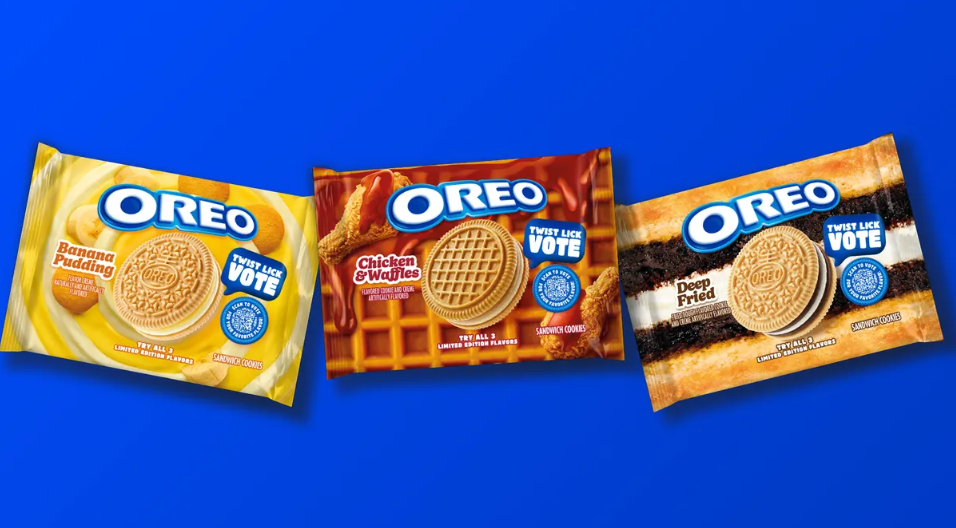
The approach has produced a wide range of experimental concepts over recent years, including strawberry milkshake, brownie batter, birthday cake and candy corn. In August 2026, Oreo expanded that portfolio again with three distinctive offerings: Banana Pudding, Deep Fried and Chicken & Waffles.
At first glance, these products may appear to be novelty-driven extensions designed primarily to generate attention. From a strategic perspective, however, they illustrate a more sophisticated model of brand management. The central Oreo proposition remains protected, while the flavor layer becomes a flexible space where the company can experiment with consumer culture, seasonal behavior, nostalgia and new taste combinations.
This distinction matters economically because Oreo is not a small experimental brand whose survival depends on every new product launch. The cookie was introduced in 1912 and has developed into the world's leading retail cookie brand, according to Mondelēz. Oreo generates more than $4 billion in annual sales and represents a significant contribution to Mondelēz's approximately $38 billion in annual revenue. The company estimates that around 60 billion Oreo cookies are sold each year, with roughly one-third of that volume coming from the United States.
These figures change the meaning of innovation. For a brand operating at that scale, experimentation does not necessarily need to replace the core product. Instead, it can function as a growth layer around an already established business.
This is why the newest flavors are better understood as strategic extensions rather than attempts to reinvent Oreo completely. The core product continues to represent the majority of the business, while limited editions give the company a mechanism for responding quickly to changing consumer interests.
The design philosophy described by Chrissy Briganti, Mondelēz's senior director of Oreo innovation, centers on creating moments of interaction between the brand and its audience. According to Briganti, Oreo's research and development, consumer insights and innovation teams work together to understand how consumer tastes are evolving and then translate those observations into products that can feel relevant at the right cultural moment.
This creates an innovation model based on responsiveness rather than random experimentation.
The company does not simply ask what flavor could be technically produced. It first looks at what consumers are becoming interested in, what cultural conversations are gaining momentum and which eating experiences are generating excitement. The product is then designed as a response to those signals.
In this sense, Oreo's flavor portfolio becomes a form of cultural interface.
The three latest launches demonstrate this approach clearly. Banana Pudding draws on nostalgic dessert culture, connecting the cookie with familiar memories and established comfort-food associations. Deep Fried moves toward experiential eating, drawing inspiration from the distinctive foods associated with fairs and similar entertainment environments. Chicken & Waffles enters the territory of sweet-and-savory combinations, a category that has become increasingly visible across contemporary food culture.
The commercial value of these concepts does not depend solely on whether consumers permanently replace their standard Oreo purchases with one of the experimental flavors. Their value can also come from generating attention, conversation, trial and renewed interaction with the brand.
That makes limited-time products particularly useful within a mature portfolio. Their temporary nature can create urgency while reducing the strategic risk associated with committing permanently to an unconventional flavor. A limited edition can therefore operate as a controlled experiment: it introduces an idea, observes the response and gives the company an opportunity to learn without fundamentally changing the flagship product.
Oreo has repeatedly used this model, with several limited-edition releases appearing each year. The strategy also extends beyond internal product development. Mondelēz has used collaborations and cultural partnerships to create additional points of relevance, including a partnership with Hershey that produced Reese's Oreo cups and cookies, as well as a collaboration connected to K-pop group BTS that drew inspiration from the Korean street food hotteok.
These collaborations demonstrate another dimension of brand design: borrowing cultural energy without abandoning recognizable brand assets.
For Oreo, the cookie remains visually and structurally familiar, while the surrounding flavor concept can change dramatically. This creates a balance between consistency and experimentation. The brand does not have to choose between protecting its heritage and pursuing novelty because the two functions can occupy different layers of the product experience.
The economic logic is particularly important in an increasingly competitive snacking market. Consumers are exposed to a growing number of products competing for attention, and established brands cannot assume that historical recognition alone will guarantee continued relevance. The challenge becomes one of maintaining mental availability while giving consumers fresh reasons to engage.
Oreo's response is to use consumer intelligence as an input for product design.
According to Briganti, the company monitors category forecasts, developments in gastronomy and other areas of food culture, social media conversations and signals from external partners. The research extends beyond cookies and even beyond packaged snacks, allowing the company to identify emerging areas before they become fully established mainstream trends.
This creates a funnel-like innovation process. A broad universe of cultural and food signals is initially monitored. Those signals are then evaluated according to their energy, momentum and potential relevance. The company narrows the field until it identifies trends that appear capable of generating meaningful consumer excitement.
The current focus on nostalgic desserts, experiential foods and sweet-and-savory combinations is therefore presented as the result of a broader trend-mapping process rather than a collection of disconnected creative ideas.
There is also a branding advantage in this system. When a company repeatedly responds to cultural movements in ways that consumers recognize as authentic, innovation itself becomes part of the brand identity.
That is particularly valuable for Oreo because the product already carries a strong historical identity. The brand was established in 1912, meaning its challenge is not to create recognition from zero but to prevent recognition from becoming cultural stagnation.
The tension between heritage and contemporary relevance is one of the defining strategic problems for long-established consumer brands. A product can become highly recognizable while gradually losing its ability to surprise. Oreo's flavor strategy provides a mechanism for introducing surprise while keeping the core visual and product identity intact.
In practical terms, the company is separating what must remain stable from what can remain flexible.
The cookie's core identity provides continuity. Flavor, collaborations, cultural references and limited-time concepts provide movement.
This approach may also support expansion into new consumption occasions. Mondelēz executives indicated during a July earnings call that the company is preparing additional Oreo flavors and expects to move the brand into new categories, including away-from-home consumption. That ambition suggests that flavor innovation is part of a broader attempt to increase the number of contexts in which Oreo can participate.
Moving into additional channels and consumption environments can increase the commercial surface area of the brand. Instead of being associated primarily with a conventional packaged cookie purchased at retail, Oreo can become a platform for different snacking experiences.
The distinction between a product and a platform is important here. A product is typically defined by its established specifications. A platform can support multiple experiences, variations and consumer interactions while maintaining a recognizable central identity.
Oreo's continuing experimentation suggests that Mondelēz increasingly treats the brand as the latter.
The strategy also reveals how product innovation can function as marketing. A new flavor is not simply an item placed on a shelf. It can generate social discussion, media coverage, consumer curiosity and opportunities for digital engagement. When the flavor is unexpected enough to become a conversation topic, the product itself becomes a communication asset.
This is particularly relevant in a market where consumer attention is fragmented across physical retail, social platforms, entertainment and cultural communities.
The result is a feedback loop between brand design and consumer behavior. Cultural trends influence flavor development; new flavors generate consumer reactions; those reactions create additional insights; and the resulting information can influence the next round of innovation.
In this model, innovation is not a one-time launch event. It becomes an ongoing organizational capability.
The strongest element of the strategy may therefore be its ability to combine economic scale with controlled experimentation. Oreo's $4 billion-plus sales base gives Mondelēz a substantial established platform, while limited-edition launches allow the company to explore emerging tastes without requiring a complete transformation of the core business.
The strategy also creates a form of brand resilience. If one experimental flavor fails to achieve lasting popularity, the core Oreo identity remains intact. If another becomes successful, it can create incremental sales, attract new consumers or open the door to additional product concepts.
That flexibility is especially valuable as consumer preferences become more difficult to predict. Today's popular flavor profile may lose momentum quickly, while a trend emerging from social media, gastronomy or another cultural space can move rapidly into mainstream consumption.
By continuously monitoring these signals, Mondelēz is attempting to shorten the distance between cultural change and commercial response.
Ultimately, Oreo's innovation strategy is less about producing the largest possible number of flavors and more about maintaining a dynamic relationship between an established brand and a changing consumer culture.
The business is using flavor as a design variable, limited editions as controlled market experiments, partnerships as cultural bridges and consumer intelligence as the system that connects all three.
For a 114-year-old brand, that may be the more sustainable definition of modernization: not abandoning heritage, but creating enough flexibility around it to ensure that the brand continues to have something new to say.
The next phase of Oreo's growth will therefore depend not only on what new flavors Mondelēz can invent, but on how effectively those flavors can extend the brand into new audiences, occasions and cultural contexts while preserving the recognition and emotional equity accumulated over more than a century.
News You Should See
2026 Nobel Medicine Prize Honors Scientists Behind Optogenetics Breakthrough
Oil Prices Edge Lower as Stronger Middle East Exports and G7 Reserves Ease Supply Concerns
Trump Offers U.S. Assistance to Russia After Death at Siberian Plague Research Institute
Trump Takes Economic Message to Nebraska as GOP Faces Rising Cost-of-Living Pressure
U.S. Appeals Court Weighs Trump Administration’s $2.6 Billion Harvard Funding Fight
U.S. Midterm Elections Begin With Resilient Jobs Market and Persistent Cost Pressures
Latest News
The 2026 Nobel Prize in Physiology or Medicine honors Karl Deisseroth, Peter Hegemann and Georg Nagel for pioneering research behind optogenetics and its impact on neuroscience.
Oil prices edged lower as stronger Middle Eastern exports and a planned G7 release of 100 million barrels eased immediate supply concerns, while Gulf security risks and the Strait of Hormuz kept markets alert.
President Donald Trump said the United States would help Russia if needed after a laboratory worker died at a Siberian plague research institute, as Russian authorities imposed precautionary quarantine measures.
Trump’s Nebraska campaign stop highlights rising fuel and grocery costs, beef prices and growing economic pressure on Republicans ahead of the November midterm elections.
A U.S. appeals court is reviewing the Trump administration’s effort to cut Harvard’s federal research funding, with more than $2.6 billion at stake.
The U.S. enters the 2026 midterm elections with unemployment at 4.2%, while higher living and energy costs create economic pressure for households and businesses.
US services growth eased in September as input prices climbed to their highest level since July 2022, with fuel costs, supply-chain disruptions and strong demand increasing pressure on businesses.
Rising Treasury yields are increasing U.S. borrowing costs as Washington manages record debt, persistent inflation and strong economic demand, narrowing its policy options.
A EGP 16 million corporate partnership will establish and equip a bone marrow transplant unit at Cairo’s Coptic Hospital, supporting access to specialized treatment for patients.