OpenAI’s Agent Strategy Moves ChatGPT From AI Assistant to Digital Work Infrastructure
With ChatGPT Work, OpenAI is expanding autonomous AI beyond software development, targeting the workflows, data and applications that define modern professional life.

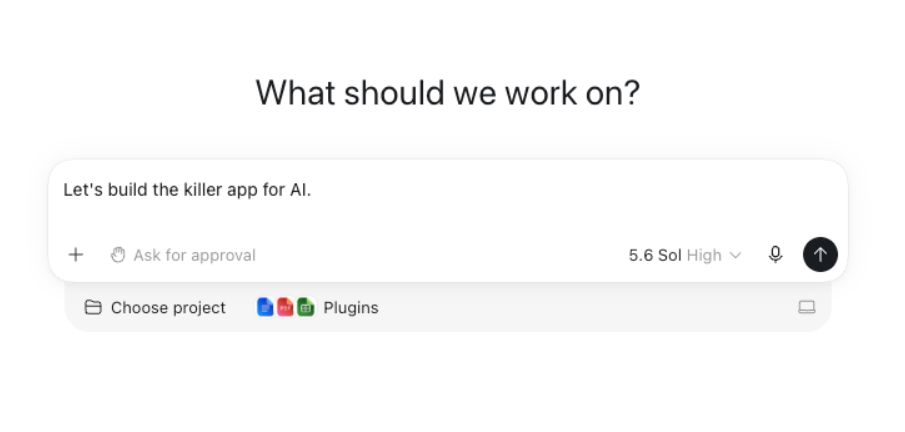
OpenAI is positioning the next stage of ChatGPT not simply as a more capable conversational assistant, but as an operating layer for professional digital work. The company’s strategy is increasingly centered on AI agents that can move beyond generating answers and instead interact with applications, retrieve information, coordinate tasks and execute multi-step workflows on behalf of users.
The shift is embodied in ChatGPT Work, a product derived in large part from the capabilities OpenAI developed for Codex. Rather than limiting agentic AI to software engineers, OpenAI is attempting to make similar autonomous capabilities useful to accountants, investors, operations teams, finance professionals, communications teams and other knowledge workers whose jobs are conducted largely through computers.
The commercial logic behind this strategy is significant. An AI system that only answers occasional questions generates limited usage, while an agent capable of working continuously across multiple applications can consume substantially more model capacity. That creates the possibility of greater value per subscriber while simultaneously opening AI adoption to professional markets far larger than software development alone. OpenAI has therefore been trying to turn agentic AI from a specialist developer product into a general-purpose productivity platform.
The challenge is that professional work is considerably less standardized than programming. A coding task can often be evaluated according to whether the software functions correctly, whereas a business presentation, investment analysis, sales strategy or internal report can involve subjective judgments and outcomes that may not become visible for weeks or months.
This makes the design of the software surrounding the AI model particularly important. OpenAI engineers describe this surrounding layer as a “harness”: the infrastructure that determines what information the model receives, what tools it can access, what permissions it has and how it is expected to execute longer tasks. For developers, command-line interfaces and coding environments already provide this structure. For mainstream users, however, the interaction needs to be considerably more intuitive.
OpenAI’s design challenge is consequently not only about improving model intelligence. It is also about hiding technical complexity from users who should not need to understand APIs, command-line interfaces, permissions systems or tool orchestration before they can benefit from an AI agent.
That explains the importance OpenAI places on interface design. ChatGPT Work maintains a relatively familiar conversational experience while introducing additional controls for projects and integrations. The philosophy is to make sophisticated agentic capabilities accessible through an interface that feels closer to a general-purpose assistant than a technical development environment.
This represents an important branding decision. OpenAI is effectively trying to preserve the simplicity associated with the ChatGPT name while dramatically increasing what the product can do behind the interface. The objective is not to make users feel that they are operating an autonomous software system; it is to make increasingly complex automation feel like a natural extension of asking ChatGPT for help.
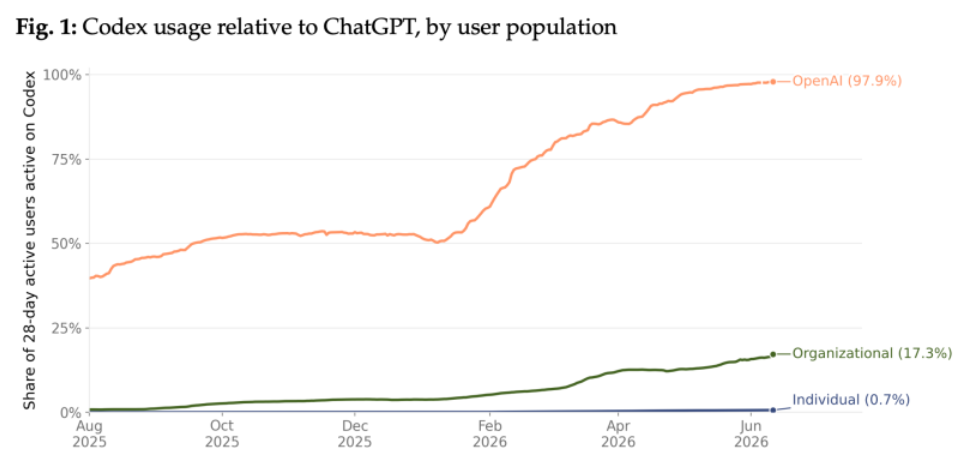
The company’s own adoption data illustrates the scale of the opportunity and the gap that remains. An OpenAI-backed study cited in the report found that 98% of OpenAI employees were using Codex in June, compared with 17% of organizational subscribers and less than 1% of individual subscribers. The contrast highlights a central problem for AI companies: capabilities can become highly valuable inside an organization while remaining difficult for the broader market to discover and incorporate into daily routines.
OpenAI is therefore testing agentic workflows across a wide range of practical activities. Examples include automatically preparing recurring metrics reports, transforming spreadsheets into planning tools, creating dashboards and visualizations, assembling research for investment analysis, organizing information from workplace communication systems and performing repetitive administrative tasks.
The broader value proposition is based on context. Modern workers already have enormous amounts of information distributed across email, calendars, messaging platforms, cloud storage and business applications. The difficulty is often not generating another piece of text, but locating the right information and turning it into an action.
An AI agent capable of operating across these systems could therefore become significantly more useful than a standalone chatbot. Instead of asking a user to copy information between applications, the agent can potentially retrieve the relevant data, interpret it and complete the next steps.
However, the transition also exposes serious usability and trust problems. Connecting an AI system to personal and professional accounts requires users to understand permissions and decide how much access they are willing to grant. Difficulties configuring cloud-storage permissions and differences between what can be done on mobile and web interfaces demonstrate that the technology still has friction at precisely the point where it is supposed to simplify work.
The trust question is even more consequential because an agent with access to email, business systems or financial information has a much greater potential impact than a chatbot that merely generates text. A system that can act is fundamentally different from one that only responds.
Competition is another major part of OpenAI’s strategy. The company is operating in a market where Anthropic’s Claude-based agentic products and specialized platforms such as Harvey and Clay are already targeting specific professional workflows. The comparison is particularly important because OpenAI’s evolution of Codex has been influenced by lessons from competing approaches.
One of those lessons concerns how much autonomy should be delegated to the model. Earlier versions of Codex were designed around the assumption that increasingly capable models could independently complete complex tasks. Claude Code demonstrated the value of a more interactive approach in which the system proposes options, receives user direction and provides continual feedback during execution.
OpenAI subsequently moved toward a more human-centered interaction model. The company argues that its latest models can provide a strong foundation for agentic work, reducing the need for large numbers of manually engineered rules and integrations. In this view, the long-term competitive advantage may come less from an increasingly complicated interface and more from the intelligence of the underlying model and its ability to understand the right context.
That approach also creates a strategic tension. If increasingly capable models can perform tasks with minimal specialized infrastructure, the surrounding “harness” could become less important over time. Yet the harness remains essential today because it determines whether ordinary users can actually access those capabilities.
Cost represents another unresolved issue. Longer-running agents can consume enormous quantities of tokens. In the testing described by TechCrunch, more than 80 million tokens were used over four days, with the model estimating a cost of about $65. Against a $20 monthly subscription, such usage illustrates how aggressively agentic products can consume computational resources.
For OpenAI, the economics therefore depend on two forces moving in opposite directions: agents must deliver enough value to justify higher usage and potentially stronger subscriptions, while model efficiency must improve rapidly enough to prevent computational costs from overwhelming the business model. OpenAI said it is continuing to push efficiency and pointed to an 80% price reduction for users of its Luna model as evidence of that direction.
There is also a strategic question surrounding customer lock-in. The more deeply an AI agent becomes connected to a user’s email, calendar, files, applications and historical context, the more valuable it becomes. But that same integration can make switching platforms increasingly inconvenient. The agent therefore becomes not only a productivity tool but potentially an access layer through which users interact with their broader digital environment.
This may ultimately be the most important part of OpenAI’s agent strategy. The company is not merely competing to build a smarter chatbot. It is attempting to establish ChatGPT as the interface between people and the software systems they already use.
If successful, the economic opportunity extends far beyond coding. Every repetitive workflow, fragmented information source and computer-based coordination task could become part of the addressable market for an AI agent. But achieving that vision requires solving problems that pure model intelligence cannot automatically eliminate: permissions, trust, discoverability, evaluation, cost, usability and the willingness of users to delegate meaningful control.
OpenAI’s strategy therefore represents a broader transition in the AI industry. The competitive question is moving from who can produce the most impressive answer to who can build the most reliable system for turning intelligence into action.
News You Should See
2026 Nobel Medicine Prize Honors Scientists Behind Optogenetics Breakthrough
Oil Prices Edge Lower as Stronger Middle East Exports and G7 Reserves Ease Supply Concerns
Trump Offers U.S. Assistance to Russia After Death at Siberian Plague Research Institute
Trump Takes Economic Message to Nebraska as GOP Faces Rising Cost-of-Living Pressure
U.S. Appeals Court Weighs Trump Administration’s $2.6 Billion Harvard Funding Fight
U.S. Midterm Elections Begin With Resilient Jobs Market and Persistent Cost Pressures
Latest News
The 2026 Nobel Prize in Physiology or Medicine honors Karl Deisseroth, Peter Hegemann and Georg Nagel for pioneering research behind optogenetics and its impact on neuroscience.
Oil prices edged lower as stronger Middle Eastern exports and a planned G7 release of 100 million barrels eased immediate supply concerns, while Gulf security risks and the Strait of Hormuz kept markets alert.
President Donald Trump said the United States would help Russia if needed after a laboratory worker died at a Siberian plague research institute, as Russian authorities imposed precautionary quarantine measures.
Trump’s Nebraska campaign stop highlights rising fuel and grocery costs, beef prices and growing economic pressure on Republicans ahead of the November midterm elections.
A U.S. appeals court is reviewing the Trump administration’s effort to cut Harvard’s federal research funding, with more than $2.6 billion at stake.
The U.S. enters the 2026 midterm elections with unemployment at 4.2%, while higher living and energy costs create economic pressure for households and businesses.
US services growth eased in September as input prices climbed to their highest level since July 2022, with fuel costs, supply-chain disruptions and strong demand increasing pressure on businesses.
Rising Treasury yields are increasing U.S. borrowing costs as Washington manages record debt, persistent inflation and strong economic demand, narrowing its policy options.
A EGP 16 million corporate partnership will establish and equip a bone marrow transplant unit at Cairo’s Coptic Hospital, supporting access to specialized treatment for patients.