NYC Backs AI-Powered Tree Mapping to Target Extreme Heat
A $250,000 City Council investment will combine AI, aerial imagery and climate data to guide neighborhood-level tree planting across New York City.

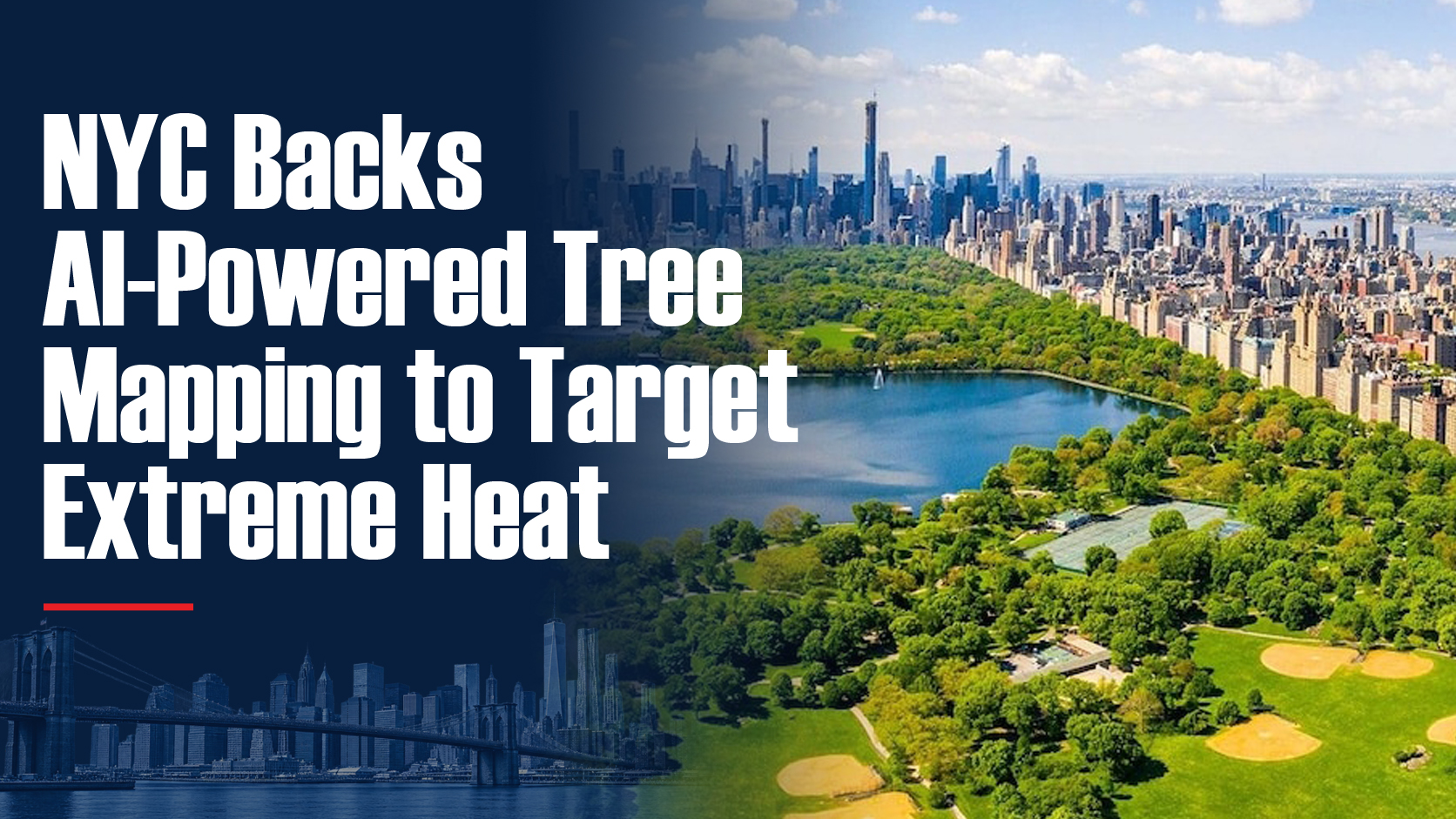
New York City is taking a data-driven approach to one of its increasingly visible climate challenges: extreme urban heat. A $250,000 investment approved by the City Council will support the Generative Canopy Project, an initiative involving Cornell Tech’s Urban Tech Hub and New Yorkers for Parks that aims to make tree planting more targeted, measurable and responsive to neighborhood conditions.
The project reflects a broader shift in how cities can approach green infrastructure. Rather than treating tree planting primarily as a matter of increasing the number of trees, the initiative seeks to determine where each new tree could deliver the greatest cooling and public-health benefit. Researchers will combine artificial intelligence, aerial imagery, existing tree census information, climate forecasting and 3D laser-scanning technology to assess the cooling contribution of individual street trees.
That approach gives policymakers a much more granular picture of the city’s urban canopy. Instead of relying solely on citywide averages, the project is designed to produce block-by-block information that can guide planting decisions. The initial focus will be on Hunts Point and Longwood in the Bronx, East New York in Brooklyn, and Corona and Elmhurst in Queens—areas identified as having both significant canopy shortages and elevated vulnerability to extreme heat.
The timing is closely connected to the growing public-health cost of hotter summers. New York experienced temperatures above 100 degrees in July, the highest level recorded in more than a decade, while heat-related emergencies increased during the period. Three New Yorkers died from heat-related illnesses during the most recent four-day heat wave cited by the City Council.
For the organizations involved, the project also represents a test of whether advanced technology can translate into practical improvements at the neighborhood level. Cornell Tech is moving research beyond the laboratory and into communities, while New Yorkers for Parks will help connect the technical work with residents and local engagement. The project includes an online dashboard, public tracking tools and community workshops, creating a structure in which residents can contribute to local planting strategies rather than simply receive decisions made elsewhere.
The economic dimension is equally significant. Urban trees are increasingly viewed not only as environmental assets but as part of resilient city infrastructure. More effective canopy planning can potentially reduce exposure to heat, improve air quality and strengthen the livability of neighborhoods that have historically received fewer green investments. By directing resources toward locations where the expected impact is highest, data-based planning could also make public spending on urban infrastructure more efficient.
The initiative carries an important equity component. City officials cited substantial disparities in tree coverage between different parts of New York, with some communities facing considerably greater exposure to heat and pollution. The project therefore positions technology as a mechanism for addressing uneven infrastructure investment, rather than simply as a tool for environmental monitoring.
There is also a strategic institutional dimension. The City Council’s investment marks its first funding commitment to Cornell Tech, strengthening a relationship between municipal government, academic research and community organizations. The partnership demonstrates how public institutions can use specialized research capabilities to address problems that require both technical expertise and local knowledge.
The longer-term ambition is to turn the project into a model that could extend beyond the three initial areas and potentially inform other cities dealing with heat, air pollution and unequal access to green infrastructure. Its success will ultimately depend not only on the sophistication of its mapping technology, but on whether the resulting data leads to sustained planting, maintenance and community participation.
New York’s experiment therefore points to a larger development in urban policy: climate resilience is increasingly becoming a data problem as well as an infrastructure problem. If the Generative Canopy Project can successfully connect precise environmental modeling with public investment and neighborhood decision-making, it could offer a practical framework for making urban climate strategies more targeted, transparent and effective.
News You Should See
2026 Nobel Medicine Prize Honors Scientists Behind Optogenetics Breakthrough
Oil Prices Edge Lower as Stronger Middle East Exports and G7 Reserves Ease Supply Concerns
Trump Offers U.S. Assistance to Russia After Death at Siberian Plague Research Institute
Trump Takes Economic Message to Nebraska as GOP Faces Rising Cost-of-Living Pressure
U.S. Appeals Court Weighs Trump Administration’s $2.6 Billion Harvard Funding Fight
U.S. Midterm Elections Begin With Resilient Jobs Market and Persistent Cost Pressures
Latest News
The 2026 Nobel Prize in Physiology or Medicine honors Karl Deisseroth, Peter Hegemann and Georg Nagel for pioneering research behind optogenetics and its impact on neuroscience.
Oil prices edged lower as stronger Middle Eastern exports and a planned G7 release of 100 million barrels eased immediate supply concerns, while Gulf security risks and the Strait of Hormuz kept markets alert.
President Donald Trump said the United States would help Russia if needed after a laboratory worker died at a Siberian plague research institute, as Russian authorities imposed precautionary quarantine measures.
Trump’s Nebraska campaign stop highlights rising fuel and grocery costs, beef prices and growing economic pressure on Republicans ahead of the November midterm elections.
A U.S. appeals court is reviewing the Trump administration’s effort to cut Harvard’s federal research funding, with more than $2.6 billion at stake.
The U.S. enters the 2026 midterm elections with unemployment at 4.2%, while higher living and energy costs create economic pressure for households and businesses.
US services growth eased in September as input prices climbed to their highest level since July 2022, with fuel costs, supply-chain disruptions and strong demand increasing pressure on businesses.
Rising Treasury yields are increasing U.S. borrowing costs as Washington manages record debt, persistent inflation and strong economic demand, narrowing its policy options.
A EGP 16 million corporate partnership will establish and equip a bone marrow transplant unit at Cairo’s Coptic Hospital, supporting access to specialized treatment for patients.