Newark Liberty Airport Enters a New Era With a Multibillion-Dollar Transformation
Terminal A, a new AirTrain system and long-term airport planning are reshaping EWR into a more efficient regional gateway for New York and New Jersey.

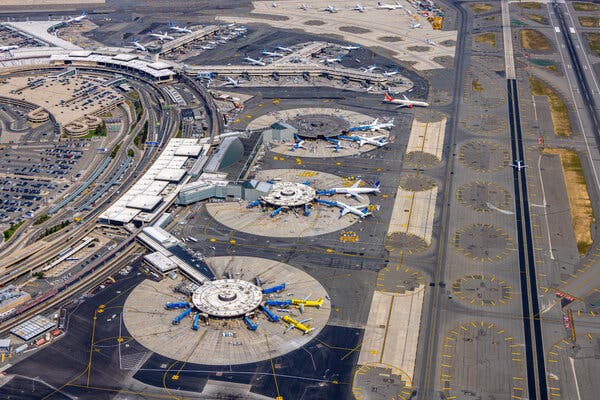
Newark Liberty International Airport is undergoing a long-term transformation designed to reposition one of the New York and New Jersey region’s major aviation gateways for the next generation of passenger growth. Rather than treating individual infrastructure projects as isolated upgrades, the redevelopment is being structured as an integrated airport strategy that combines terminals, rail connectivity, roadways, aircraft movement infrastructure and community access.
The transformation began to take visible shape with the opening of the new Terminal A in 2023. The $2.7 billion facility replaced the previous terminal, which had opened in 1973, and established a new benchmark for passenger experience at Newark Liberty. Covering approximately 1 million square feet and featuring 33 gates, the terminal combines modern digital technology, upgraded passenger amenities, dining and retail facilities, and public art featuring local artists.
Its significance extends beyond its physical scale. Terminal A serves as the first major component of a broader repositioning strategy aimed at turning Newark Liberty into a world-class gateway for the New York and New Jersey region. Its LEED Gold-oriented design also reflects the growing importance of sustainability in large transportation infrastructure projects.
The need for such investment is closely connected to the airport’s economic role. Newark Liberty handled a record 49.1 million passengers in 2023, underscoring the pressure on existing infrastructure and the need for additional capacity. The airport contributes more than $29.3 billion annually to the regional economy and supports approximately 137,000 regional jobs, while around 23,000 people work directly at the airport across sectors including logistics, tourism, retail and hospitality.
The next major stage is the replacement of the existing AirTrain Newark. The Port Authority began construction of the new system in October 2025, marking a $3.5 billion investment in a modern automated people mover. The new AirTrain will cover 2.5 miles and is designed to replace infrastructure that has become outdated and increasingly constrained by airport growth.
The project is also a response to projected demand. The existing system carries roughly 33,000 passengers and employees each day, or approximately 12 million annually, while ridership is forecast to increase by 50 percent by 2040. The new system is expected to begin operations in 2030 and will connect airport terminals with regional transportation links, parking facilities and rental-car operations more efficiently.
Beyond mobility, the AirTrain investment has an economic dimension. The project is expected to generate approximately 1,380 job years, $125 million in direct wages and nearly $300 million in economic activity over its life. The Port Authority has also incorporated opportunities for local and minority-, women- and disadvantaged-business enterprises into the broader project delivery strategy.
The redevelopment is not limited to the airport’s internal infrastructure. The EWR Vision Plan represents a longer-term blueprint extending through 2065 and seeks to align airport capacity with anticipated changes in aviation, passenger demand and regional development.
A central element of the plan is the development of additional modern terminal capacity. Future plans envision replacing the existing Terminal B with a new international terminal while enhancing Terminal C. Together with Terminal A, the future terminals are intended to provide additional capacity while creating more efficient passenger flows and leaving room for continued expansion.
The airside infrastructure is also targeted for redesign. A more efficient taxiway network is intended to accommodate larger aircraft, increase aircraft parking capacity and reduce operational delays. Additional redundancy and deicing capabilities are designed to make the airport more resilient during irregular operations while improving the movement of aircraft between gates and runways.
Ground transportation represents another strategic pillar. The EWR Station Access project is designed to improve connections between Newark and Elizabeth communities and the airport, particularly for underserved areas. By providing a new public access point and pedestrian connection at the Newark Airport Rail Link station, the project is expected to reduce travel times between the airport and Newark Penn Station from roughly 40 minutes to less than 10 minutes for affected trips.
That connectivity has implications beyond convenience. Better access to the airport can broaden the labor pool available to businesses operating at and around EWR, improve access to employment for neighboring communities and strengthen the airport’s relationship with the regional transportation network.
The redevelopment therefore represents a shift in how Newark Liberty is positioned economically and institutionally. The objective is not simply to build newer facilities, but to create an airport system capable of supporting higher passenger volumes while reducing congestion, improving reliability and strengthening the overall customer experience from curb to gate.
The scale and sequencing of the investment also reflect the competitive environment among major airports serving the New York metropolitan area. With LaGuardia and JFK undergoing major modernization efforts, Newark Liberty’s transformation is increasingly important to the Port Authority’s broader regional infrastructure strategy. A modern terminal alone would not be sufficient; competitiveness depends on the quality of the entire passenger journey, including surface access, internal transportation and operational efficiency.
The long-term vision also places greater emphasis on community participation and economic inclusion. The planning process incorporated extensive engagement with airport tenants, operational partners and the public, while individual projects include programs intended to expand opportunities for local businesses and workers.
If the projects proceed according to plan, Newark Liberty will gradually move from a collection of aging and newly modernized components toward a more unified airport ecosystem. Terminal A has established the initial benchmark, the new AirTrain is intended to improve internal connectivity, station access will strengthen regional mobility, and future terminal and airside projects are expected to provide the capacity required for long-term growth.
The broader economic logic is clear: as passenger demand expands, infrastructure quality becomes increasingly important to an airport’s ability to generate regional value. Newark Liberty’s redevelopment is therefore not simply an aviation project. It is a long-term investment in transportation capacity, economic competitiveness, employment and the region’s position as an international gateway.
News You Should See
2026 Nobel Medicine Prize Honors Scientists Behind Optogenetics Breakthrough
Oil Prices Edge Lower as Stronger Middle East Exports and G7 Reserves Ease Supply Concerns
Trump Offers U.S. Assistance to Russia After Death at Siberian Plague Research Institute
Trump Takes Economic Message to Nebraska as GOP Faces Rising Cost-of-Living Pressure
U.S. Appeals Court Weighs Trump Administration’s $2.6 Billion Harvard Funding Fight
U.S. Midterm Elections Begin With Resilient Jobs Market and Persistent Cost Pressures
Latest News
The 2026 Nobel Prize in Physiology or Medicine honors Karl Deisseroth, Peter Hegemann and Georg Nagel for pioneering research behind optogenetics and its impact on neuroscience.
Oil prices edged lower as stronger Middle Eastern exports and a planned G7 release of 100 million barrels eased immediate supply concerns, while Gulf security risks and the Strait of Hormuz kept markets alert.
President Donald Trump said the United States would help Russia if needed after a laboratory worker died at a Siberian plague research institute, as Russian authorities imposed precautionary quarantine measures.
Trump’s Nebraska campaign stop highlights rising fuel and grocery costs, beef prices and growing economic pressure on Republicans ahead of the November midterm elections.
A U.S. appeals court is reviewing the Trump administration’s effort to cut Harvard’s federal research funding, with more than $2.6 billion at stake.
The U.S. enters the 2026 midterm elections with unemployment at 4.2%, while higher living and energy costs create economic pressure for households and businesses.
US services growth eased in September as input prices climbed to their highest level since July 2022, with fuel costs, supply-chain disruptions and strong demand increasing pressure on businesses.
Rising Treasury yields are increasing U.S. borrowing costs as Washington manages record debt, persistent inflation and strong economic demand, narrowing its policy options.
A EGP 16 million corporate partnership will establish and equip a bone marrow transplant unit at Cairo’s Coptic Hospital, supporting access to specialized treatment for patients.