MTA Speed Cameras Begin Issuing Fines in NYC Bridge and Tunnel Work Zones
New York’s MTA has activated automated speed enforcement across designated bridge and tunnel work zones, introducing escalating fines while keeping violations outside the moving-offense and insurance-point system.

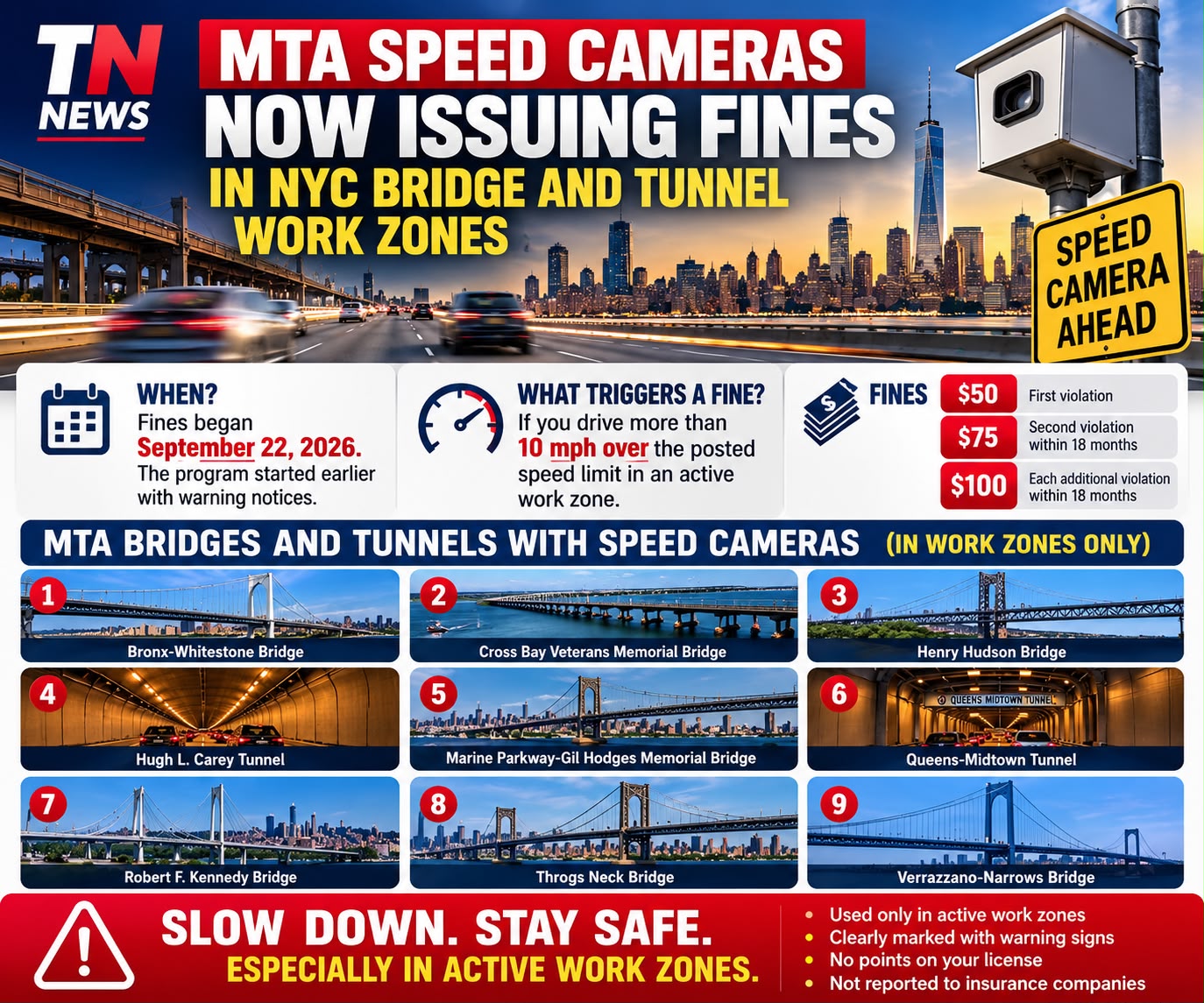
New York’s Metropolitan Transportation Authority has moved from warning drivers about speeding in bridge and tunnel construction areas to actively enforcing the rules, marking a broader shift toward automated safety management across the city’s transportation infrastructure.
Since September 22, 2026, vehicles recorded traveling more than 10 mph above the posted speed limit in designated active construction or maintenance zones have been subject to automated violations. The policy applies across all nine MTA bridge and tunnel facilities, putting speeding enforcement directly into environments where road conditions can change quickly because of maintenance activity, lane restrictions and the presence of workers.
The financial structure of the program is deliberately progressive. A first violation carries a $50 fine, while a second violation within 18 months rises to $75. Each additional violation during the same period carries a $100 penalty. Although the escalating structure increases the cost of repeated non-compliance, the violations remain classified as non-moving infractions. Drivers therefore do not receive license points, and the violations are not reported to insurance companies.
From a transportation-management perspective, the significance of the initiative extends beyond the size of the fines. Work zones create a more complicated operating environment than ordinary road sections, making speed control an important part of protecting both construction personnel and motorists. By relying on automated detection, the MTA can maintain enforcement in designated areas without requiring traffic officers to monitor every work zone continuously.
The program also establishes limits intended to make enforcement predictable. Cameras are restricted to active work zones rather than being used throughout MTA facilities, and warning signs must be installed before drivers enter an enforcement area. This distinction is important because it ties the technology to a clearly defined safety purpose rather than treating automated cameras as a general-purpose speed monitoring system.
The initiative covers major crossings and tunnels, including the Verrazzano-Narrows Bridge, Throgs Neck Bridge, Bronx-Whitestone Bridge, RFK Bridge, Queens-Midtown Tunnel and Hugh L. Carey Tunnel. With these facilities handling substantial daily traffic, even a targeted enforcement program can affect a large number of motorists and create a stronger incentive for drivers to adjust their behavior around active work areas.
For the MTA, the policy also reflects a broader institutional priority: using technology to manage risk around critical transportation assets. The economic value of the approach lies less in collecting fines than in reducing the likelihood of crashes, injuries, work disruptions and delays associated with unsafe driving around construction activity.
The effectiveness of the program will ultimately depend on whether drivers respond to the presence of cameras by slowing down before entering marked work zones. If compliance improves, automated enforcement could become an increasingly important component of how major transportation agencies balance infrastructure maintenance, worker safety and uninterrupted mobility in densely traveled urban corridors.
News You Should See
2026 Nobel Medicine Prize Honors Scientists Behind Optogenetics Breakthrough
Oil Prices Edge Lower as Stronger Middle East Exports and G7 Reserves Ease Supply Concerns
Trump Offers U.S. Assistance to Russia After Death at Siberian Plague Research Institute
Trump Takes Economic Message to Nebraska as GOP Faces Rising Cost-of-Living Pressure
U.S. Appeals Court Weighs Trump Administration’s $2.6 Billion Harvard Funding Fight
U.S. Midterm Elections Begin With Resilient Jobs Market and Persistent Cost Pressures
Latest News
The 2026 Nobel Prize in Physiology or Medicine honors Karl Deisseroth, Peter Hegemann and Georg Nagel for pioneering research behind optogenetics and its impact on neuroscience.
Oil prices edged lower as stronger Middle Eastern exports and a planned G7 release of 100 million barrels eased immediate supply concerns, while Gulf security risks and the Strait of Hormuz kept markets alert.
President Donald Trump said the United States would help Russia if needed after a laboratory worker died at a Siberian plague research institute, as Russian authorities imposed precautionary quarantine measures.
Trump’s Nebraska campaign stop highlights rising fuel and grocery costs, beef prices and growing economic pressure on Republicans ahead of the November midterm elections.
A U.S. appeals court is reviewing the Trump administration’s effort to cut Harvard’s federal research funding, with more than $2.6 billion at stake.
The U.S. enters the 2026 midterm elections with unemployment at 4.2%, while higher living and energy costs create economic pressure for households and businesses.
US services growth eased in September as input prices climbed to their highest level since July 2022, with fuel costs, supply-chain disruptions and strong demand increasing pressure on businesses.
Rising Treasury yields are increasing U.S. borrowing costs as Washington manages record debt, persistent inflation and strong economic demand, narrowing its policy options.
A EGP 16 million corporate partnership will establish and equip a bone marrow transplant unit at Cairo’s Coptic Hospital, supporting access to specialized treatment for patients.