Meta Expands AI-Powered Game Creation With Pocket App
The new app turns AI prompts into interactive games and social experiences, strengthening Meta’s strategy to make AI creation accessible to mainstream users.

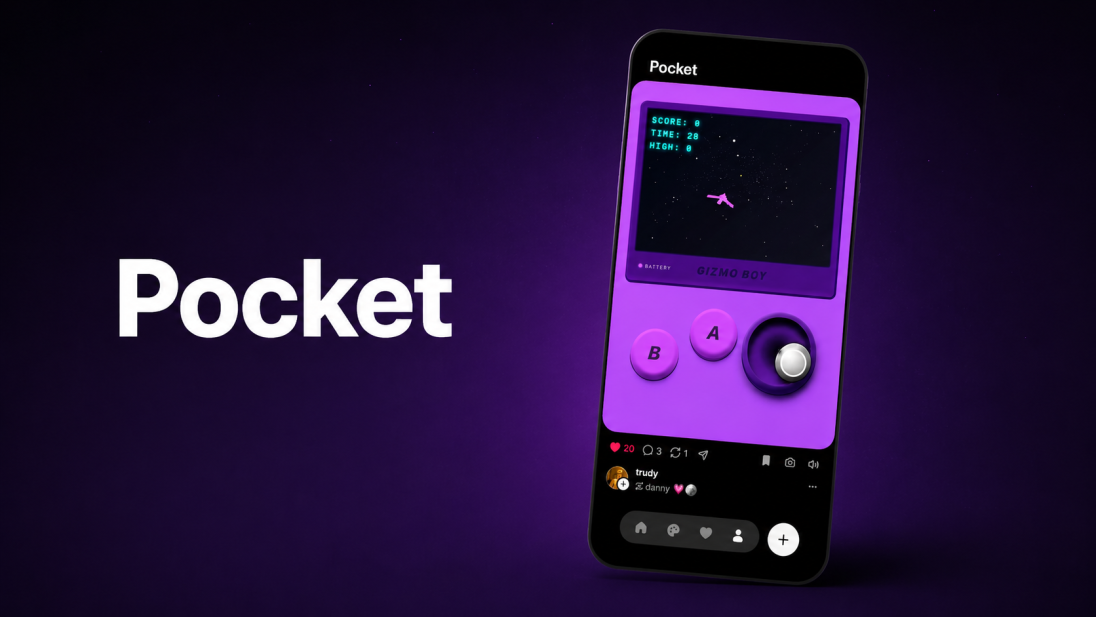
Meta is taking another step toward making artificial intelligence a mainstream creative tool with the U.S. expansion of Pocket, an experimental mobile application designed to let users create and share interactive games through simple AI prompts. The move places game creation inside a social-media-style environment, potentially lowering the technical barrier that has traditionally separated game developers from ordinary mobile users.
Pocket allows users to describe an idea and turn it into a small interactive experience without requiring conventional game-development skills. Meta refers to these creations as “gizmos,” and they can respond to touch and phone movement, include sound effects and incorporate music clips. Users can also bring elements from their own camera rolls or use their device cameras as part of the experience.
The product's significance lies in the combination of AI generation, mobile interaction and social distribution. Rather than treating AI creation as a standalone productivity feature, Pocket connects creation directly with discovery and sharing. Games can be published to a scrolling feed, while other users can save, repost or remix them into new creations. This structure gives Meta an opportunity to turn AI-generated content into a continuously evolving social ecosystem rather than a collection of isolated outputs.
Pocket was first introduced quietly in Brazil as a test market before expanding to users across the United States. Its development follows Meta's acquisition of the team behind Gizmo, the AI-powered gaming platform developed by Atma Sciences. With the launch of Pocket, Meta is also discontinuing the original Gizmo application, effectively bringing the acquired technology and team into a broader product strategy under its own brand.
From a competitive standpoint, the launch reflects a broader shift in the technology industry toward AI-assisted creation. The traditional gaming market depends heavily on specialized skills, development tools and production resources. By allowing users to create functioning interactive experiences through natural-language prompts, Meta is testing whether AI can transform game development from a specialist activity into a form of everyday digital expression.
That approach could also strengthen Meta's position in the competition for users' attention. A successful Pocket ecosystem would not simply generate games; it could generate a steady stream of personalized content that users create, consume and modify within the same environment. The more users participate, the greater the potential volume of content available for Meta's recommendation systems to distribute.
This strategy is consistent with Meta's broader effort to accelerate the development of standalone applications. The company has recently launched or experimented with several independent products, including Instagram Instants, Forum for Groups and Seller for Marketplace, alongside other AI-focused applications and experiments. Meta CEO Mark Zuckerberg has attributed the company's ability to develop and release more products partly to AI-enabled software development, arguing that AI is making it easier to test and ship new ideas.
The commercial importance of this approach extends beyond any individual application. Faster product development allows Meta to run more experiments, identify emerging consumer behaviors and allocate resources toward concepts that gain traction. AI therefore becomes both a product category and an internal business capability, potentially reducing the cost and time required to move an idea from experimentation to public release.
Pocket also represents a branding opportunity. By placing AI-powered creation inside an accessible entertainment product, Meta can position artificial intelligence not only as a technical technology but as part of everyday consumer behavior. This may help the company normalize AI-generated experiences among users who have little interest in traditional programming or generative-AI tools.
However, the product's long-term success will depend on more than the novelty of AI-generated games. Meta will need to maintain quality, encourage meaningful creation and prevent the social feed from becoming overwhelmed by repetitive or low-value content. The company's recommendation infrastructure could become an important competitive advantage if it can identify compelling creations and deliver them efficiently to users.
The launch also highlights how Meta is increasingly using acquisitions, AI-assisted development and rapid experimentation as complementary components of its product strategy. Instead of relying exclusively on a small number of flagship platforms, the company is creating a wider portfolio of applications designed to test new behaviors and technologies.
Pocket's U.S. expansion therefore represents a strategic experiment with implications beyond gaming. If users adopt AI-generated interactive experiences as a new form of social content, Meta could gain a new category through which creativity, entertainment and recommendation technology intersect. If adoption remains limited, the company can still use the experiment to refine its understanding of how consumers want to interact with AI.
The broader market implication is that AI is gradually moving from generating static text, images and videos toward creating interactive digital environments. Pocket places Meta directly inside that transition, testing whether the next stage of consumer AI will be something users simply watch or read—or something they actively build, remix and share.
News You Should See
2026 Nobel Medicine Prize Honors Scientists Behind Optogenetics Breakthrough
Oil Prices Edge Lower as Stronger Middle East Exports and G7 Reserves Ease Supply Concerns
Trump Offers U.S. Assistance to Russia After Death at Siberian Plague Research Institute
Trump Takes Economic Message to Nebraska as GOP Faces Rising Cost-of-Living Pressure
U.S. Appeals Court Weighs Trump Administration’s $2.6 Billion Harvard Funding Fight
U.S. Midterm Elections Begin With Resilient Jobs Market and Persistent Cost Pressures
Latest News
The 2026 Nobel Prize in Physiology or Medicine honors Karl Deisseroth, Peter Hegemann and Georg Nagel for pioneering research behind optogenetics and its impact on neuroscience.
Oil prices edged lower as stronger Middle Eastern exports and a planned G7 release of 100 million barrels eased immediate supply concerns, while Gulf security risks and the Strait of Hormuz kept markets alert.
President Donald Trump said the United States would help Russia if needed after a laboratory worker died at a Siberian plague research institute, as Russian authorities imposed precautionary quarantine measures.
Trump’s Nebraska campaign stop highlights rising fuel and grocery costs, beef prices and growing economic pressure on Republicans ahead of the November midterm elections.
A U.S. appeals court is reviewing the Trump administration’s effort to cut Harvard’s federal research funding, with more than $2.6 billion at stake.
The U.S. enters the 2026 midterm elections with unemployment at 4.2%, while higher living and energy costs create economic pressure for households and businesses.
US services growth eased in September as input prices climbed to their highest level since July 2022, with fuel costs, supply-chain disruptions and strong demand increasing pressure on businesses.
Rising Treasury yields are increasing U.S. borrowing costs as Washington manages record debt, persistent inflation and strong economic demand, narrowing its policy options.
A EGP 16 million corporate partnership will establish and equip a bone marrow transplant unit at Cairo’s Coptic Hospital, supporting access to specialized treatment for patients.