Maven Robotics Builds Its Industrial Strategy Around Solving the Job, Not Selling the Robot
After raising $100 million, Maven Robotics is betting that end-to-end automation, wheeled humanoid-style machines, and measurable ROI can outperform the race to build increasingly complex general-purpose robots.

Maven Robotics is entering the increasingly competitive robotics market with a strategy that challenges one of the industry's most common assumptions: that the path to commercial success begins with building the most advanced robot possible. The company, which has emerged from stealth after raising $100 million, is instead focusing on a different proposition. Rather than selling customers a machine and asking them to adapt their operations around it, Maven wants to begin with an industrial problem and take responsibility for solving the workflow from end to end. The approach has already helped the startup secure a major customer deployment despite competing against established robotics companies that already had working products in the market. For Maven, the robot is not intended to be the final product. The value proposition is the completed task, the operational result, and ultimately the economic return delivered to the customer.
The company's strategy began to take shape in 2024, when Maven was still a new venture with little more than what CEO and co-founder Hamza Derbas described as a team and a cartoon representation of a robot. At the time, a large consumer goods company with significant logistics requirements was visiting the area to meet with four competing robotics businesses about potential automation projects. Derbas managed to secure Maven a meeting, but instead of presenting an ambitious vision for the future of robotics, the startup asked to visit the company's factories and warehouses. The team observed how employees worked and studied the operational flows where automation could create immediate value. Maven then presented an approach centered not on solving a single robotic challenge, but on connecting an autonomous system directly to the customer's broader workflow, from warehouse management systems on one side to finished products moving onto trucks on the other.
That approach helped Maven win the deployment despite competing against companies with existing robots. After approximately two years of working with that customer and several other partners, Derbas says the company has deployed as many as eight robots operating for 16 hours per day while maintaining uptime of 99% or higher. The result gives Maven something particularly valuable in the current robotics market: real-world operating data and evidence that its systems can function consistently inside industrial environments rather than only in controlled demonstrations.
The startup has now emerged from stealth with $100 million in funding from RoboStrategy, LocalGlobe, Vine Ventures, and XTX Markets Ventures. Maven plans to use the capital to build 250 units of its third-generation robot while also beginning design work on a fourth-generation platform. The funding represents a major step for a company that has built its early identity around industrial deployment rather than public demonstrations or speculative promises about fully general-purpose humanoid machines.
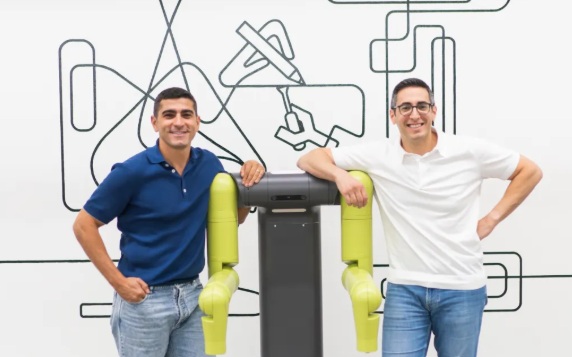
Maven's current robots are built around wheeled mobile bases and feature two robotic arms capable of lifting up to 30 kilograms. The machines can move at speeds of up to 10 miles per hour and are designed primarily for industrial environments. Their central task today is mixed palletizing, a process in which goods arriving from different factories are reorganized at a distribution center into new pallets containing different combinations of products destined for retail stores. These combinations may need to change rapidly in response to real-time demand, creating a workflow that currently depends heavily on human workers moving through warehouses to select and arrange individual products.
The mixed palletizing use case illustrates the company's broader product philosophy. Maven is not attempting to build a robot capable of doing everything immediately. Instead, it is targeting a specific industrial problem where automation can produce measurable value. In the company's Santa Clara facility, the robots use vacuum-based gripping systems to pick up and arrange boxes, while live video feeds show machines operating inside customer facilities alongside human employees. The emphasis on real deployments is important because industrial robotics is often evaluated not only by technical capability but by reliability, integration, safety, maintenance requirements, and the financial return generated over time.
Derbas brings an engineering background that influences this approach. He spent his career in automotive engineering with a focus on electric vehicles before spending nine years at Apple working within the company's special projects group. Although he did not discuss the specific work undertaken there, the group has widely been associated with Apple's former autonomous vehicle effort. When that program was disbanded in 2024, Derbas founded Maven with his brother Khalid Derbas, who serves as the company's CFO after working in private equity. Their combined backgrounds bring together automotive engineering, autonomous systems, industrial technology, and financial experience.
Like many companies working in physical artificial intelligence, Maven is also benefiting from expertise developed during the evolution of self-driving vehicles. Autonomous vehicle programs created some of the most sophisticated systems for training machines using large volumes of real-world data, and Maven is applying similar principles to robotics. The company requires data pipelines capable of returning information from operating robots within minutes or hours, allowing teams to retrain systems, evaluate performance, conduct ablation studies, determine appropriate model weights, redeploy updated software, and repeat the process continuously. This feedback loop is becoming a central part of how physical AI companies improve their products once robots enter real operational environments.
In a crowded robotics market, Maven believes its advantage comes from its understanding of industrial systems rather than a culture focused primarily on robotics research or a specific technical architecture. Jack Pearson, an investor at RoboStrategy, has pointed to the company's industrial background as an important differentiator. This distinction reflects a larger divide emerging across the robotics industry. Some companies are pursuing increasingly general intelligence and broad capabilities, hoping that advances in foundation models will eventually allow robots to perform many different tasks. Others are focusing on narrower but commercially valuable workflows, using real deployments to generate revenue and collect the data needed to expand capabilities over time.
Maven clearly belongs to the second group, at least in its current strategy. The company describes itself as a developer of general-purpose robots, but its route toward that objective is deliberately incremental. Rather than attempting to solve general-purpose robotics in a single step, Maven plans to move from one significant industrial task to another. The company argues that each large operational problem can represent a multibillion-dollar market and can also generate the real-world data necessary to improve robotic capabilities.
This philosophy also shapes Maven's hardware design. One of the company's closest competitors in terms of industrial positioning may be Agility Robotics, which is focused on safety and specific industrial workflows and is preparing to go public through a $2.5 billion SPAC transaction. However, Agility's Digit robots move on two legs, while Maven has chosen wheeled platforms. Derbas has argued that humanoid legs create unnecessary complexity, reliability challenges, and additional costs for many industrial environments. His view is based on a simple economic principle: if the job can be completed more effectively with wheels, adding legs may increase technical sophistication without improving the customer's return on investment.
That perspective goes directly to the center of Maven's brand identity. In an industry where humanoid robots have become powerful symbols of technological ambition, the company is positioning itself around operational pragmatism. Its message is that the most impressive robot is not necessarily the most valuable one. For an industrial customer, the important questions are whether the machine can operate reliably, integrate with existing systems, reduce labor pressure, and generate a positive financial return.
This makes return on investment a central design principle rather than a final business calculation. Hardware decisions, software architecture, mobility systems, manipulation capabilities, deployment models, and workflow integration are all evaluated through the lens of whether they create measurable value for customers. Maven's decision to use wheeled robots therefore reflects more than an engineering preference. It is part of a larger strategy that treats cost, reliability, and industrial efficiency as core components of product design.
The company's focus on industrial realities may also help it avoid one of the biggest challenges facing general-purpose robotics. Robots that demonstrate impressive capabilities in research environments often face a much more difficult test when introduced into real facilities. Warehouses can be hot, crowded, unpredictable, and constantly changing. Products vary in size, shape, weight, and packaging. Human employees move around the machines. Existing software systems may be old or highly customized. Downtime can have immediate financial consequences.
For Maven, successful deployment therefore requires more than computer vision or advanced manipulation. The company must build systems that can operate inside the full complexity of an industrial business. This includes connecting robots to warehouse management software, monitoring performance, collecting data, maintaining uptime, and adapting to the specific needs of individual customers. The company's early success in winning a deployment before having an established robot product suggests that its ability to understand the complete workflow may be as commercially important as the machine itself.
The current palletizing market alone could represent an opportunity worth approximately $80 billion, according to the company's assessment. However, Maven does not intend to remain focused on one workflow. Its next major effort is to collect more data and train robots to handle a wider range of materials before moving toward automation and fabrication tasks. Some of these future applications will require manipulation capabilities that do not yet exist at the level Maven needs for commercial deployment.
To address this challenge, the company plans to use multiple sources of training data, including information generated through its own systems and data obtained from third-party providers. Maven has also developed a pair of pincer-like gloves that allow human operators to mimic the type of gripper configuration the company wants its robots to use. This creates another connection between human behavior and machine learning, allowing physical movements to potentially become part of the data used to train robotic systems.
The strategy reflects a broader trend in physical AI, where data is becoming one of the most valuable assets in the development process. The more robots operate in real environments, the more information companies can collect about objects, movements, errors, unexpected situations, and successful task completion. That information can then be used to improve models and hardware. Maven's task-by-task approach is designed to create this cycle: solve a commercially valuable problem, deploy robots, collect real-world data, improve capabilities, and use the resulting knowledge to expand into additional tasks.
The model also offers an economic advantage over spending years developing a fully general robot before generating meaningful revenue. By targeting large industrial problems individually, Maven can potentially build a business while simultaneously creating the technical foundation for broader capabilities. Each deployment becomes both a source of income and a source of training data. Each solved workflow can improve the company's understanding of robotic manipulation in real environments.
However, this strategy also carries risks. Robotics is advancing rapidly, and companies developing powerful physical AI models could potentially create systems capable of performing multiple tasks without requiring the same level of task-specific development. Maven's incremental approach could therefore face pressure if a major breakthrough allows competitors to deploy more flexible robots at scale. The company is effectively betting that solving real industrial problems and building deep operational knowledge will remain valuable even as robotics models become more capable.
Maven's response to this challenge is clear: it does not consider itself to be competing primarily in a race to produce the most advanced AI model. Instead, the company sees its competition as a race to solve industrial labor problems and make automation work at the scale required by the global economy. This positioning separates the company from businesses focused primarily on research milestones and places greater emphasis on deployment, reliability, and measurable outcomes.
From an economic perspective, this could become one of the most important strategic distinctions in the robotics market. The industry has attracted enormous investment around humanoid robots and physical AI, but large-scale commercial success will ultimately depend on whether companies can demonstrate that automation creates more value than it costs. Businesses deploying robots need to calculate not only the purchase price of a machine but also installation, maintenance, software integration, training, energy consumption, downtime, and operational support.
Maven is attempting to build its entire product around this calculation. Its focus on wheeled platforms, specific workflows, end-to-end integration, rapid data feedback, and industrial reliability represents an effort to reduce the gap between technological capability and commercial adoption. Instead of asking customers to imagine how robots might transform their business in the future, the company begins with existing operations and searches for places where automation can create immediate value.
The $100 million funding round now gives Maven the resources to test whether this strategy can scale. Building 250 third-generation robots will require the company to move from relatively limited deployments toward a more substantial manufacturing and operational model. Designing a fourth-generation platform at the same time will add another layer of technical complexity. The company will need to maintain its focus on customer problems while also developing the research and engineering capabilities necessary to expand beyond its current tasks.
The larger significance of Maven's strategy lies in what it says about the direction of commercial robotics. The market may not ultimately be won by a single type of robot or a single approach to artificial intelligence. Some applications may require humanoid machines, while others may benefit from wheels, specialized hardware, or entirely different form factors. The key question for industrial customers is likely to remain more practical: what system can complete the required task reliably and economically?
Maven Robotics is building its identity around that question. Its robots are designed not as futuristic symbols but as tools intended to fit into existing industrial systems and remove specific operational constraints. The company's approach suggests that the path toward general-purpose robotics may not begin with trying to solve every possible problem at once. Instead, it may emerge from solving one valuable problem after another, building data, trust, technical knowledge, and commercial relationships along the way.
With $100 million in new funding and plans to expand production, Maven now faces the challenge of proving that its philosophy can move beyond early deployments. If successful, the company could demonstrate that the future of robotics is not defined only by how human a robot looks or how broad its capabilities appear in a demonstration. It may instead be defined by how effectively machines can enter existing workplaces, integrate with real systems, deliver measurable returns, and solve the labor challenges that businesses are already willing to pay to address.
News You Should See
2026 Nobel Medicine Prize Honors Scientists Behind Optogenetics Breakthrough
Oil Prices Edge Lower as Stronger Middle East Exports and G7 Reserves Ease Supply Concerns
Trump Offers U.S. Assistance to Russia After Death at Siberian Plague Research Institute
Trump Takes Economic Message to Nebraska as GOP Faces Rising Cost-of-Living Pressure
U.S. Appeals Court Weighs Trump Administration’s $2.6 Billion Harvard Funding Fight
U.S. Midterm Elections Begin With Resilient Jobs Market and Persistent Cost Pressures
Latest News
The 2026 Nobel Prize in Physiology or Medicine honors Karl Deisseroth, Peter Hegemann and Georg Nagel for pioneering research behind optogenetics and its impact on neuroscience.
Oil prices edged lower as stronger Middle Eastern exports and a planned G7 release of 100 million barrels eased immediate supply concerns, while Gulf security risks and the Strait of Hormuz kept markets alert.
President Donald Trump said the United States would help Russia if needed after a laboratory worker died at a Siberian plague research institute, as Russian authorities imposed precautionary quarantine measures.
Trump’s Nebraska campaign stop highlights rising fuel and grocery costs, beef prices and growing economic pressure on Republicans ahead of the November midterm elections.
A U.S. appeals court is reviewing the Trump administration’s effort to cut Harvard’s federal research funding, with more than $2.6 billion at stake.
The U.S. enters the 2026 midterm elections with unemployment at 4.2%, while higher living and energy costs create economic pressure for households and businesses.
US services growth eased in September as input prices climbed to their highest level since July 2022, with fuel costs, supply-chain disruptions and strong demand increasing pressure on businesses.
Rising Treasury yields are increasing U.S. borrowing costs as Washington manages record debt, persistent inflation and strong economic demand, narrowing its policy options.
A EGP 16 million corporate partnership will establish and equip a bone marrow transplant unit at Cairo’s Coptic Hospital, supporting access to specialized treatment for patients.