Let Go of Their Harm and Trust Allah: Friday Sermon Explores Healing from Past Wounds and Finding Peace Without Abandoning Justice
Friday khutbah delivered by Detective Mohamed Amen explores the role of faith in emotional healing, forgiveness, and resilience, emphasizing that trusting Allah does not mean surrendering one's rights or remaining silent in the face of injustice.

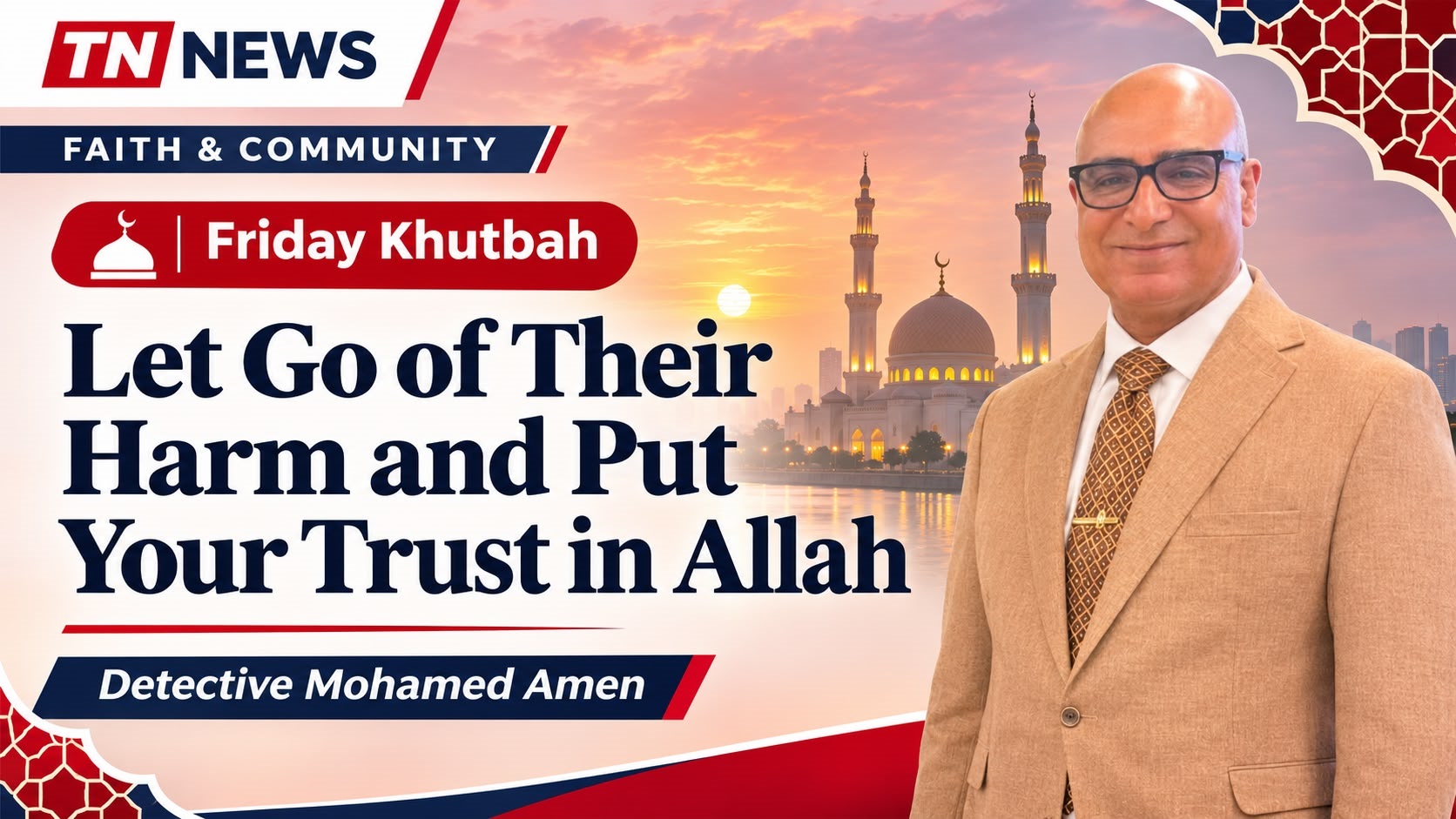
How can individuals overcome the pain of betrayal, injustice, and disappointment without losing their inner peace? How can they move beyond painful experiences without compromising their values? And does trusting Allah mean remaining silent in the face of injustice?
These questions were addressed in a Friday khutbah delivered by Detective Mohamed Amen, titled “Let Go of Their Harm and Put Your Trust in Allah.”
Drawing upon the Holy Quran, prophetic teachings, and examples from Islamic history, the sermon presented a comprehensive perspective on emotional healing, personal growth, spiritual resilience, and the importance of moving forward without allowing the wrongdoing of others to control one's future.
When the Past Becomes an Emotional Prison
Many people live physically in the present while their hearts and minds remain trapped in the past.
Experiences of betrayal, injustice, and disappointment can leave emotional wounds that continue to affect individuals long after the original incidents have ended.
Questions such as “Why did they hurt me?” and “Why did they respond to my kindness with cruelty?” can dominate a person's thoughts for years.
However, making emotional peace dependent on an apology that may never come can prevent individuals from appreciating their present blessings and pursuing future opportunities.
The Quran offers a powerful reminder in Surah Al-Ahzab:
“Disregard their harm, put your trust in Allah, and sufficient is Allah as a Disposer of affairs.” — Quran 33:48
The message is not necessarily about forgetting painful experiences, but about refusing to allow those experiences to determine the direction of one's life.
Yesterday's injustice should not steal today's blessings or tomorrow's opportunities.
Acceptance Does Not Mean Approving Injustice
One of the central themes of the khutbah was the distinction between accepting reality and accepting injustice.
Acknowledging that something painful has happened does not mean excusing wrongdoing, abandoning legitimate rights, or relieving those responsible of accountability.
Rather, acceptance represents the beginning of recovery.
Just as a broken glass cannot be restored by repeatedly regretting its destruction, painful experiences cannot be reversed through endless reflection.
Individuals can, however, protect themselves from further harm, learn from their experiences, and begin rebuilding their lives.
Faith in divine decree does not excuse injustice. It reminds believers that even their most difficult experiences have never escaped Allah's knowledge.
Understanding What We Can and Cannot Control
The sermon explored the concept of the “Circle of Concern and the Circle of Influence,” emphasizing the importance of distinguishing between circumstances beyond our control and areas where meaningful action remains possible.
We cannot control other people's intentions, decisions, behavior, or willingness to apologize.
However, we can work on our own character, reactions, health, relationships, professional development, spiritual growth, and personal boundaries.
Prophet Muhammad (peace be upon him) taught that true strength is not measured by the ability to overpower others, but by the ability to control oneself during moments of anger.
This principle encourages individuals to respond to adversity with wisdom rather than revenge and to maintain their moral values regardless of how others behave.
Trusting Allah Does Not Mean Surrendering Your Rights
A common misconception is that placing one's trust in Allah requires remaining passive in the face of injustice.
Islam, however, recognizes the right of individuals to defend themselves, protect their families, and pursue justice through lawful and ethical means.
The Quran states:
“And whoever defends himself after having been wronged — those are the ones upon whom there is no blame.” — Quran 42:41
While forgiveness carries a tremendous spiritual reward, seeking justice without committing further injustice is also permitted.
The relationship between trust and personal responsibility is illustrated through the prophetic teaching about birds that leave their nests hungry in the morning and return satisfied in the evening.
The birds actively seek their provision rather than remaining in their nests waiting for it.
Similarly, individuals are encouraged to work, plan, protect themselves, and take appropriate action while entrusting the ultimate outcome to Allah.
Trust is an act of the heart. Effort is an act of the body.
Finding Peace Without Waiting for Revenge
Emotional freedom should not depend on witnessing the punishment or failure of those who have caused harm.
Constantly monitoring the lives of wrongdoers or waiting for them to experience consequences may prolong emotional suffering and prevent personal growth.
The Quranic expression “Hasbunallahu wa ni'mal wakeel” — Allah is sufficient for us, and He is the best Disposer of affairs — offers reassurance during times of hardship and uncertainty.
The Quran also reminds believers:
“And never think that Allah is unaware of what the wrongdoers do.” — Quran 14:42
Individuals can continue pursuing their legitimate rights while rebuilding their emotional well-being independently of the actions or fate of others.
Justice and inner peace do not have to be competing goals.
Self-Accountability Without Self-Punishment
Sometimes, long after others have stopped causing harm, individuals continue punishing themselves.
They question why they trusted certain people, why they failed to recognize warning signs, or why they did not make different decisions.
There is, however, a fundamental difference between constructive self-accountability and destructive self-condemnation.
Self-accountability encourages learning, repentance, improvement, and wiser future decisions. Constant self-condemnation can contribute to despair, emotional exhaustion, and helplessness.
Islamic teachings emphasize that individuals have responsibilities toward themselves, their families, and their Creator.
Learning from mistakes and treating oneself with compassion are essential elements of personal and spiritual development.
The past should become a source of wisdom rather than a permanent source of punishment.
Forgiveness Is a Sign of Strength, Not Weakness
The khutbah presented a historical example involving Abu Bakr Al-Siddiq, the first caliph of Islam.
When Mistah ibn Uthatha participated in spreading false accusations against Abu Bakr's daughter, Aisha, Abu Bakr decided to discontinue the financial assistance he had previously provided him.
A Quranic revelation subsequently encouraged forgiveness:
“Let them pardon and overlook. Would you not love for Allah to forgive you? And Allah is Forgiving and Merciful.” — Quran 24:22
Abu Bakr responded that he wished for Allah's forgiveness and restored his financial assistance.
His decision did not mean that the offense was insignificant. Rather, it demonstrated that his faith and moral principles were stronger than his desire for retaliation.
Forgiveness does not necessarily require restoring trust or allowing harmful behavior to continue. Individuals can pursue forgiveness while maintaining appropriate boundaries and protecting their rights.
Faith and Mental Health: A Relationship of Mutual Support
An especially important aspect of the khutbah was its emphasis on emotional and psychological well-being.
The sermon encouraged individuals experiencing overwhelming emotional distress to seek assistance from qualified professionals, emphasizing that psychological treatment does not contradict faith or reliance on Allah.
Three practical steps were presented for dealing with recurring painful memories:
Recognize: Acknowledge emotional pain without condemning yourself, while seeking strength through remembrance of Allah.
Move: Change your surroundings, perform ablution, take a walk, or participate in a beneficial activity.
Redirect: Invest your time and energy in worship, family, health, work, education, and personal development.
This message reinforces the importance of reducing the stigma surrounding mental health care and encouraging individuals to seek professional support when necessary.
Faith, prayer, and appropriate psychological care can complement one another in the journey toward recovery.
Do Not Make Success an Act of Revenge
Painful experiences sometimes motivate individuals to pursue success simply to prove something to those who mistreated them.
Yet when success becomes an act of revenge, the people responsible for past suffering may continue to influence one's decisions and ambitions.
True emotional freedom begins when personal growth is motivated by meaningful goals, gratitude, and the desire to build a better life.
Rather than measuring achievements against the failures of others, individuals should recognize their abilities and opportunities as blessings and use them constructively.
Acceptance and Trust: Two Keys to Emotional Freedom
The khutbah concluded by identifying two essential principles for breaking free from the emotional burdens of the past:
Acceptance: Acknowledging what has happened, learning from the experience, and refusing to allow it to control the present.
Tawakkul: Taking practical responsibility for one's life, making sincere efforts, and entrusting the future to Allah.
The sermon concluded with prayers for emotional healing, protection from injustice, relief from anxiety, strength during hardship, and the spread of peace, justice, and compassion throughout society.
In a world where individuals face increasing personal, professional, and social pressures, the message offers a meaningful reminder of the importance of balancing faith with action, forgiveness with justice, and personal growth with emotional well-being.
True strength is not found in taking revenge against those who have hurt us, but in overcoming their harm without losing our values, our faith, or our hope for a better future.
Accept the past. Build the present. Trust Allah with the future.
TN News | Faith, Community & Society
News You Should See
Let Go of Their Harm and Trust Allah: Friday Sermon Explores Healing from Past Wounds and Finding Peace Without Abandoning Justice
Misr El-Kheir International to Launch in the United States with Inaugural New York Gala on December 12
Kevin Durant Reaches 33,000 Career Points as Houston Rockets Defeat Phoenix Suns
Duran Duran's Original Guitarist Andy Taylor Dies at 65 After Cancer Battle
MiniMax Faces Data Security Questions After Confidential AI Links Were Reportedly Accessed
SAP Reportedly Weighs 10,000 Job Cuts as AI Reshapes Its Business Strategy
Latest News
A Friday khutbah by Detective Mohamed Amen explores how faith, forgiveness, acceptance, and trust in Allah can help individuals overcome emotional pain while preserving their rights and seeking justice.
Misr El-Kheir International will launch in the United States with an inaugural gala on December 12, 2026, at 583 Park Avenue in New York, featuring humanitarian initiatives and fundraising activities.
Kevin Durant became the fifth NBA player to reach 33,000 career points as the Houston Rockets defeated the Phoenix Suns 116-104. Alperen Sengun recorded a triple-double.
Andy Taylor, original Duran Duran guitarist, has died at 65 following prostate cancer. His guitar work helped define the band's iconic 1980s sound.
A cybersecurity investigation raises concerns after confidential links submitted to Chinese AI company MiniMax were reportedly accessed by unidentified parties, highlighting data privacy and third-party security risks.
SAP is reportedly considering cutting at least 10,000 jobs in an AI-driven restructuring that could affect around 9% of its global workforce.
Growing GLP-1 use is changing Thanksgiving meals in the US, with smaller portions, reduced appetites and new dietary considerations for families and medication users.
Rising debt costs and credit risks are challenging the AI infrastructure boom, with SoftBank and CoreWeave facing growing investor concerns over financing and returns.
A Georgia judge temporarily suspends an order requiring Fulton County to hand over digital copies of 2020 election ballots and records to the State Election Board pending an appeal.