Kyoto Fusioneering Moves Deeper Into the Fusion Supply Chain With New Fuel-Breeding Technology
The Japanese fusion specialist is developing Unity-3 with Oak Ridge National Laboratory to test breeding-blanket technologies that could help turn experimental reactors into commercially viable power plants.

The race to commercialize fusion energy is increasingly expanding beyond the reactor itself. While much of the industry's attention remains focused on plasma confinement and the machines designed to trigger fusion reactions, the path to a functioning power plant depends on a much broader industrial ecosystem.
Kyoto Fusioneering is positioning itself at the center of that ecosystem. The Japan-based company has secured grants from the U.S. Department of Energy and the state of Tennessee to develop a prototype fuel-breeding device at Oak Ridge National Laboratory. The project, known as Unity-3, is designed to test technologies that could become essential components of future fusion power plants.
The move represents a strategic shift in the way the fusion industry is developing. Instead of competing primarily to build a complete reactor, Kyoto Fusioneering is building a business around the specialized infrastructure that many reactor developers will need regardless of which fusion architecture ultimately succeeds.
That positioning could become commercially valuable as the number of private fusion companies grows. More than half of fusion startups surveyed by the Fusion Industry Association have indicated that they expect to work with external suppliers for fuel-cycle technologies, creating a potentially large market for specialized engineering companies.
Kyoto Fusioneering has already established itself as one of the larger specialists in this emerging supply chain, with $121 million in committed capital. Alongside the Unity-3 announcement, the company is also moving its U.S. headquarters to Oak Ridge, strengthening its connection with the American fusion research and industrial ecosystem.
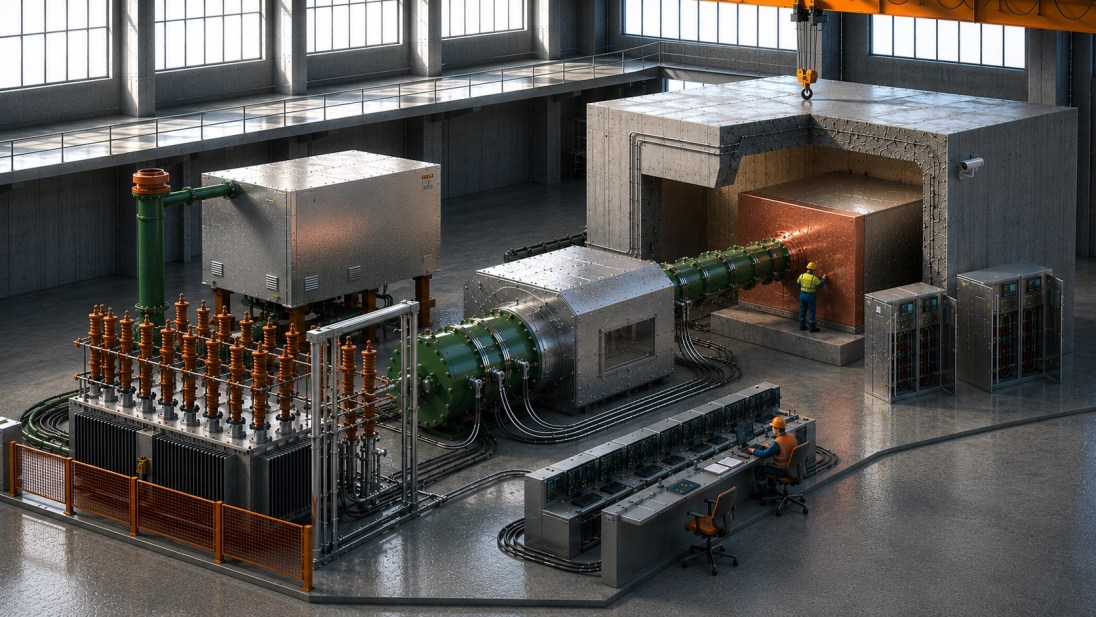
At the technical level, Unity-3 will focus on a critical component known as a breeding blanket. These systems sit around the fusion reaction and have two important functions: capturing energy generated by the reaction and producing fresh fuel needed to sustain future fusion operations.
One design under consideration uses liquid lithium. Neutrons generated during fusion can interact with lithium atoms, producing tritium, an isotope of hydrogen that serves as fuel for many fusion reactor concepts. The system must then separate the tritium, return it to the reactor's fuel cycle and simultaneously extract heat for electricity generation.
This makes the breeding blanket much more than an auxiliary component. It connects the fusion reaction to the fuel supply and thermal systems required to transform experimental physics into an energy-producing industrial process.
The engineering challenge is substantial. A commercial system must operate under extreme heat and neutron exposure while maintaining reliable circulation, fuel recovery and heat extraction. That requires specialized materials, pumps, fluid-handling systems and control technologies.
Unity-3 is intended to provide a physical testing environment for these technologies rather than relying primarily on computer simulations. Kyoto Fusioneering plans to evaluate liquid lithium alongside other breeding-blanket materials, allowing researchers and fusion startups to compare real-world performance against models.
That data could have significant commercial value. Fusion developers such as Realta Fusion, Thea Energy, Type One Energy and Xcimer Energy are expected to use information from the Unity-3 experiments as they design their own reactors. The diversity of these companies is particularly important because they are pursuing different approaches to fusion power.
For Kyoto Fusioneering, this creates a potentially powerful supplier strategy. If multiple reactor designs require similar fuel-cycle, heat-management or power-conversion technologies, the company can serve several segments of the market without having to bet its future on a single reactor architecture.
This is similar to the role specialized suppliers play in other complex technology industries. Rather than attempting to own the entire product, a company can establish itself as a critical infrastructure provider whose components become embedded across competing platforms.
Fusion may be particularly suited to this model because the technology requires an unusually broad range of engineering disciplines. Plasma systems are only one part of the challenge. Future plants will also need fuel-cycle infrastructure, heat extraction, power generation, materials capable of surviving harsh operating environments and systems for managing the reactor's exhaust.
Kyoto Fusioneering is already developing technologies across several of these areas, including systems designed to heat fusion fuel into plasma, recycle unused fuel and extract heat for electricity generation.
The company's strategy also reflects the growing internationalization of the fusion industry. Moving its U.S. headquarters to Oak Ridge puts Kyoto Fusioneering closer to one of the world's important centers for nuclear and fusion research while deepening its relationship with U.S. government-backed infrastructure.
The partnership with Oak Ridge is part of a broader U.S.-Japan effort to accelerate fusion commercialization. Earlier in 2026, the U.S. Department of Energy and Kyoto Fusioneering established a strategic partnership focused on fusion infrastructure and collaborative research, including a public-private partnership involving Oak Ridge National Laboratory.
This international dimension could prove strategically important as governments increasingly treat fusion not only as a scientific challenge but also as an energy-security and industrial-policy opportunity.
Japan is simultaneously expanding its own fusion industrial base. Kyoto Fusioneering has been developing integrated testing facilities and expanding technologies such as gyrotron systems, while Japanese government and industry initiatives increasingly emphasize the transition from research toward commercial demonstration.
The timing is also significant because fusion startups are moving closer to commercial demonstrations. Companies such as Commonwealth Fusion Systems and Helion are pursuing increasingly ambitious power-plant projects, increasing demand for suppliers capable of delivering components beyond the reactor core.
This creates an emerging market distinction between companies trying to build the power-producing reactor and companies developing the infrastructure needed to make those reactors economically useful.
Kyoto Fusioneering is betting that the second category can become a substantial business in its own right.
The economics of fusion will ultimately depend on more than achieving a successful fusion reaction. A commercially competitive plant must reliably capture energy, maintain its fuel supply, withstand neutron damage, operate for long periods and convert heat into electricity at an acceptable cost.
That means components such as breeding blankets could become major determinants of whether fusion plants remain expensive experimental facilities or evolve into dependable energy infrastructure.
The company is therefore building intellectual property and operational expertise around a problem that every deuterium-tritium fusion plant must eventually confront: how to produce and recycle enough tritium to sustain commercial operation.
The Unity-3 project does not by itself establish that commercial fusion power is ready for deployment. Its importance lies in moving a critical piece of the technology from theoretical designs and simulations toward physical validation.
That transition is one of the central challenges facing the fusion sector. Demonstrating that individual technologies work under laboratory conditions is different from integrating them into systems that can operate continuously, economically and safely.
For Kyoto Fusioneering, however, the opportunity is broader than a single demonstration project. By testing multiple breeding-blanket approaches and sharing the resulting data with different reactor developers, the company can strengthen its position as an independent technology partner across the fusion ecosystem.
If the fusion industry succeeds in moving from experimental machines to commercial power plants, the winners may not be limited to the companies that build the reactors. A new industrial supply chain will be required around them, and specialized companies capable of solving difficult engineering problems could capture a significant share of that value.
Unity-3 places Kyoto Fusioneering directly in that emerging market.
The company's long-term strategy appears to be built around becoming a foundational supplier for an industry that has yet to choose a single winning reactor design. That may prove to be a particularly resilient position: while individual fusion concepts can fail or change direction, the need for fuel management, heat extraction and power-generation infrastructure is likely to remain.
As fusion moves closer to commercial reality, the competitive question will therefore extend beyond who can create the hottest plasma. It will also involve who can build the industrial systems that allow that plasma to become reliable electricity.
Kyoto Fusioneering is positioning itself for that second race.
News You Should See
2026 Nobel Medicine Prize Honors Scientists Behind Optogenetics Breakthrough
Oil Prices Edge Lower as Stronger Middle East Exports and G7 Reserves Ease Supply Concerns
Trump Offers U.S. Assistance to Russia After Death at Siberian Plague Research Institute
Trump Takes Economic Message to Nebraska as GOP Faces Rising Cost-of-Living Pressure
U.S. Appeals Court Weighs Trump Administration’s $2.6 Billion Harvard Funding Fight
U.S. Midterm Elections Begin With Resilient Jobs Market and Persistent Cost Pressures
Latest News
The 2026 Nobel Prize in Physiology or Medicine honors Karl Deisseroth, Peter Hegemann and Georg Nagel for pioneering research behind optogenetics and its impact on neuroscience.
Oil prices edged lower as stronger Middle Eastern exports and a planned G7 release of 100 million barrels eased immediate supply concerns, while Gulf security risks and the Strait of Hormuz kept markets alert.
President Donald Trump said the United States would help Russia if needed after a laboratory worker died at a Siberian plague research institute, as Russian authorities imposed precautionary quarantine measures.
Trump’s Nebraska campaign stop highlights rising fuel and grocery costs, beef prices and growing economic pressure on Republicans ahead of the November midterm elections.
A U.S. appeals court is reviewing the Trump administration’s effort to cut Harvard’s federal research funding, with more than $2.6 billion at stake.
The U.S. enters the 2026 midterm elections with unemployment at 4.2%, while higher living and energy costs create economic pressure for households and businesses.
US services growth eased in September as input prices climbed to their highest level since July 2022, with fuel costs, supply-chain disruptions and strong demand increasing pressure on businesses.
Rising Treasury yields are increasing U.S. borrowing costs as Washington manages record debt, persistent inflation and strong economic demand, narrowing its policy options.
A EGP 16 million corporate partnership will establish and equip a bone marrow transplant unit at Cairo’s Coptic Hospital, supporting access to specialized treatment for patients.