Instagram Rewrites the Rules of AI Identity as Undisclosed Synthetic Profiles Face Reduced Reach
A new disclosure framework turns AI transparency into a distribution issue, reshaping how virtual personalities can build audiences, influence consumers, and establish credibility on Instagram.

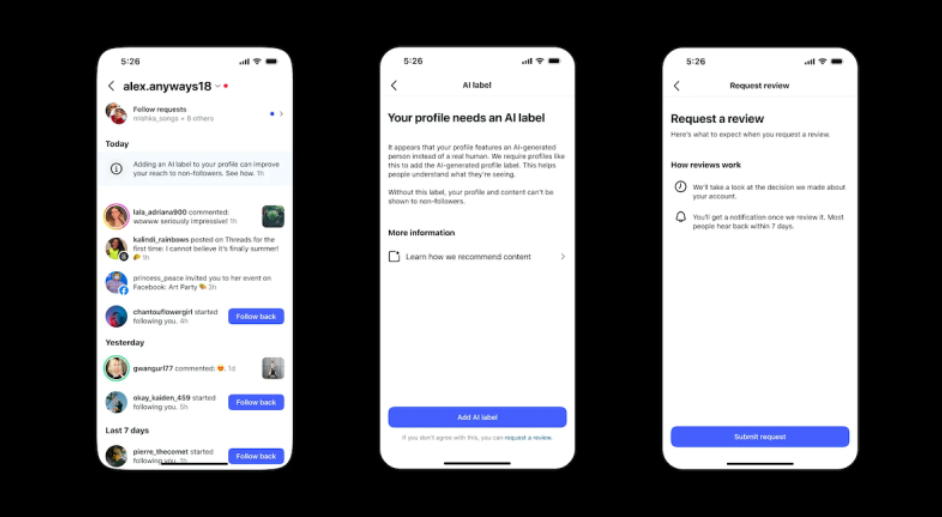
Instagram is moving to a more explicit model of identity disclosure for accounts built around artificial people, signaling that the platform increasingly views transparency about synthetic identities as part of the architecture of its recommendation economy rather than as a simple labeling exercise.
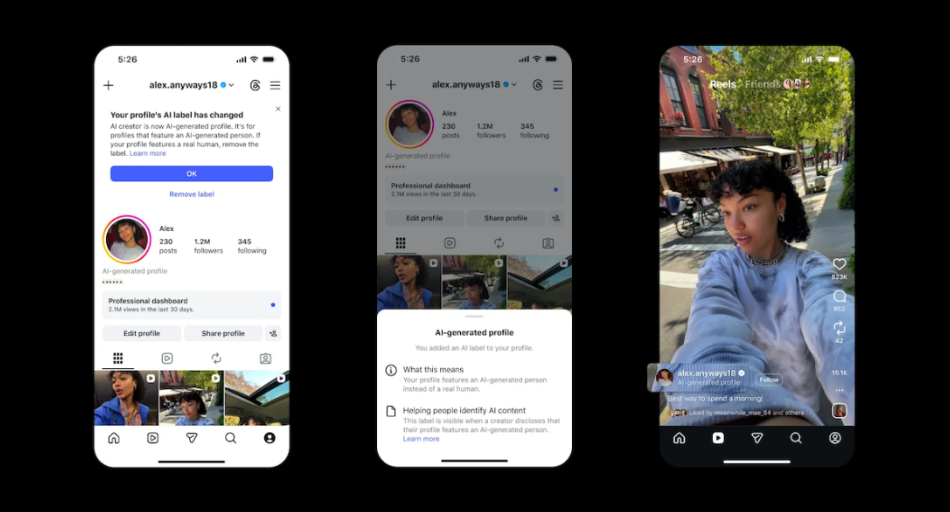
The company announced on August 31 that it is replacing its existing “AI creator” designation with “AI-generated profile.” The revised wording is intended to make the nature of these accounts immediately clearer to users: the person represented on the profile has been generated or substantially constructed through artificial intelligence rather than being a real individual using AI merely as a production tool.
The strategic significance of the change goes beyond terminology. Instagram is also introducing a distribution consequence for profiles that feature AI-generated people but fail to disclose that fact. Accounts that do not apply the appropriate designation may experience reduced reach, while creators who proactively identify their profiles as AI-generated will not be penalized simply because the central personality represented by the account is artificial. In practical terms, transparency is therefore becoming connected to visibility, audience acquisition, and the ability to participate fully in Instagram’s recommendation ecosystem.
This distinction is particularly important because Instagram is not attempting to classify every piece of content that has been touched by artificial intelligence. The new profile-level designation is aimed at accounts where the person presented to the audience is itself generated or substantially created by AI. A real person who uses AI to retouch a photograph, improve a caption, produce graphics, or make other creative adjustments does not automatically fall into the same category.
That distinction creates a clearer strategic boundary between AI as a production instrument and AI as the identity of the creator. The first describes a human creator using a new generation of digital tools; the second creates a synthetic personality that can potentially operate as an influencer, marketer, entertainer, commentator, or commercial representative. Instagram’s revised approach is primarily concerned with the latter because the identity presented to the audience can influence whether users believe they are interacting with an actual person.
From a platform-design perspective, the change addresses a growing authenticity problem. Users can encounter highly realistic profiles that visually resemble ordinary influencers and only discover later that the featured individual does not exist in the conventional human sense. Instagram says the policy was influenced by feedback from people who do not object to artificial intelligence itself but want to know when the person represented by an account is AI-generated. The underlying issue is therefore not simply whether AI content exists, but whether the interface gives users enough information to understand what kind of social relationship they are entering.
The economic implications are significant because visibility on Instagram is closely tied to the value of an account. Reach can determine audience growth, engagement, brand partnerships, affiliate opportunities, advertising potential, and the commercial viability of an influencer identity. By connecting disclosure to distribution, Instagram is effectively turning transparency into a condition of maintaining normal access to the platform’s discovery mechanisms.
For AI-native creators, this creates a new strategic calculation. An artificial personality can still be developed as a recognizable brand, but its commercial identity must increasingly be built around disclosure rather than ambiguity. Instead of presenting synthetic characters as indistinguishable substitutes for human influencers, creators may need to treat their artificial nature as part of the brand itself. That could ultimately produce a more structured market for virtual personalities in which audiences understand from the beginning that the character is digitally constructed.
The policy also arrives at a moment when the volume and sophistication of AI-generated social content are increasing rapidly. Recent cases have demonstrated how synthetic influencers can move beyond entertainment and into commercial persuasion. Earlier in 2026, an investigation by Wired examined a network of apparently AI-generated male influencers promoting the gay dating application Goose. The investigation identified more than two dozen accounts that appeared to feature AI-generated personalities, with some reportedly contacting potential users through direct messages to encourage them to sign up.
Health and wellness represents an even more sensitive commercial category. The New York Times reported in July that it had identified hundreds of AI-generated doctors, healers, and wellness personalities operating across social media, some of which promoted supplements or made health-related claims. The example illustrates why synthetic identity can become more consequential when an artificial personality is not merely entertaining an audience but is being used to influence consumer decisions involving money, products, or personal well-being.
Instagram’s decision also follows a broader series of controversies surrounding the relationship between generative AI, user identity, and consent. The platform recently faced criticism over an AI feature that allowed users to generate images using other people’s likenesses. Users objected to the possibility of their public Instagram material being incorporated into AI-generated creations without an explicit opt-in mechanism, after which Meta removed the disputed feature. The episode highlighted a recurring problem for technology companies: technical capability can develop faster than the social expectations governing how identity and personal content should be used.
The new profile policy can therefore be understood as part of a larger attempt by Meta to establish clearer boundaries around artificial identity. Rather than prohibiting AI-generated personalities altogether, Instagram is choosing a disclosure-and-distribution model. This approach allows synthetic creators to remain part of the ecosystem while making their status more visible and creating consequences for accounts that attempt to benefit from human-like presentation without identifying themselves as artificial.
There is also a branding dimension to the terminology change. “AI creator” can describe a human creator who regularly uses artificial intelligence, making the phrase relatively broad and potentially ambiguous. “AI-generated profile,” by contrast, places the emphasis on the profile itself and on the artificial origin of the person represented within it. The wording is therefore more closely aligned with the user’s actual question: is the person I am seeing real, or is this identity generated?
For Instagram, that clarity can become an important component of platform trust. Social networks depend on users believing that interactions, recommendations, creators, and commercial messages have understandable origins. As synthetic media becomes increasingly realistic, the distinction between authentic human identity and artificial representation becomes harder to establish visually. Labels consequently become part of the platform’s identity infrastructure, helping users interpret what they encounter before deciding whether to follow, engage with, purchase from, or trust an account.
The timing is also notable because Meta is simultaneously facing broader scrutiny over how its platforms affect younger users. Last week, the company reached an $18 billion settlement with U.S. states concerning allegations related to the effects of Facebook and Instagram on children and teenagers. Under the agreement, Meta is expected to introduce a default two-hour daily usage limit for teens across Facebook and Instagram, a Night Mode restriction, muted notifications during school hours, and additional safeguards.
Taken together, these developments suggest that platform governance is increasingly becoming part of Meta’s product strategy. Instead of treating trust, safety, authenticity, and user protection as separate policy layers, the company is embedding them directly into the mechanisms that determine how content is identified, recommended, and distributed.
For AI-generated personalities, the message is consequently clear: artificial identity is not being removed from Instagram, but hiding that identity is becoming increasingly difficult to reconcile with full participation in the platform’s discovery system. The long-term effect could be a shift in how virtual influencers are designed and marketed. Their artificial nature may move from being something creators conceal into something that forms part of their recognizable brand proposition.
Instagram’s update therefore represents more than a new label. It is an adjustment to the relationship between identity, recommendation algorithms, and commercial reach. As generative AI becomes a larger component of digital culture, platforms will increasingly have to determine not only what content is acceptable, but also how clearly users should be told who—or what—is behind the account speaking to them.
News You Should See
2026 Nobel Medicine Prize Honors Scientists Behind Optogenetics Breakthrough
Oil Prices Edge Lower as Stronger Middle East Exports and G7 Reserves Ease Supply Concerns
Trump Offers U.S. Assistance to Russia After Death at Siberian Plague Research Institute
Trump Takes Economic Message to Nebraska as GOP Faces Rising Cost-of-Living Pressure
U.S. Appeals Court Weighs Trump Administration’s $2.6 Billion Harvard Funding Fight
U.S. Midterm Elections Begin With Resilient Jobs Market and Persistent Cost Pressures
Latest News
The 2026 Nobel Prize in Physiology or Medicine honors Karl Deisseroth, Peter Hegemann and Georg Nagel for pioneering research behind optogenetics and its impact on neuroscience.
Oil prices edged lower as stronger Middle Eastern exports and a planned G7 release of 100 million barrels eased immediate supply concerns, while Gulf security risks and the Strait of Hormuz kept markets alert.
President Donald Trump said the United States would help Russia if needed after a laboratory worker died at a Siberian plague research institute, as Russian authorities imposed precautionary quarantine measures.
Trump’s Nebraska campaign stop highlights rising fuel and grocery costs, beef prices and growing economic pressure on Republicans ahead of the November midterm elections.
A U.S. appeals court is reviewing the Trump administration’s effort to cut Harvard’s federal research funding, with more than $2.6 billion at stake.
The U.S. enters the 2026 midterm elections with unemployment at 4.2%, while higher living and energy costs create economic pressure for households and businesses.
US services growth eased in September as input prices climbed to their highest level since July 2022, with fuel costs, supply-chain disruptions and strong demand increasing pressure on businesses.
Rising Treasury yields are increasing U.S. borrowing costs as Washington manages record debt, persistent inflation and strong economic demand, narrowing its policy options.
A EGP 16 million corporate partnership will establish and equip a bone marrow transplant unit at Cairo’s Coptic Hospital, supporting access to specialized treatment for patients.