Google Redesigns Password Migration on Android to Make Switching More Seamless
Android’s new transfer system moves passwords and passkeys directly between supported password managers, replacing CSV-based migration with a more integrated and security-focused experience.

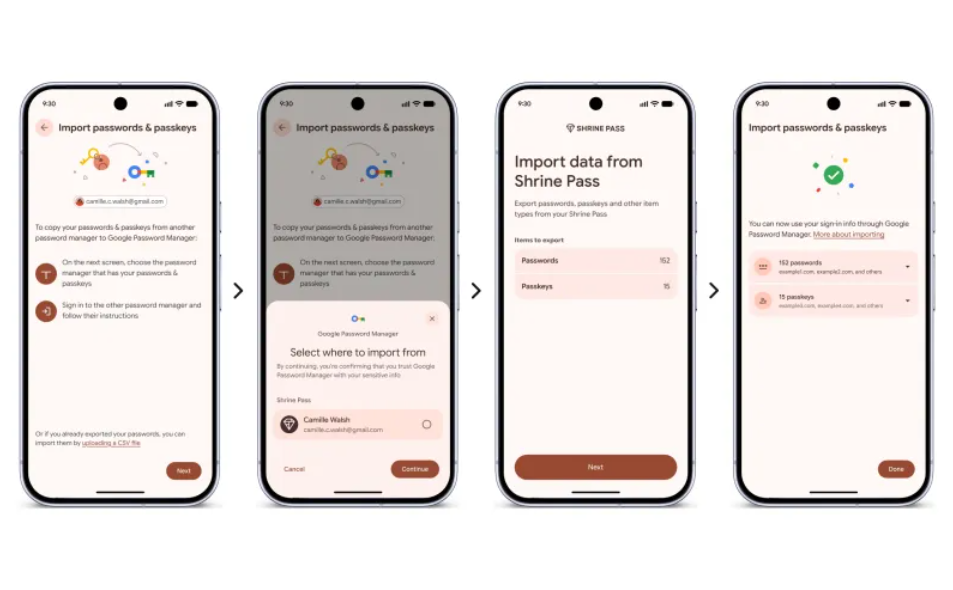
Google is introducing a new way for Android users to move between password manager applications, addressing one of the less visible but important challenges in the modern digital ecosystem: the difficulty of transferring sensitive credentials from one service to another.
The new password manager switching experience is designed to eliminate the traditional requirement of exporting credentials into a CSV file before importing them into a different application. Instead, Android can now coordinate a more direct transfer process between compatible password manager apps installed on the same device.
The change represents more than a convenience update. Password managers have become increasingly important digital infrastructure, storing credentials that connect users to banking platforms, social networks, work tools, shopping services, and countless other online accounts. As users accumulate more passwords and security credentials, the cost and complexity of changing password management services can become a significant barrier to switching.
Google's new approach is designed to reduce that friction.
Under the new system, users begin by opening the password manager application they want to move to and selecting the option to import or copy credentials from their existing password manager. Android then detects compatible password manager apps already installed on the device and coordinates the transfer between the old and new applications.
Before the migration is completed, users can review the information that is scheduled to be transferred and approve the process with only a few interactions. The goal is to create a transition that is more closely integrated into the Android experience rather than forcing users to manually export, locate, store, and import credential files.
One of the most important elements of the new system is its support for passkeys.
Passkeys are increasingly becoming part of the authentication ecosystem as technology companies move toward alternatives to conventional passwords. Their inclusion in Android's new password manager migration experience means users will not need to manually create their passkeys again when moving from one supported password manager to another.
This is particularly important from a product design perspective. A migration process becomes significantly more complicated when users must move different categories of credentials through separate procedures. By supporting both passwords and passkeys within the same transfer experience, Android is attempting to create a more unified system for managing digital authentication data.
The design strategy behind the update focuses on reducing the number of technical steps placed in front of users. Traditional migration through CSV files typically requires users to export their passwords from one service, save the resulting file, locate it on their device, and then upload or import it into another application.
That workflow introduces both complexity and security concerns.
CSV files can contain highly sensitive credential information in a format that may remain stored on a device after the transfer process is completed. Users must also understand where the file has been saved and how it should be handled. Google's new system is intended to remove that additional layer of exposure by allowing compatible applications to coordinate the transfer directly through Android.
The update therefore reflects a broader change in how platform companies are approaching user experience and security. Instead of treating security tools as isolated applications, operating systems are increasingly building shared frameworks that allow different services to work together through standardized processes.
For Android, this creates an opportunity to position the operating system itself as an intermediary that simplifies transitions between competing services.
That point has strategic and economic implications for the wider password manager market. One of the factors that can make users reluctant to change software services is the cost of migration. This cost is not always financial. It can also include the time required to transfer data, the risk of losing information, the possibility of exposing sensitive files, and the technical effort needed to understand a new system.
By lowering those switching costs, Android could make it easier for users to evaluate password managers based on product features rather than migration difficulty.
This can create a more competitive environment for password manager providers. Applications may have a greater incentive to differentiate themselves through user experience, security features, pricing models, cross-platform availability, and additional services when users are no longer as strongly tied to an existing provider by the complexity of moving their credentials elsewhere.
Google has already made the new password manager switching experience available through its own password manager and selected partner applications.
The currently supported services include 1Password, Bitwarden, and Dashlane. Google has indicated that additional password manager applications are expected to gain support for the system in the future.
The presence of third-party services in the new framework is also significant from a platform strategy perspective. Google is not limiting the migration experience to its own password manager. Instead, the Android system is being positioned as a shared technical layer that can facilitate movement between multiple supported services.
This approach can strengthen the overall Android ecosystem by making the operating system more flexible without requiring users to remain exclusively within Google's own products.
From a brand perspective, the move also supports an increasingly important message in consumer technology: convenience and security do not have to be competing priorities.
Security products have traditionally been associated with complexity. Stronger protection has often required additional passwords, recovery codes, authentication steps, backups, and technical knowledge. Companies are now competing to redesign those experiences so that security becomes easier to use rather than another source of friction.
Google's new transfer system follows this design philosophy by making a sensitive operation simpler while attempting to reduce the risks associated with temporary credential exports.
The inclusion of passkeys further demonstrates how authentication design is changing. Password managers are evolving from simple repositories for usernames and passwords into broader identity management tools capable of storing and coordinating multiple forms of digital authentication.
As this transition continues, the ability to move authentication data between services could become increasingly important. Users may expect the same portability for their digital identities that they already expect for photos, contacts, files, and other forms of personal information.
Google's decision to build the switching process into Android can therefore be viewed as infrastructure development for a more interoperable authentication ecosystem.
The new feature will be available on devices running Android 8 and later, giving it access to a broad range of Android users and devices.
Its importance lies not only in making password transfers faster. The feature also changes the design of the switching journey itself. Instead of asking users to handle sensitive credential files manually, Android is introducing a coordinated process in which compatible applications and the operating system share responsibility for managing the migration.
For users, that can mean fewer technical steps and less concern about handling exported credential files. For password manager companies, it could reduce the barriers preventing potential customers from trying alternative services. For Google and Android, the system reinforces the platform's role as a technology layer that connects services rather than simply hosting them.
Ultimately, the update reflects a broader evolution in digital product design. As users become increasingly dependent on applications to manage sensitive personal information, the quality of a service is no longer defined only by what happens inside the application itself. The experience of entering, leaving, and moving between services is becoming part of the product.
By redesigning password manager migration around direct transfers, passkey support, reduced exposure to credential files, and interoperability between supported applications, Google is turning what was previously a technical migration task into a more integrated part of the Android user experience.
The move may appear to be a relatively focused feature, but it carries a larger strategic message: digital ecosystems become more competitive and easier to use when users can move their data securely without being forced to navigate unnecessary technical barriers.

News You Should See
2026 Nobel Medicine Prize Honors Scientists Behind Optogenetics Breakthrough
Oil Prices Edge Lower as Stronger Middle East Exports and G7 Reserves Ease Supply Concerns
Trump Offers U.S. Assistance to Russia After Death at Siberian Plague Research Institute
Trump Takes Economic Message to Nebraska as GOP Faces Rising Cost-of-Living Pressure
U.S. Appeals Court Weighs Trump Administration’s $2.6 Billion Harvard Funding Fight
U.S. Midterm Elections Begin With Resilient Jobs Market and Persistent Cost Pressures
Latest News
The 2026 Nobel Prize in Physiology or Medicine honors Karl Deisseroth, Peter Hegemann and Georg Nagel for pioneering research behind optogenetics and its impact on neuroscience.
Oil prices edged lower as stronger Middle Eastern exports and a planned G7 release of 100 million barrels eased immediate supply concerns, while Gulf security risks and the Strait of Hormuz kept markets alert.
President Donald Trump said the United States would help Russia if needed after a laboratory worker died at a Siberian plague research institute, as Russian authorities imposed precautionary quarantine measures.
Trump’s Nebraska campaign stop highlights rising fuel and grocery costs, beef prices and growing economic pressure on Republicans ahead of the November midterm elections.
A U.S. appeals court is reviewing the Trump administration’s effort to cut Harvard’s federal research funding, with more than $2.6 billion at stake.
The U.S. enters the 2026 midterm elections with unemployment at 4.2%, while higher living and energy costs create economic pressure for households and businesses.
US services growth eased in September as input prices climbed to their highest level since July 2022, with fuel costs, supply-chain disruptions and strong demand increasing pressure on businesses.
Rising Treasury yields are increasing U.S. borrowing costs as Washington manages record debt, persistent inflation and strong economic demand, narrowing its policy options.
A EGP 16 million corporate partnership will establish and equip a bone marrow transplant unit at Cairo’s Coptic Hospital, supporting access to specialized treatment for patients.