Google Bets on Indian Climate Tech as Mitti Labs Scales Rice Methane Credits
A four-year agreement for one million carbon credits positions Mitti Labs at the intersection of AI, sustainable agriculture, water efficiency, and the growing corporate demand for verified climate solutions.

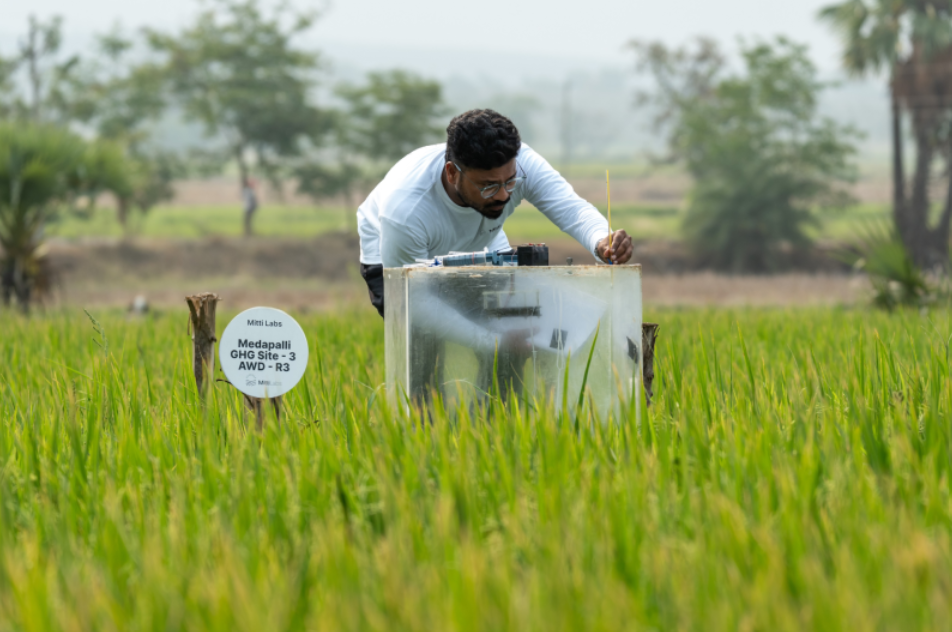
Google has entered into a four-year agreement to purchase one million carbon credits from Indian climate technology startup Mitti Labs through 2030, marking what the companies describe as the largest publicly announced transaction so far involving carbon credits generated by reducing methane emissions from rice farming. The agreement covers rice-growing regions across Karnataka, Andhra Pradesh, and Telangana and is expected to reach approximately 100,000 hectares at peak delivery. While the financial value of the transaction was not disclosed, the scale of the agreement represents a significant commercial milestone for Mitti Labs and reflects the growing interest of major technology companies in agricultural climate solutions that combine measurable emissions reductions with wider environmental benefits.
At the center of the project is a change in how rice fields are managed. Farmers participating in Mitti Labs' programs are encouraged to adopt irrigation practices that reduce the amount of time fields remain continuously flooded. Flooded rice cultivation creates conditions that lead to methane emissions, making water management an important part of efforts to reduce the climate impact of rice production. Mitti Labs says its approach can reduce methane emissions by approximately 50% while cutting irrigation water use by around 40%, without reducing crop yields. This combination gives the project a broader strategic value because it addresses two connected challenges at once: agricultural emissions and increasing pressure on freshwater resources.
The Google agreement comes at an important moment for the company's broader climate strategy. Google continues to pursue its goal of reaching net-zero emissions by 2030 while simultaneously investing heavily in artificial intelligence infrastructure, an expansion that has increased pressure on its environmental targets. According to Google's environmental report released in June, the company's greenhouse gas emissions reached approximately 14.5 million metric tons of carbon dioxide equivalent in 2025, representing an 18% increase compared with the previous year. The Mitti Labs agreement therefore illustrates how major technology companies are increasingly looking beyond conventional renewable energy purchases and toward more diverse climate investments as they attempt to manage the environmental consequences of expanding digital infrastructure.
For Google, the attraction of the Mitti Labs project was not limited to methane reduction. The company was also interested in the project's water-saving potential and the startup's ability to operate at significant scale. Mitti Labs says its programs have already saved more than 500 billion liters of water during the past two years, and the Google agreement is expected to provide the company with additional capacity to expand its work with large corporate buyers. This creates an important economic model for climate technology: environmental improvements are transformed into measurable outcomes, those outcomes are independently verified, and the resulting carbon credits create a financial mechanism capable of supporting agricultural communities while attracting corporate investment.
The agreement also demonstrates how artificial intelligence and satellite technology are becoming increasingly important to the design of climate infrastructure. Founded in 2023 and headquartered across New York and Bengaluru, Mitti Labs has developed a GeoAI platform that combines satellite radar imagery with field measurements to remotely monitor crop growth, soil moisture, and flooding across smallholder farms. The platform uses synthetic aperture radar imagery from commercial and public satellites with resolutions ranging from 50 centimeters to 10 meters. In addition to satellite information, the company relies on proprietary datasets collected through field operations to train its AI models and improve its ability to understand agricultural conditions across large and geographically distributed areas.
This technology model is particularly important because traditional agricultural monitoring can be expensive and difficult to scale across thousands of small farms. Mitti Labs is attempting to solve this problem by creating a digital layer capable of observing farming conditions remotely while combining those observations with information collected directly from the field. The result is a product design that connects physical agriculture with artificial intelligence, satellite infrastructure, environmental measurement, and carbon markets. Instead of treating carbon credits as a purely financial product, the company's model depends on building a technical system that can measure and verify the environmental changes that generate those credits.
Google's evaluation of the project included close examination of Mitti Labs' monitoring technology and visits to farms before the agreement was finalized. This level of scrutiny highlights a critical issue within the carbon market: buyers increasingly require stronger evidence that environmental claims are real, measurable, and independently verifiable. According to Mitti Labs, the credits purchased by Google can be issued under either Gold Standard or Isometric, two organizations involved in carbon-credit certification. The projects are also subject to independent third-party verification before credits are issued, adding another layer of oversight to the commercial model.
From a market perspective, the transaction represents Mitti Labs' largest offtake agreement to date. The startup already works with customers including carbon marketplace Cool Effect, rice producer Ebro Foods, and agricultural company Syngenta. It currently works with more than 100,000 farmers and aims to expand its network to millions of farmers by 2030. The Google deal is expected to accelerate progress toward that objective by providing the company with a major corporate buyer capable of supporting expansion across a larger agricultural footprint.
The economic dimension of the model is also closely connected to farming communities. Mitti Labs says that a majority of the revenue generated through its projects goes to those communities, although the company did not disclose the exact amount that farmers participating in the Google project would receive. This approach is significant because carbon markets can potentially create an additional source of income for farmers who adopt more sustainable practices. Rather than treating environmental compliance as a cost imposed on agricultural communities, the model attempts to create a financial incentive for changing farming methods while connecting local producers to international corporate demand for verified emissions reductions.
The project therefore represents a broader redesign of the relationship between agriculture and the climate economy. Farmers are no longer positioned only as food producers but can also become participants in environmental markets through measurable changes in land and water management. Technology companies such as Mitti Labs act as the infrastructure layer connecting farmers, environmental data, verification organizations, carbon markets, and corporate buyers. Google, meanwhile, represents the demand side of that ecosystem, using its purchasing power to secure verified climate outcomes while supporting its broader emissions strategy.
This design also gives Mitti Labs an opportunity to build a distinctive brand identity in the climate technology market. Rather than presenting itself simply as a carbon credit developer, the company combines agricultural operations, artificial intelligence, satellite data, water management, and environmental measurement. Its brand proposition is therefore built around the ability to turn complex agricultural practices into measurable and scalable climate outcomes. The Google agreement provides a powerful signal in that positioning because large corporate buyers often conduct extensive technical and commercial evaluations before entering into long-term agreements.
For the startup, securing Google as a customer could therefore have value beyond the direct revenue generated by the transaction. A major agreement with one of the world's largest technology companies can strengthen market credibility, support future fundraising and make it easier to attract additional corporate buyers. In climate technology, where trust in measurement and verification is essential, the identity of the buyer can become an important part of a company's commercial positioning. Mitti Labs' ability to demonstrate that its technology has passed Google's due diligence process may strengthen confidence among other organizations considering agricultural carbon projects.
The agreement also highlights India's growing role in the global climate technology and carbon market ecosystem. Rice is one of the world's most important crops, and the scale of rice cultivation across India and Asia creates a substantial opportunity for projects focused on methane reduction and water efficiency. Mitti Labs estimates that approximately 150 million farmers grow rice across India, Southeast Asia, and China, creating a vast potential market for technologies capable of supporting more sustainable agricultural practices. The company currently operates its Google project in India but plans to expand internationally, with operations expected to launch in the Philippines later this year before moving into Indonesia and other Southeast Asian markets in 2027.
This regional expansion could change the company's role from an Indian climate technology startup into a larger agricultural infrastructure provider for Asian markets. Different countries will require adaptation to local farming systems, irrigation networks, regulatory environments, and carbon market structures. However, the underlying product architecture of combining remote sensing, artificial intelligence, field operations, and environmental verification could potentially be replicated across multiple markets. The ability to scale this model will be central to Mitti Labs' long-term economic strategy.
The transaction also reflects a broader transformation in corporate climate purchasing. Companies are increasingly exploring different types of carbon credits as they search for credible ways to address emissions that are difficult to eliminate directly. Methane reduction has attracted particular attention because methane is a powerful greenhouse gas, while agricultural projects can offer environmental benefits beyond carbon accounting. In the case of rice farming, reducing the amount of time fields remain flooded can simultaneously lower methane emissions and reduce pressure on water resources.
For Google, this creates an opportunity to build a climate portfolio that addresses multiple environmental objectives rather than focusing exclusively on one type of carbon removal or renewable energy investment. The Mitti Labs agreement is not Google's first climate investment in India. In January 2025, the company partnered with Gurugram-based startup Varaha to purchase 100,000 tons of carbon credits, marking Google's first large-scale carbon removal credit purchase in the country and the largest publicly announced agreement involving biomass-produced biochar at the time. Google has also expanded its clean energy activity in India through an agreement connected to a 150-megawatt solar project in Rajasthan, bringing its contracted solar capacity with ReNew in the state to 300 megawatts.
Together, these investments suggest a broader strategic interest in India as both a technology market and a source of climate solutions. The country offers large-scale opportunities across renewable energy, agriculture, artificial intelligence, and climate technology. For global companies seeking measurable environmental outcomes, Indian startups and infrastructure projects can provide access to large populations, extensive agricultural systems, and rapidly developing technology ecosystems.
The Mitti Labs agreement ultimately illustrates how the future of climate technology is increasingly being shaped by integrated systems rather than individual innovations. Satellite imagery alone cannot transform agriculture, artificial intelligence alone cannot generate credible carbon credits, and carbon markets alone cannot ensure that farmers adopt sustainable practices. The model depends on connecting these elements into a functioning ecosystem that combines technology, field operations, financial incentives, independent verification, and corporate demand.
For Mitti Labs, the agreement with Google provides both commercial validation and an opportunity to scale its technology and operations. For Google, it offers another mechanism for addressing emissions while supporting its net-zero strategy during a period of rapid infrastructure growth driven by artificial intelligence. For farmers, the model could create additional financial incentives while reducing water consumption and methane emissions without affecting crop production.
The larger significance of the deal lies in its demonstration of how climate action is becoming a product and infrastructure challenge as much as an environmental one. The companies capable of designing reliable systems for measurement, verification, financing, and implementation may become increasingly important players in the global transition toward lower-emission economies. Google's one-million-credit agreement with Mitti Labs therefore represents more than a carbon transaction. It is a strategic bet on a model in which artificial intelligence, satellite technology, sustainable agriculture, corporate capital, and local farming communities are connected through a shared climate infrastructure.

News You Should See
2026 Nobel Medicine Prize Honors Scientists Behind Optogenetics Breakthrough
Oil Prices Edge Lower as Stronger Middle East Exports and G7 Reserves Ease Supply Concerns
Trump Offers U.S. Assistance to Russia After Death at Siberian Plague Research Institute
Trump Takes Economic Message to Nebraska as GOP Faces Rising Cost-of-Living Pressure
U.S. Appeals Court Weighs Trump Administration’s $2.6 Billion Harvard Funding Fight
U.S. Midterm Elections Begin With Resilient Jobs Market and Persistent Cost Pressures
Latest News
The 2026 Nobel Prize in Physiology or Medicine honors Karl Deisseroth, Peter Hegemann and Georg Nagel for pioneering research behind optogenetics and its impact on neuroscience.
Oil prices edged lower as stronger Middle Eastern exports and a planned G7 release of 100 million barrels eased immediate supply concerns, while Gulf security risks and the Strait of Hormuz kept markets alert.
President Donald Trump said the United States would help Russia if needed after a laboratory worker died at a Siberian plague research institute, as Russian authorities imposed precautionary quarantine measures.
Trump’s Nebraska campaign stop highlights rising fuel and grocery costs, beef prices and growing economic pressure on Republicans ahead of the November midterm elections.
A U.S. appeals court is reviewing the Trump administration’s effort to cut Harvard’s federal research funding, with more than $2.6 billion at stake.
The U.S. enters the 2026 midterm elections with unemployment at 4.2%, while higher living and energy costs create economic pressure for households and businesses.
US services growth eased in September as input prices climbed to their highest level since July 2022, with fuel costs, supply-chain disruptions and strong demand increasing pressure on businesses.
Rising Treasury yields are increasing U.S. borrowing costs as Washington manages record debt, persistent inflation and strong economic demand, narrowing its policy options.
A EGP 16 million corporate partnership will establish and equip a bone marrow transplant unit at Cairo’s Coptic Hospital, supporting access to specialized treatment for patients.