Global Conflict and New York’s Public Services Take Focus in WBAI Discussion
A WBAI discussion links rising global conflict with emergency response, transit staffing and the growing demands facing major cities.

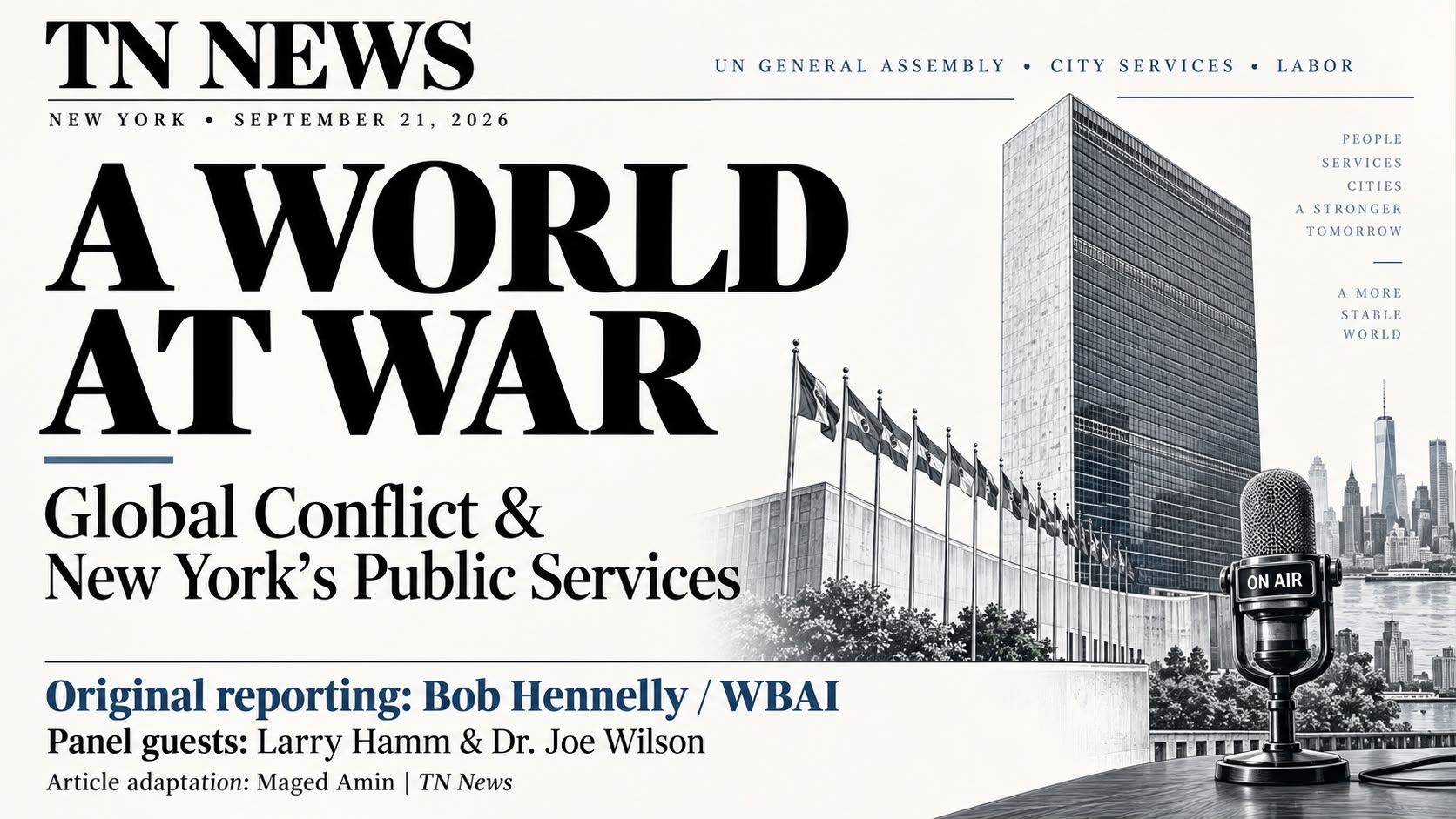
New York’s role as the host city for the United Nations General Assembly has once again placed international security and domestic urban pressures in the same public conversation. Based on reporting by WBAI journalist Bob Hennelly, a September 21 discussion examined that overlap, moving between the escalation of armed conflicts abroad and the practical pressures facing New Yorkers at home.
The timing gives the discussion a broader significance. New York is simultaneously a center of international diplomacy and a large metropolitan government responsible for delivering essential services to millions of residents. That combination makes questions about global instability relevant not only to foreign policy but also to the capacity of cities to maintain transportation, emergency response and social infrastructure.
Recent research from the Peace Research Institute Oslo underscores the scale of the international challenge. PRIO recorded 65 state-based conflicts across 35 countries in 2025, the highest number in its historical dataset dating back to 1946. The institute also reported a sharp increase in violence against civilians, with Sudan among the most severe cases. The findings indicate that conflict is not simply becoming more frequent; in many cases, different forms of violence are becoming interconnected across borders.
That international backdrop shaped the WBAI discussion, which included community organizer Larry Hamm and labor historian Dr. Joe Wilson. The program also featured Mike DeCillis, identified by WBAI as a Democratic candidate for New York’s 11th Congressional District. The conversation addressed the wars in Ukraine and Gaza as well as debates surrounding U.S. foreign policy and military support.
The discussion also highlighted a different level of the same challenge: how governments translate broad political priorities into functioning public services. New York’s municipal debate has increasingly centered on whether cities have sufficient resources and authority to respond to housing pressures, migration, climate risks and the demands placed on public infrastructure.
That issue was visible during the 2026 Urban 20 Mayors Summit, co-chaired by New York and Los Angeles. City leaders representing 34 cities gathered in New York to address housing affordability, climate change and migration, while calling for national governments to provide cities with greater resources and authority.
Mayor Zohran Mamdani used the summit to emphasize the role of cities in responding to these pressures. His remarks framed migration, housing and public services as interconnected urban policy issues, while the summit’s final communiqué called for stronger support for municipal governments.
For New York, however, the effectiveness of public policy ultimately depends on operational capacity. The WBAI program therefore turned toward emergency medical services and public transportation, where staffing decisions can have immediate consequences for residents.
FDNY EMS union representatives discussed concerns involving emergency response times and patient outcomes. Robert Kelley, vice president of stations for TWU Local 100, addressed subway staffing and the experiences of transit workers during the September 11 response and the COVID-19 pandemic.
The transit dispute has also entered the courts. On September 18, Justice Nicholas Moyne ordered the Metropolitan Transportation Authority and New York City Transit to stop a policy that prevented certain unexpected station-booth vacancies from being filled through overtime. The ruling also required the agencies to provide community boards with 30 days’ notice before public hearings concerning the service change. TWU Local 100 said station agents play important roles in emergencies and in assisting passengers with disabilities.
Taken together, these issues illustrate a central challenge for large cities: international instability, migration, economic pressure and climate risks increasingly intersect with the everyday systems residents rely upon. The debate is therefore not limited to diplomatic policy or municipal budgets. It also concerns whether institutions have the staffing, funding and administrative authority needed to keep essential services functioning.
For New York, the convergence is particularly visible during UN General Assembly week. The city becomes a meeting point for international diplomacy while simultaneously confronting questions that are intensely local, from ambulance response and subway staffing to housing and migration.
The broader policy challenge will be maintaining that balance. As global conflicts remain elevated and cities assume greater responsibility for responding to economic, social and environmental pressures, the effectiveness of urban institutions may increasingly depend on how well national and international policy frameworks support the services delivered at street level.
News You Should See
2026 Nobel Medicine Prize Honors Scientists Behind Optogenetics Breakthrough
Oil Prices Edge Lower as Stronger Middle East Exports and G7 Reserves Ease Supply Concerns
Trump Offers U.S. Assistance to Russia After Death at Siberian Plague Research Institute
Trump Takes Economic Message to Nebraska as GOP Faces Rising Cost-of-Living Pressure
U.S. Appeals Court Weighs Trump Administration’s $2.6 Billion Harvard Funding Fight
U.S. Midterm Elections Begin With Resilient Jobs Market and Persistent Cost Pressures
Latest News
The 2026 Nobel Prize in Physiology or Medicine honors Karl Deisseroth, Peter Hegemann and Georg Nagel for pioneering research behind optogenetics and its impact on neuroscience.
Oil prices edged lower as stronger Middle Eastern exports and a planned G7 release of 100 million barrels eased immediate supply concerns, while Gulf security risks and the Strait of Hormuz kept markets alert.
President Donald Trump said the United States would help Russia if needed after a laboratory worker died at a Siberian plague research institute, as Russian authorities imposed precautionary quarantine measures.
Trump’s Nebraska campaign stop highlights rising fuel and grocery costs, beef prices and growing economic pressure on Republicans ahead of the November midterm elections.
A U.S. appeals court is reviewing the Trump administration’s effort to cut Harvard’s federal research funding, with more than $2.6 billion at stake.
The U.S. enters the 2026 midterm elections with unemployment at 4.2%, while higher living and energy costs create economic pressure for households and businesses.
US services growth eased in September as input prices climbed to their highest level since July 2022, with fuel costs, supply-chain disruptions and strong demand increasing pressure on businesses.
Rising Treasury yields are increasing U.S. borrowing costs as Washington manages record debt, persistent inflation and strong economic demand, narrowing its policy options.
A EGP 16 million corporate partnership will establish and equip a bone marrow transplant unit at Cairo’s Coptic Hospital, supporting access to specialized treatment for patients.