From Electric Cars to Embodied AI: Why Chinese Automakers Are Redesigning Their Business Around Humanoid Robots
The shift toward humanoid machines reflects more than a technology race: automakers are seeking higher-value businesses, reusable industrial capabilities, and a new identity built around physical AI.

The automotive industry is beginning to redefine what it means to be a technology company. For years, electric vehicles and autonomous driving represented the central pillars of that transformation. Now, a new category is becoming increasingly important: humanoid robotics powered by physical artificial intelligence.
The change is particularly visible among Chinese automakers, several of which are moving beyond the traditional vehicle business and investing heavily in robots designed to operate in commercial, industrial and eventually consumer environments. The strategy is not simply about adding another product line. It represents an attempt to reuse the engineering, manufacturing, software and artificial-intelligence capabilities developed for smart vehicles in a market that could potentially offer different economics and stronger long-term margins.
Tesla has helped establish this strategic narrative through Optimus, its humanoid robotics program. Chinese manufacturers are now developing their own versions of the same idea, but their approach is closely connected to the industrial strengths that already exist inside the automotive sector.
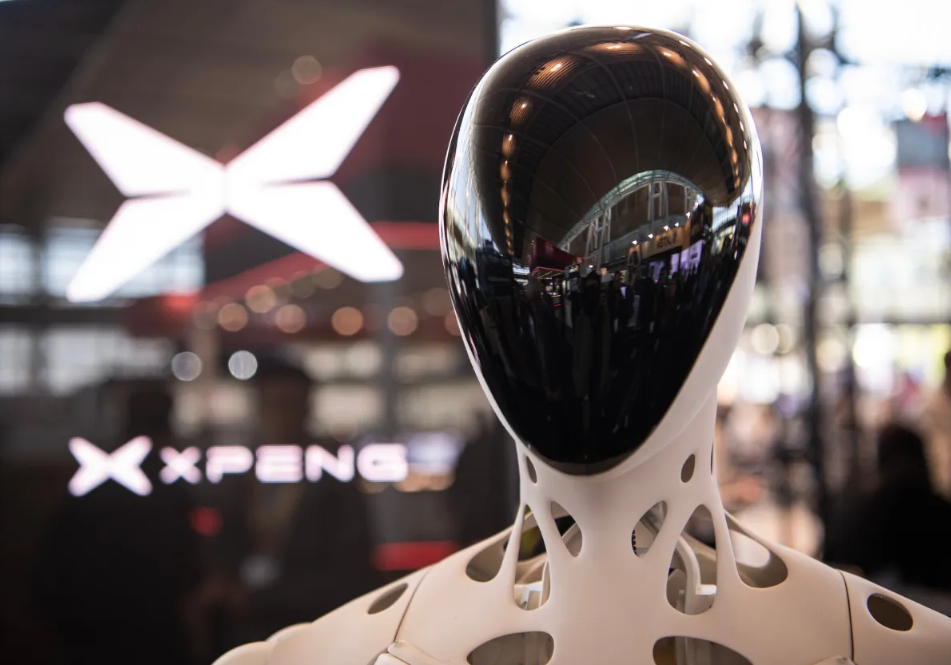
XPeng is one of the clearest examples. The company's robotics operation recently secured more than $900 million in financing at a post-money valuation exceeding $6.3 billion. The round was led by IDG Capital, with participation from Gaorong Ventures and strategic backing from Tencent and Alibaba. XPeng described the transaction as the largest single-round private financing recorded in China's embodied-AI sector.
The significance of the transaction extends beyond the amount of capital raised. It gives XPeng's robotics business a distinct financial identity while providing resources for hardware development, Physical AI models, data generation, manufacturing infrastructure and international commercialization. XPeng expects its IRON humanoid robot to enter mass production by the end of 2026, with initial deployments planned for its own stores and campuses before broader commercial deliveries in China and overseas markets in 2027.
This structure reveals an important change in product strategy. Rather than treating robotics as an experimental research project, XPeng is positioning the robot as a scalable commercial product. The physical design of IRON is deliberately humanoid, allowing the machine to operate in spaces originally designed around human movement, tools and workflows. That design decision could reduce the need to redesign existing environments and make the robot easier to integrate into retail and industrial operations.
The economic argument is equally important. Automobile manufacturing is an enormous industrial business, but it is also highly competitive and capital intensive. Vehicle companies must continuously invest in new models, batteries, software, factories and distribution while competing on price, range, performance and technology. Robotics offers automakers the possibility of creating products whose value could be determined not only by hardware but also by software, artificial intelligence, data and continuous capability improvements.
This is where the concept of Physical AI becomes strategically important. Traditional software AI operates primarily in digital environments, while embodied or physical AI connects intelligence to machines capable of sensing, moving and interacting with the real world. The same advances in machine learning that have made large language models increasingly capable are also influencing robotics research, allowing robots to learn increasingly complex behaviors from data and training.
Chinese automakers possess several assets that could accelerate this transition. They already operate sophisticated supply chains for batteries, motors, sensors, electronic systems and power management. They also have large-scale manufacturing facilities, engineering teams and experience moving technology from prototypes into mass production. These capabilities can potentially shorten the path from a laboratory robot to a commercially manufactured machine.
However, manufacturing alone does not guarantee success. The critical competitive question is increasingly moving toward artificial intelligence. A company may be able to manufacture thousands of robotic bodies, but the commercial value of those machines depends on whether their software can reliably interpret environments, learn tasks, respond to unexpected situations and operate safely alongside people.
This creates a strategic contrast between two forms of industrial strength. Automotive manufacturers have traditionally competed through manufacturing efficiency, supply-chain control and mechanical engineering. The emerging robotics market adds another layer: intelligence as a product capability. The winners may therefore be companies capable of combining physical production with proprietary AI models, high-quality operational data and continuous software improvement.
XPeng's strategy reflects this convergence. Its experience in autonomous driving gives the company exposure to perception systems, computing platforms, sensors, mapping, software development and AI training. These technologies are not identical to humanoid robotics, but they share important technical foundations. The company can therefore attempt to build a broader identity around Physical AI rather than defining itself exclusively as an electric-car manufacturer.
The trend is not limited to XPeng. Chery's robotics subsidiary AiMOGA has been expanding internationally and is reportedly preparing for a potential public listing. The company has already delivered thousands of robots across multiple markets and is targeting substantially higher global deliveries. Its activities also illustrate how Chinese manufacturers are using robotics as an international technology-export opportunity rather than restricting the technology to domestic factories.
BYD has also entered the humanoid-robotics field, while Changan, GAC, Li Auto, SAIC and Seres are among other Chinese automotive groups developing robotics initiatives. Taken together, these moves indicate that humanoid machines are increasingly being viewed as part of the wider technology portfolio of automotive companies.
The competitive landscape is global. Agility Robotics, Apptronik and Figure are among the specialist robotics companies pursuing large-scale commercial deployment. Hyundai is taking a different but related approach through Boston Dynamics and its Atlas humanoid robot. Hyundai plans to introduce Atlas into its Georgia manufacturing ecosystem, initially focusing on validated industrial applications such as parts sequencing from 2028 and expanding toward more complex assembly tasks later.
Hyundai's robotics strategy demonstrates another important design principle: robots do not necessarily need to replace human workers to create economic value. Instead, humanoid machines can be designed to take responsibility for repetitive, physically demanding or potentially hazardous activities while people remain responsible for supervision, training and higher-level decision-making.
The planned Robot Metaplant Application Center is particularly significant in this model. The facility is intended to train robots by mapping human movements and transferring operational experience into robotic behavior. Data collected from real manufacturing environments can then feed back into training systems, creating a continuous learning cycle in which robots become more capable as they accumulate practical experience.
That model changes the meaning of manufacturing design. A factory is no longer simply a place where machines produce cars. It can also become a source of training data for AI systems. The physical workplace becomes part of the intelligence infrastructure, connecting product design, manufacturing operations, robotics and software development into one integrated loop.
The branding implications are substantial as well. Automotive companies are increasingly presenting themselves not merely as manufacturers of vehicles but as technology platforms capable of building intelligent machines. This repositioning can influence investor perception, talent attraction and consumer expectations. A company associated with autonomy, AI and robotics may command a different strategic narrative from a company competing solely on vehicle specifications.
Yet the transition carries considerable uncertainty. Humanoid robotics remains an emerging market, and commercial scale has not been fully established. Building robots is only one part of the challenge; finding repeatable applications that justify their cost is another. Companies must demonstrate reliability, safety, maintenance economics and measurable productivity gains before large-scale adoption becomes sustainable.
The financial logic therefore depends on execution. High valuations and large funding rounds indicate strong expectations, but they do not guarantee profitability. Automotive companies entering robotics must continue financing expensive AI research, hardware development and manufacturing expansion while their traditional vehicle businesses remain under competitive pressure.
The larger strategic lesson is that the automotive industry may be entering another phase of convergence. Batteries, sensors, autonomous systems, computing hardware, AI models and advanced manufacturing are increasingly becoming shared building blocks across vehicles and robots.
For Chinese automakers, humanoid robotics therefore represents more than a speculative extension of the car business. It is a potential route toward a broader industrial identity in which the company designs intelligent physical systems rather than simply vehicles.
The ultimate competition will likely be determined by the ability to connect three layers: industrial-scale manufacturing, sophisticated artificial intelligence and a commercially compelling product identity. If automakers succeed in combining those elements, humanoid robots could become a new business platform built on decades of automotive expertise.
The shift also explains why the sector is attracting significant capital and strategic attention. The opportunity is not simply to sell a robot; it is to build an ecosystem in which hardware, software, data, manufacturing and services reinforce one another. For companies facing intense competition and increasingly narrow automotive economics, that ecosystem could become one of the most important bets of the next stage of the technology industry.
News You Should See
2026 Nobel Medicine Prize Honors Scientists Behind Optogenetics Breakthrough
Oil Prices Edge Lower as Stronger Middle East Exports and G7 Reserves Ease Supply Concerns
Trump Offers U.S. Assistance to Russia After Death at Siberian Plague Research Institute
Trump Takes Economic Message to Nebraska as GOP Faces Rising Cost-of-Living Pressure
U.S. Appeals Court Weighs Trump Administration’s $2.6 Billion Harvard Funding Fight
U.S. Midterm Elections Begin With Resilient Jobs Market and Persistent Cost Pressures
Latest News
The 2026 Nobel Prize in Physiology or Medicine honors Karl Deisseroth, Peter Hegemann and Georg Nagel for pioneering research behind optogenetics and its impact on neuroscience.
Oil prices edged lower as stronger Middle Eastern exports and a planned G7 release of 100 million barrels eased immediate supply concerns, while Gulf security risks and the Strait of Hormuz kept markets alert.
President Donald Trump said the United States would help Russia if needed after a laboratory worker died at a Siberian plague research institute, as Russian authorities imposed precautionary quarantine measures.
Trump’s Nebraska campaign stop highlights rising fuel and grocery costs, beef prices and growing economic pressure on Republicans ahead of the November midterm elections.
A U.S. appeals court is reviewing the Trump administration’s effort to cut Harvard’s federal research funding, with more than $2.6 billion at stake.
The U.S. enters the 2026 midterm elections with unemployment at 4.2%, while higher living and energy costs create economic pressure for households and businesses.
US services growth eased in September as input prices climbed to their highest level since July 2022, with fuel costs, supply-chain disruptions and strong demand increasing pressure on businesses.
Rising Treasury yields are increasing U.S. borrowing costs as Washington manages record debt, persistent inflation and strong economic demand, narrowing its policy options.
A EGP 16 million corporate partnership will establish and equip a bone marrow transplant unit at Cairo’s Coptic Hospital, supporting access to specialized treatment for patients.