Flydubai Captain Describes Fight to Regain Control After Cockpit Attack
Flydubai captain Smit Machchhar recounts how he fought to reopen the cockpit door and protect passengers after being attacked during a Dubai-Tel Aviv flight.

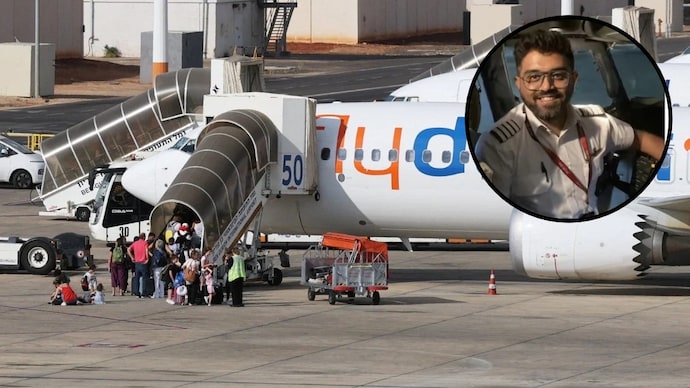
The Flydubai cockpit attack has exposed a difficult dimension of aviation security: the possibility that a serious threat can emerge from inside the flight deck itself.
Captain Smit Machchhar, who is recovering in an Abu Dhabi hospital, described the incident during a video call with Indian Prime Minister Narendra Modi. According to his account, he was seriously wounded after being attacked by his co-pilot while the aircraft was descending sharply during a flight from Dubai to Tel Aviv.
Machchhar said that despite his injuries and having fallen to the cockpit floor, he realized that remaining incapacitated could place everyone aboard the aircraft at further risk. He therefore focused on reaching the cockpit door and opening it. Once the door was opened, passengers and crew members were able to enter and restrain the attacker, while additional pilots helped stabilize the aircraft.
The aircraft was subsequently diverted to Tabuk in northwestern Saudi Arabia, where it made an emergency landing. Current reports place the number of people aboard at 174, although the initial account cited 182. The discrepancy illustrates why investigators will need to establish a precise operational timeline and passenger count as part of the broader examination of the incident.
Beyond the immediate emergency, the episode carries wider implications for airlines operating across the Middle East. Regional carriers have faced repeated operational disruptions amid heightened geopolitical tensions, making safety, contingency planning and crew security increasingly important parts of airline management.
The incident also highlights a structural challenge in aviation security. Modern cockpit protections are designed largely to prevent unauthorized access from outside the flight deck. An attack involving a member of the authorized cockpit crew presents a fundamentally different risk, because the individual already possesses legitimate access, operational knowledge and familiarity with aircraft procedures.
For Flydubai, the investigation will therefore have significance beyond the circumstances of a single flight. The airline and relevant authorities will need to establish the sequence of events, determine the circumstances surrounding the confrontation and examine whether any security or procedural changes are necessary. The findings could influence future assessments of crew screening, cockpit protocols and emergency response procedures across regional aviation.
The event also demonstrates the importance of redundancy in airline operations. The ability of passengers, cabin crew and additional pilots to intervene became a critical factor after the cockpit confrontation disrupted normal flight operations. Such layers of response are not substitutes for primary aviation safeguards, but the incident shows how multiple safety mechanisms can become decisive when an emergency develops rapidly.
The investigation remains ongoing, and the motive behind the attack has not been conclusively established. Until authorities complete their examination, broader conclusions about intent or systemic failures remain premature. What is already clear is that the incident has added another serious security concern for airlines operating in an increasingly complex Middle Eastern aviation environment.
News You Should See
2026 Nobel Medicine Prize Honors Scientists Behind Optogenetics Breakthrough
Oil Prices Edge Lower as Stronger Middle East Exports and G7 Reserves Ease Supply Concerns
Trump Offers U.S. Assistance to Russia After Death at Siberian Plague Research Institute
Trump Takes Economic Message to Nebraska as GOP Faces Rising Cost-of-Living Pressure
U.S. Appeals Court Weighs Trump Administration’s $2.6 Billion Harvard Funding Fight
U.S. Midterm Elections Begin With Resilient Jobs Market and Persistent Cost Pressures
Latest News
The 2026 Nobel Prize in Physiology or Medicine honors Karl Deisseroth, Peter Hegemann and Georg Nagel for pioneering research behind optogenetics and its impact on neuroscience.
Oil prices edged lower as stronger Middle Eastern exports and a planned G7 release of 100 million barrels eased immediate supply concerns, while Gulf security risks and the Strait of Hormuz kept markets alert.
President Donald Trump said the United States would help Russia if needed after a laboratory worker died at a Siberian plague research institute, as Russian authorities imposed precautionary quarantine measures.
Trump’s Nebraska campaign stop highlights rising fuel and grocery costs, beef prices and growing economic pressure on Republicans ahead of the November midterm elections.
A U.S. appeals court is reviewing the Trump administration’s effort to cut Harvard’s federal research funding, with more than $2.6 billion at stake.
The U.S. enters the 2026 midterm elections with unemployment at 4.2%, while higher living and energy costs create economic pressure for households and businesses.
US services growth eased in September as input prices climbed to their highest level since July 2022, with fuel costs, supply-chain disruptions and strong demand increasing pressure on businesses.
Rising Treasury yields are increasing U.S. borrowing costs as Washington manages record debt, persistent inflation and strong economic demand, narrowing its policy options.
A EGP 16 million corporate partnership will establish and equip a bone marrow transplant unit at Cairo’s Coptic Hospital, supporting access to specialized treatment for patients.