Federal Appeals Court Revives NFL Sunday Ticket Antitrust Verdict
The ruling restores a jury verdict in the long-running Sunday Ticket antitrust case while leaving the question of damages open for further legal proceedings.

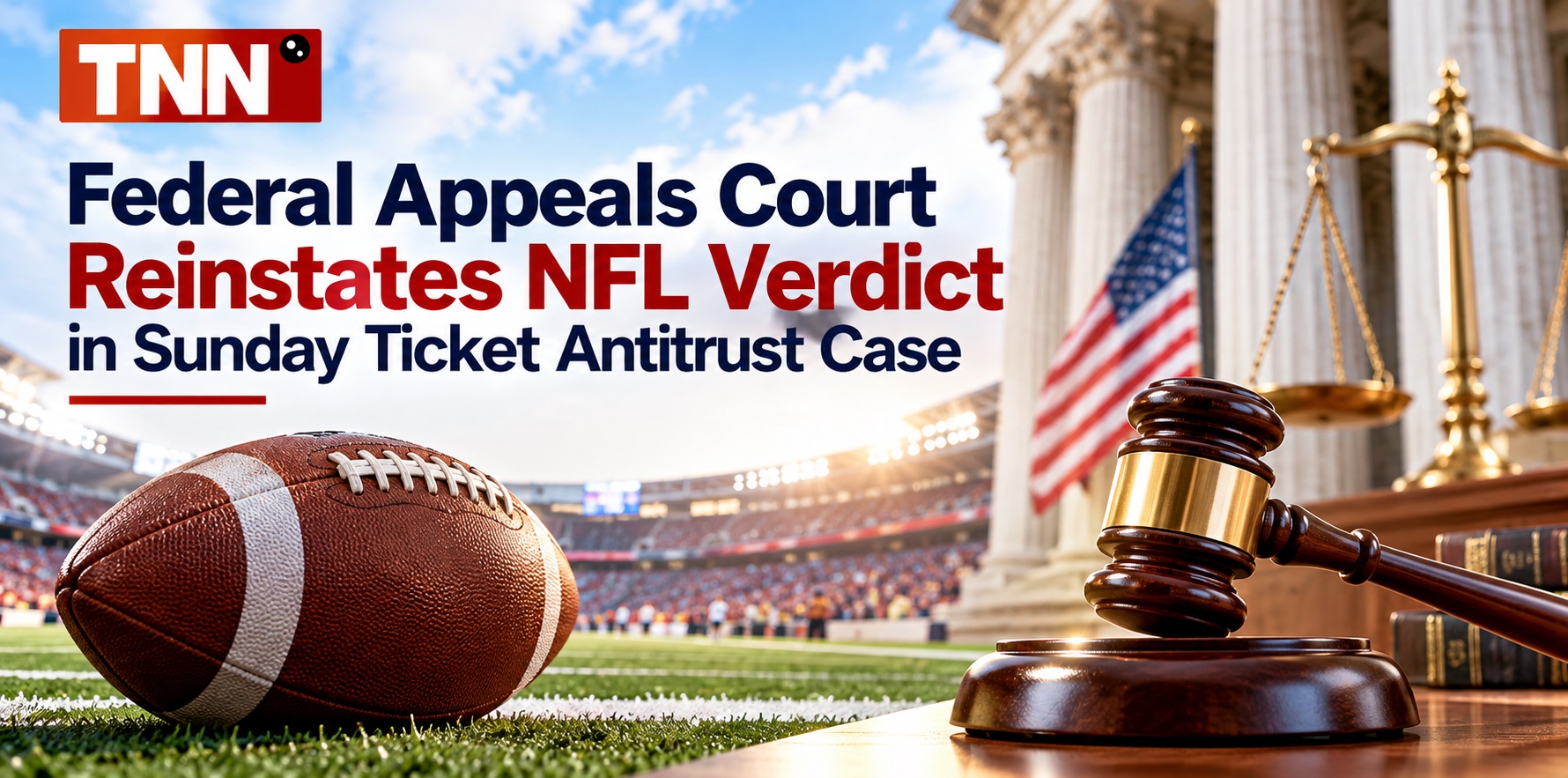
A federal appeals court has revived a jury verdict against the National Football League in the long-running antitrust dispute surrounding its Sunday Ticket package, reopening a major legal debate over the economics of premium sports broadcasting in the United States.
The decision restores a significant part of the case against the NFL while allowing the league to pursue further legal proceedings over damages. As a result, the dispute remains far from over, but the ruling returns the central questions surrounding the league's distribution of out-of-market games to the forefront of the sports-media industry.
At the heart of the lawsuit are allegations that Sunday Ticket subscribers paid excessive prices to access games involving teams outside their local television markets. The claims cover a period extending for more than a decade and challenge the economic structure behind one of the most valuable premium sports packages in American broadcasting.
The case has broader importance because the NFL's media strategy is built around the exceptional commercial value of live football. Broadcasting rights are among the league's most important sources of revenue, and exclusive packages have traditionally played a central role in protecting the value of those rights.
Sunday Ticket represents a particularly important part of that model. By packaging access to out-of-market games as a premium product, the NFL created a distinct commercial offering for consumers willing to pay for broader access than traditional local broadcasts provide.
The legal dispute now raises questions about where the boundary should be drawn between a sports league's ability to organize and market its media rights collectively and antitrust concerns surrounding consumer pricing and competition.
That distinction matters well beyond the NFL. Professional sports leagues rely heavily on centralized media arrangements to create predictable revenue streams and maintain the commercial value of their competitions. Any legal outcome that challenges how premium packages are structured could influence future decisions across the broader sports and entertainment economy.
For broadcasters and streaming platforms, the case also highlights the changing economics of live sports. As competition for major sports rights has intensified, premium programming has become increasingly important for attracting subscribers and advertising revenue. The way leagues package exclusive content can therefore affect not only consumers but also the business strategies of television networks and digital platforms.
The appeals court's decision does not settle the financial consequences of the case. The question of damages remains subject to additional legal proceedings, giving the NFL an opportunity to challenge that part of the dispute through a new trial process.
This leaves several key uncertainties unresolved. The ultimate financial exposure for the league has yet to be determined, and the final legal outcome could depend on further court decisions.
From a market perspective, however, the case is already significant. It places renewed scrutiny on whether premium sports packages deliver sufficient value to consumers relative to their price and whether exclusive distribution arrangements can create competitive concerns.
The outcome will be closely watched by sports leagues, broadcasters, streaming companies and consumers. A final ruling could influence how future premium sports services are priced, packaged and marketed across the United States.
For the NFL, the immediate challenge is managing a legal dispute that touches one of the foundations of its commercial success: the ability to transform live game access into highly valuable media products.
The broader question, meanwhile, extends beyond a single football package. The Sunday Ticket case has become part of a larger examination of how exclusive content, consumer choice and competition should coexist in an increasingly valuable and rapidly evolving sports-media marketplace.
News You Should See
Man City Faces Calls for Further Premier League Investigation Over Post-2018 Finances
Apple Maps Blurs Satellite Images of Key U.S. Military and NASA Sites
Who Is Delorean Bijon Brandon? The Case of Christina Downer’s Disappearance and Suspected Murder
From Siskel and Ebert to The Beatles: Celebrating Entertainment Legends
Olive Oil Before Carbs: Could Timing Influence Blood Sugar?
Jack Hughes Leads Devils to Shootout Victory, Ending Oilers’ Winning Run
Latest News
Premier League executives are debating a possible new investigation into Manchester City's finances after 2018, while the club appeals a verdict involving 114 financial-rule breaches.
Apple Maps has blurred satellite imagery of several U.S. military and NASA sites, including Cape Canaveral and Area 51. The reason for the changes remains unclear.
Delorean Bijon Brandon, 41, has been charged in connection with Christina Downer’s suspected murder after her disappearance in September 2025.
Chicago will honor film critics Gene Siskel and Roger Ebert with life-sized bronze statues, celebrating a partnership that reshaped popular film criticism.
Researchers are examining whether taking olive oil before glucose can slow stomach emptying and influence blood sugar levels, based on promising findings in mice.
Jack Hughes scores twice and adds an assist as the New Jersey Devils defeat the Edmonton Oilers 4-3 in a shootout, ending their three-game winning streak.
Researchers found that physical contact with dogs after an initial stressful task was associated with lower stress levels during a second challenge.
Researchers analyzed genetic data from 2.8 million people and identified 48 previously unknown genomic regions associated with Alzheimer's disease risk.
Screen-free schools are gaining interest among Silicon Valley tech families, raising questions about children's digital exposure and the role of technology in education.