Discovered Materials Raises $9 Million to Use AI in the Search for Cooler Chips
The startup is using AI agents and physics simulations to identify semiconductor materials that could reduce heat and improve chip efficiency

The race to build more powerful AI is creating a physical problem that software alone cannot solve: heat.
As AI workloads become increasingly demanding, the chips responsible for processing them generate substantial amounts of heat, forcing data centers to devote significant electricity and infrastructure to cooling. This has created an opportunity for a new category of technology companies that are applying artificial intelligence not to the software layer, but to the materials from which future computing hardware will be built.
Discovered Materials is positioning itself in that emerging market. The startup has raised $9 million in seed funding led by Lightspeed India Partners after emerging from Y Combinator, with participation from Peak XV Partners and angel investors including Paul Graham, Gokul Rajaram and Thariq Shihipar.
The company's strategy is built around a relatively simple proposition with potentially large economic implications: if AI hardware is becoming constrained by heat and energy consumption, finding better materials could improve the efficiency of the entire computing stack.
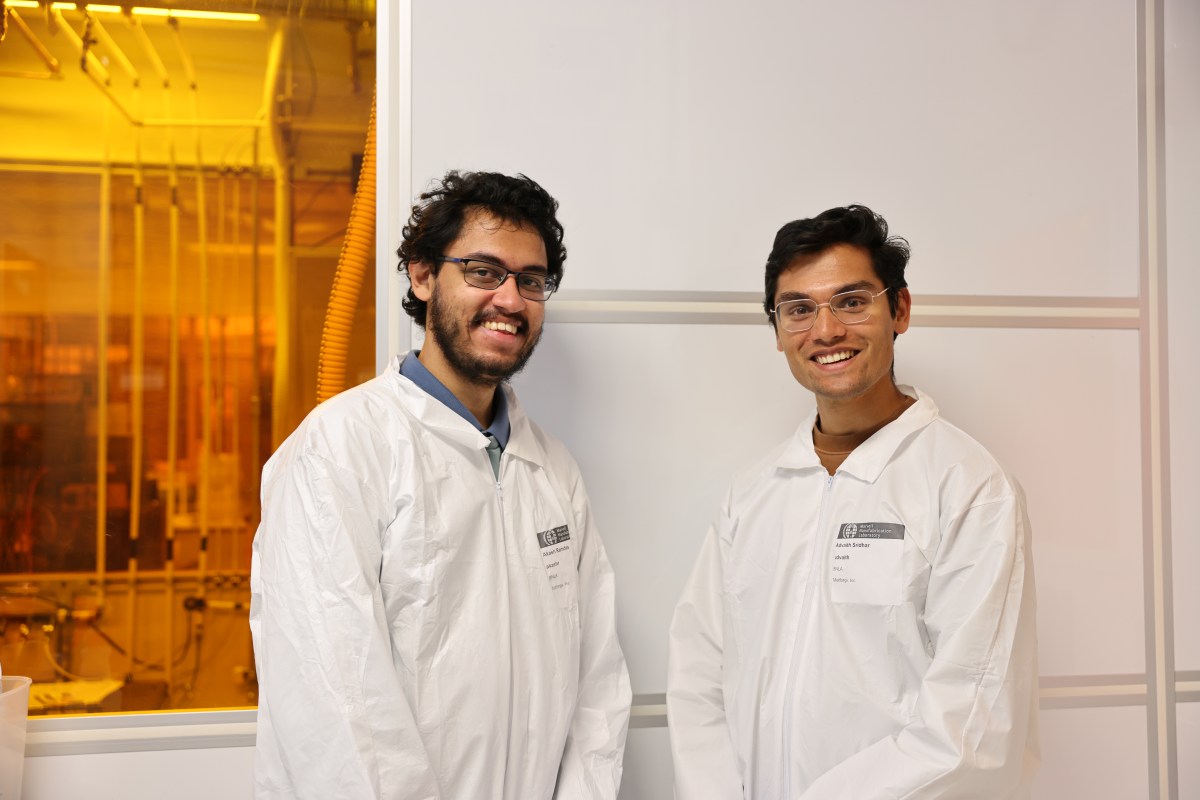
Its founders, Advaith Sridhar and Akash Ramdas, combine experience in AI agents and materials science. Ramdas holds a doctorate in materials science from Stanford, while Sridhar previously worked on agents at Persona AI and Luma Labs. Their backgrounds have shaped a system designed to automate a portion of the traditionally slow process of materials discovery.
The company's software uses Anthropic models inside a customized framework to generate potential material candidates. Those candidates are then evaluated through physics models developed by the company, which simulate their properties and determine whether they are worth pursuing experimentally.
The scale difference is significant.
Traditional materials research can require scientists to evaluate a limited number of hypotheses at a time. Discovered Materials says its AI agents can generate thousands of guesses each day by operating continuously in the cloud, compared with the roughly 20 daily guesses Ramdas could make during his doctoral research.
That change illustrates one of the most important economic advantages of AI-driven scientific discovery: increasing the number of experiments and hypotheses that researchers can evaluate before committing scarce laboratory resources.
But the company's opportunity is not simply about generating more ideas.
Materials science has a particularly difficult optimization problem because a material needs to satisfy several requirements simultaneously. A candidate may have excellent thermal characteristics but be too difficult to manufacture. Another may be easy to integrate into a chip but have electrical properties that undermine its usefulness.
This creates a multidimensional engineering trade-off in which improving one property can damage another.
Discovered Materials is therefore targeting the problem as a search across atomic structures, using computational tools to eliminate weaker candidates before they reach the laboratory stage. The company has already reported discovering several materials with properties comparable to existing materials used by major chipmakers, although it has not disclosed their identities.
The commercial logic is potentially attractive.
The semiconductor industry spends enormous amounts of money optimizing performance, power consumption and thermal characteristics. Even relatively modest improvements in materials could become valuable if they allow chips to operate at higher performance levels, consume less energy or require less cooling.
For AI infrastructure, thermal efficiency is particularly important.
The expansion of AI data centers has created an enormous demand for electricity. But the energy consumed by computing hardware is only part of the infrastructure challenge. The resulting heat must also be removed, which requires additional cooling equipment and power.
A chip that can deliver more computing performance while generating less heat could therefore have benefits beyond the processor itself.
It could reduce pressure on data-center power systems, cooling infrastructure and operating costs.
That gives materials innovation a strategic role in the AI infrastructure market.
The most visible competition in AI is taking place around models, GPUs and cloud platforms. Less visible is the competition over the physical technologies that determine how efficiently those systems can operate.
This creates an opportunity for startups such as Discovered Materials to attack bottlenecks that are becoming increasingly important as AI computing scales.
The company is not alone.
MatNex, SandboxAQ and CuspAI are pursuing related approaches to AI-assisted materials discovery. Discovered Materials is attempting to differentiate itself by focusing specifically on thermal challenges in semiconductor materials rather than treating materials discovery as a broad general-purpose problem.
That specialization could become a competitive advantage if the company develops proprietary knowledge about the relationship between material structures and chip performance.
It could also become a commercial weakness if the market ultimately rewards broader materials platforms capable of serving multiple industries.
For now, the company is pursuing a business model centered on intellectual property.
When it identifies valuable materials, it plans to seek patents covering their use in GPUs or the processes required to manufacture chips from them. The company would then license those technologies to semiconductor manufacturers rather than attempting to become a chip manufacturer itself.
That approach could allow Discovered Materials to scale without taking on the enormous capital requirements associated with semiconductor fabrication.
It also creates the possibility of becoming an enabling technology provider to established chip companies.
However, the path from computational discovery to commercial hardware remains the central challenge.
Finding a promising candidate is only the beginning. The material must be synthesized, tested, integrated into manufacturing processes and validated under real-world operating conditions.
This is where AI's advantages become more limited.
Software can accelerate the search space, but physical experiments still require laboratories, equipment, skilled researchers and time.
The company itself acknowledges that laboratory work cannot be accelerated indefinitely.
This distinction could determine which AI materials companies ultimately succeed.
The bottleneck may no longer be generating enough theoretical candidates. As AI models become better at proposing new compounds, the scarce resource could increasingly become the ability to identify the right candidates and manufacture them reliably.
That creates a new layer of competition: not simply who has the best AI model, but who can build the best feedback loop between computation and physical experimentation.
Discovered Materials is attempting to build that loop.
The company has released examples of hundreds of new materials and introduced its Material Discovery Bench, designed to evaluate how advanced AI models perform on materials-discovery tasks.
This is strategically significant because benchmark data can become an important asset in an emerging technology category.
As the market develops, investors and researchers will need ways to distinguish systems that merely generate plausible chemical structures from systems capable of identifying materials that can actually be manufactured and used.
A strong benchmark can help establish that distinction.
The company's funding also reflects growing investor interest in technologies that address the physical constraints of AI.
The first generation of AI investment was concentrated heavily around software and model development. The next wave is increasingly moving toward power, cooling, chips, manufacturing and materials.
This shift is logical.
As AI systems become larger, efficiency improvements at the hardware level can generate economic benefits across the entire ecosystem.
A reduction in heat generation, for example, could lower data-center cooling requirements. Better electrical characteristics could improve chip performance. More efficient materials could reduce energy consumption over millions of processors.
Small technical improvements can therefore become economically significant when deployed at massive scale.
But the startup faces a high-risk development path.
AI-generated materials have yet to demonstrate widespread commercial deployment at scale. The industry has produced promising candidates, but moving from laboratory discovery to industrial adoption remains difficult.
That means Discovered Materials will ultimately be judged by physical outcomes rather than the volume of candidates generated by its AI systems.
Its real competitive advantage will have to come from successfully filtering the search space, validating promising materials and turning discoveries into commercially useful semiconductor technologies.
The company's founders believe proprietary data and expertise can help it compete with much larger frontier AI laboratories.
That may prove important because general-purpose AI companies have increasingly sophisticated models and enormous computing resources. A startup cannot necessarily win by spending more on computation.
It must instead develop specialized expertise, proprietary datasets and experimental capabilities that are difficult to replicate.
This is where Discovered Materials' combination of AI agents, physics simulation and laboratory validation could become its core identity.
The broader significance of the company extends beyond semiconductors.
If AI agents can reliably discover useful materials, the same methodology could eventually be applied to batteries, catalysts, magnets, industrial chemicals and other areas where materials performance determines technological progress.
That would turn materials discovery into a broader computational platform opportunity.
For now, however, semiconductor thermal management provides a focused commercial entry point.
The market need is clear: AI computing is becoming more powerful, but power consumption and heat are becoming increasingly difficult constraints.
The companies that can improve efficiency without sacrificing performance could therefore capture substantial value as AI infrastructure expands.
Discovered Materials is betting that one answer lies at the atomic level.
Its $9 million seed round gives the company resources to expand its AI-driven search and laboratory validation efforts. The founders expect to identify materials worth patenting within the next year.
Whether those discoveries eventually reach mass-produced chips remains uncertain.
But the company's strategy highlights a larger transformation in technology development.
AI is increasingly being used not only to design software, but also to search through the physical building blocks of the machines that run it.
That creates a feedback loop in which AI helps solve the energy and hardware constraints created by the expansion of AI itself.
The winners of this emerging market may therefore be companies that can bridge two worlds: computational intelligence capable of searching millions of possibilities, and physical science capable of proving which possibilities actually work.
Discovered Materials is building its business around that intersection.
News You Should See
2026 Nobel Medicine Prize Honors Scientists Behind Optogenetics Breakthrough
Oil Prices Edge Lower as Stronger Middle East Exports and G7 Reserves Ease Supply Concerns
Trump Offers U.S. Assistance to Russia After Death at Siberian Plague Research Institute
Trump Takes Economic Message to Nebraska as GOP Faces Rising Cost-of-Living Pressure
U.S. Appeals Court Weighs Trump Administration’s $2.6 Billion Harvard Funding Fight
U.S. Midterm Elections Begin With Resilient Jobs Market and Persistent Cost Pressures
Latest News
The 2026 Nobel Prize in Physiology or Medicine honors Karl Deisseroth, Peter Hegemann and Georg Nagel for pioneering research behind optogenetics and its impact on neuroscience.
Oil prices edged lower as stronger Middle Eastern exports and a planned G7 release of 100 million barrels eased immediate supply concerns, while Gulf security risks and the Strait of Hormuz kept markets alert.
President Donald Trump said the United States would help Russia if needed after a laboratory worker died at a Siberian plague research institute, as Russian authorities imposed precautionary quarantine measures.
Trump’s Nebraska campaign stop highlights rising fuel and grocery costs, beef prices and growing economic pressure on Republicans ahead of the November midterm elections.
A U.S. appeals court is reviewing the Trump administration’s effort to cut Harvard’s federal research funding, with more than $2.6 billion at stake.
The U.S. enters the 2026 midterm elections with unemployment at 4.2%, while higher living and energy costs create economic pressure for households and businesses.
US services growth eased in September as input prices climbed to their highest level since July 2022, with fuel costs, supply-chain disruptions and strong demand increasing pressure on businesses.
Rising Treasury yields are increasing U.S. borrowing costs as Washington manages record debt, persistent inflation and strong economic demand, narrowing its policy options.
A EGP 16 million corporate partnership will establish and equip a bone marrow transplant unit at Cairo’s Coptic Hospital, supporting access to specialized treatment for patients.