Día de Muertos in Mexico: A Cultural Journey Through Tradition, Memory and Celebration
From family altars and candlelit cemeteries to colorful parades and regional rituals, Día de Muertos offers a unique window into Mexico’s relationship with life, death and cultural identity

Día de Muertos, or Day of the Dead, is one of Mexico’s most distinctive cultural traditions. Far from being a conventional celebration of death, it represents a collective way of remembering loved ones, preserving family connections and treating memory as an essential part of life.
The celebration takes place primarily on November 1 and 2, although preparations and local events can begin weeks earlier. The first day is traditionally associated with children who have died, while November 2 focuses primarily on deceased adults. The modern calendar reflects the interaction between pre-Columbian Indigenous traditions and Catholic observances introduced after the arrival of the Spanish.
At its heart, Día de Muertos is built around remembrance rather than mourning alone.
Families create ofrendas, or altars, dedicated to relatives and friends who have died. These displays can range from simple arrangements to elaborate structures filled with photographs, candles, flowers, favorite foods, drinks and personal belongings.
The purpose of an ofrenda is deeply personal. It can serve as a symbolic space where families remember the personality and preferences of someone who is no longer alive, while also reflecting the belief that departed spirits return to their communities during the celebration.
This combination of memory, symbolism and family participation explains why the tradition has remained powerful across generations.
The celebration also demonstrates how Indigenous heritage and Catholic traditions became intertwined over centuries. The result is not a single standardized ceremony but a collection of regional practices that share common symbols while retaining strong local identities.
One of the most recognizable symbols is the cempasúchil, or Mexican marigold.
Its bright orange color and distinctive fragrance have long been associated with guiding the spirits of the dead back toward their homes. During Día de Muertos, marigolds appear on altars, graves and streets, particularly across central and southern Mexico.
The flower has consequently become more than a decorative element. It connects contemporary celebrations with much older cultural beliefs and gives the festival one of its most recognizable visual identities.
Food plays an equally important role.
Families often place dishes and drinks favored by deceased relatives on their ofrendas. The food varies according to regional traditions, creating a culinary map of Mexico as much as a cultural one.
Oaxaca is associated with dishes such as mole negro, while pozole is prominent in Mexico City and calabaza en tacha, candied pumpkin prepared with sugar-cane syrup, is associated with the Yucatán.
One food appears particularly widely during the season: pan de muerto.
This soft, sweet bread is traditionally decorated with shapes representing bones and has become one of the defining seasonal foods of Día de Muertos. Bakeries typically begin selling it in the weeks leading up to the celebration, turning it into both an offering and a popular seasonal treat.
Another central element is the cemetery.
Families commonly clean and decorate the graves of their relatives with flowers, candles and other offerings. In many communities, cemetery visits are not brief ceremonies. Families may spend hours or even an entire night at the gravesite, sharing food, conversation and memories.
Music can also become part of the experience, with musicians moving through cemeteries and performing songs associated with the people being remembered.
This atmosphere illustrates one of the defining characteristics of Día de Muertos: grief and celebration exist alongside each other rather than being treated as opposites.
The visual language of the celebration has evolved as well.
La Catrina, the elegant skeleton associated with Día de Muertos, has become one of Mexico’s most recognizable cultural images. The character originated in the work of Mexican illustrator José Guadalupe Posada in the early 20th century and was later incorporated into Mexico’s broader artistic identity through figures including muralist Diego Rivera.
La Catrina transformed the skeleton from a symbol of fear into a satirical reminder that death ultimately ignores differences in wealth and social status.
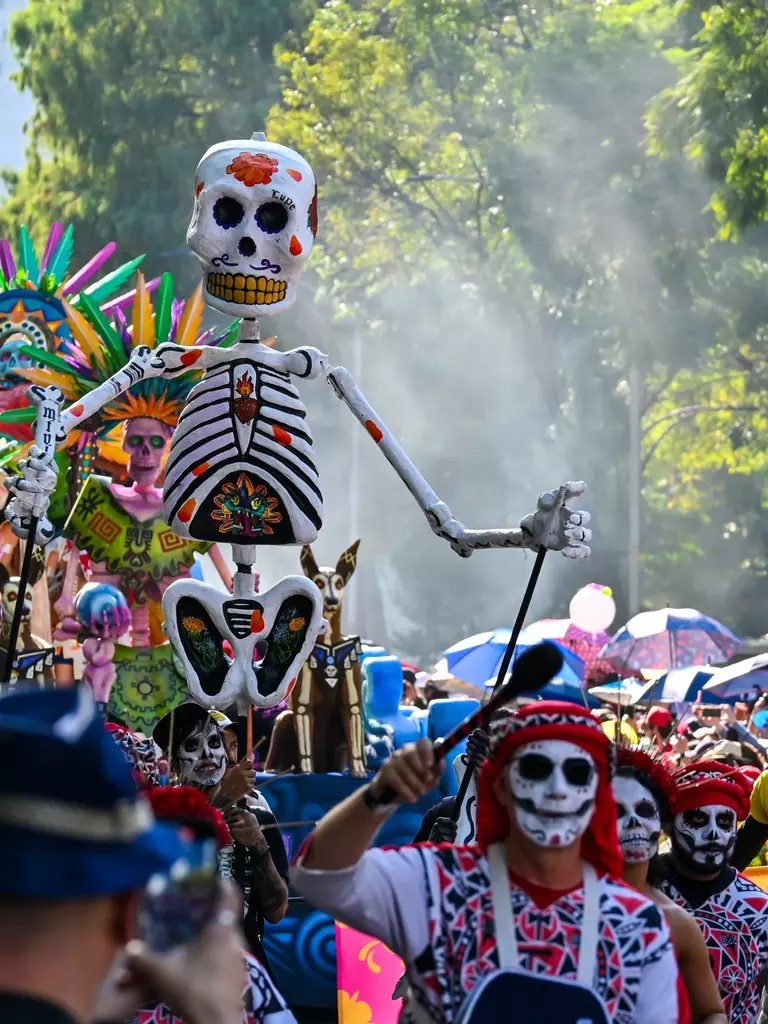
Today, skeleton imagery appears throughout celebrations in costumes, decorations, signs, papier-mâché figures and face painting.
For international travelers, however, understanding the cultural context is more important than simply viewing Día de Muertos as a colorful festival.
The tradition is fundamentally connected to families and communities. Public parades and large-scale events have expanded in recent decades, but they exist alongside private ceremonies that remain deeply personal.
This distinction is particularly important when visiting cemeteries. Travelers are entering spaces where families are honoring people they have lost, rather than attending a conventional tourist attraction.
Mexico City offers one of the most visible public expressions of the celebration.
Its large Day of the Dead parade features elaborate floats, Catrina performers and giant figures inspired by Mexican cultural and historical personalities. The capital also hosts other events and processions, making it one of the country's most accessible destinations for travelers seeking a large-scale interpretation of the tradition.
For a more intimate experience close to the capital, Mixquic offers a different perspective.
The neighborhood is known for its cemetery traditions, where graves are decorated with marigolds, candles and elaborate floral arrangements. During La Alumbrada, thousands of candles illuminate the cemetery, creating an atmosphere centered more on remembrance than spectacle.
Michoacán provides another major cultural destination.
On Lake Pátzcuaro, the island of Janitzio becomes one of the most visually striking settings for Día de Muertos. Candlelight and marigold flowers transform the island at night, while visitors can experience cemetery traditions and local ceremonies.
The scale of demand during the celebration means accommodation can become difficult to secure, making advance planning particularly important.
Oaxaca is arguably one of the strongest choices for travelers seeking a combination of traditional culture, food and public celebrations.
The city's strong Indigenous heritage is reflected in its Día de Muertos traditions, which extend over several days. Cemeteries become focal points at night, markets fill with seasonal crafts and foods, and surrounding communities organize their own celebrations.
Travelers can also experience local cuisine, including pan de muerto and pan de yema, traditionally enjoyed with Oaxacan hot chocolate.
The popularity of the season, however, means accommodation should be reserved well in advance.
For travelers interested in a less internationally visible tradition, La Huasteca Potosina offers an especially different experience.
Here, Día de Muertos is known as Xantolo. Instead of focusing primarily on cemetery rituals, communities combine remembrance with public performances in which people dress in costumes and participate in dances known as comparsas.
The result resembles a community festival while retaining the underlying purpose of honoring the dead.
This regional diversity is one of the most important reasons why Día de Muertos cannot be reduced to a single image of painted skulls, orange flowers and parades.
Mexico’s geography and cultural history produce different versions of the celebration, each revealing something about the communities that maintain it.
The growth of Día de Muertos as an international cultural phenomenon has also created a new relationship between heritage and tourism.
The celebration has become an important attraction for visitors, particularly in Mexico City, Oaxaca and Michoacán. This generates economic activity for hotels, restaurants, transportation companies, artisans, markets and local tour operators.
At the same time, its increasing international visibility creates a challenge for destinations: how to welcome visitors without turning deeply personal traditions into purely commercial entertainment.
The strongest tourism experiences are therefore those that allow visitors to observe and understand local customs while respecting the communities that maintain them.
For travelers, the most valuable approach is to treat Día de Muertos as a cultural experience rather than a themed event.
Learning the meaning of an ofrenda, understanding the role of marigolds, trying traditional seasonal food and observing cemetery customs with respect can provide a much deeper connection to the celebration than simply attending a parade.
Día de Muertos ultimately represents a distinctive Mexican philosophy of remembrance.
Instead of separating death completely from everyday life, the tradition creates a temporary space in which families bring memories, photographs, food, music and stories together.
Its enduring strength comes from that combination.
It is simultaneously Indigenous and Catholic, personal and communal, solemn and joyful, traditional and constantly evolving.
For Mexico’s tourism industry, that cultural depth is precisely what makes Día de Muertos so powerful.
For travelers, it offers something even more significant: an opportunity to understand a culture through the way it remembers the people who came before it.
News You Should See
2026 Nobel Medicine Prize Honors Scientists Behind Optogenetics Breakthrough
Oil Prices Edge Lower as Stronger Middle East Exports and G7 Reserves Ease Supply Concerns
Trump Offers U.S. Assistance to Russia After Death at Siberian Plague Research Institute
Trump Takes Economic Message to Nebraska as GOP Faces Rising Cost-of-Living Pressure
U.S. Appeals Court Weighs Trump Administration’s $2.6 Billion Harvard Funding Fight
U.S. Midterm Elections Begin With Resilient Jobs Market and Persistent Cost Pressures
Latest News
The 2026 Nobel Prize in Physiology or Medicine honors Karl Deisseroth, Peter Hegemann and Georg Nagel for pioneering research behind optogenetics and its impact on neuroscience.
Oil prices edged lower as stronger Middle Eastern exports and a planned G7 release of 100 million barrels eased immediate supply concerns, while Gulf security risks and the Strait of Hormuz kept markets alert.
President Donald Trump said the United States would help Russia if needed after a laboratory worker died at a Siberian plague research institute, as Russian authorities imposed precautionary quarantine measures.
Trump’s Nebraska campaign stop highlights rising fuel and grocery costs, beef prices and growing economic pressure on Republicans ahead of the November midterm elections.
A U.S. appeals court is reviewing the Trump administration’s effort to cut Harvard’s federal research funding, with more than $2.6 billion at stake.
The U.S. enters the 2026 midterm elections with unemployment at 4.2%, while higher living and energy costs create economic pressure for households and businesses.
US services growth eased in September as input prices climbed to their highest level since July 2022, with fuel costs, supply-chain disruptions and strong demand increasing pressure on businesses.
Rising Treasury yields are increasing U.S. borrowing costs as Washington manages record debt, persistent inflation and strong economic demand, narrowing its policy options.
A EGP 16 million corporate partnership will establish and equip a bone marrow transplant unit at Cairo’s Coptic Hospital, supporting access to specialized treatment for patients.