Clicks Bets on Physical Typing to Give Smartphones a New Productivity Edge
The $99 Power Keyboard revives the BlackBerry-style typing experience while testing whether users will accept extra weight and reduced portability for better control

The smartphone market has spent more than a decade moving toward larger touchscreens, thinner designs and increasingly software-driven interfaces. Clicks Technology is betting that one piece of the past still has commercial value: the physical keyboard.
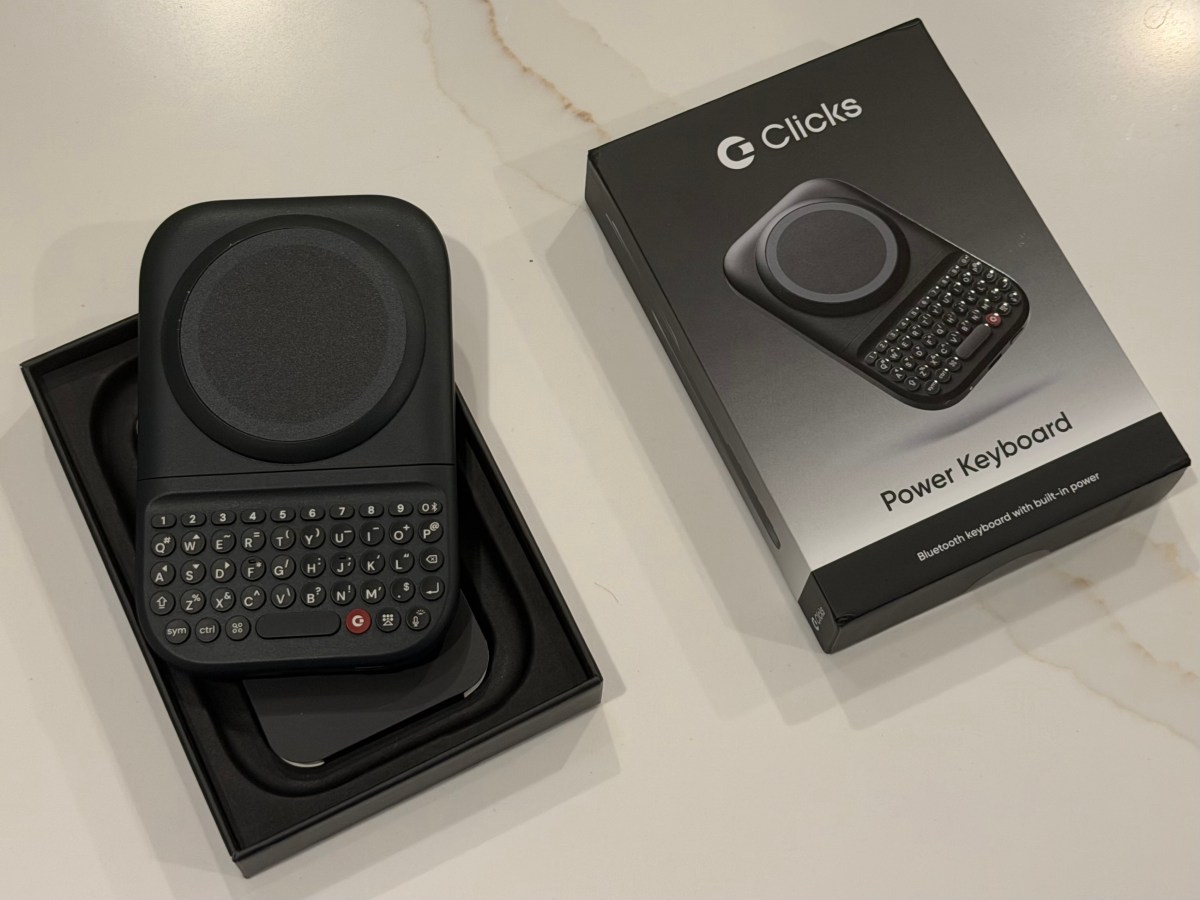
The company’s Power Keyboard, now shipping after delays, takes the familiar BlackBerry-style typing experience and turns it into a detachable accessory that can work across multiple smartphones. Priced at $99, the device is positioned less as a mainstream smartphone accessory than as a productivity tool for users who believe physical keys remain superior for serious typing.
The strategy is notable because Clicks is not attempting to compete with Apple, Google or Samsung on the traditional dimensions of smartphone hardware. Instead, it is targeting a specific behavioral preference that mainstream manufacturers largely abandoned: tactile interaction.
That gives the company a narrow but clearly differentiated market.
The Power Keyboard is essentially a sliding physical keyboard that connects magnetically through MagSafe or Qi2 and communicates with the phone through Bluetooth. It can accommodate different phone sizes and operate in portrait or landscape orientation. For devices without the required magnetic technology, Clicks says users can rely on an adhesive ring or a compatible case.
The proposition is simple: replace part of the touchscreen experience with physical buttons.
For users who type long emails, messages, documents or other text-heavy content on their phones, that distinction can matter. Physical keys provide tactile feedback, allowing users to identify individual presses without looking continuously at the screen.
That advantage, however, comes with a physical cost.
The Power Keyboard weighs 180 grams and adds considerable bulk to a smartphone. With larger devices such as the iPhone 17 Pro Max and Pixel 10 XL, the additional weight can make the phone feel top-heavy and less comfortable to hold vertically. The larger the smartphone, the more pronounced the compromise becomes.
This is the central tension in Clicks’ business model.
The company is selling an experience that depends on adding hardware to devices that the broader smartphone industry has spent years making lighter and thinner.
The more capable smartphones become, the harder it is to justify carrying another substantial component simply to regain a feature that once came built into the phone.
Clicks therefore has to sell more than nostalgia.
It needs to convince users that physical typing provides enough productivity value to justify the added weight and complexity.
The company appears to understand that challenge and has designed the Power Keyboard as more than a collection of buttons.
It includes a built-in 2,150 mAh battery, allowing the keyboard to operate independently rather than drawing power from the phone through USB-C as the company's earlier keyboard case did. The battery can also provide wireless charging to compatible devices, giving the accessory a secondary function when the keyboard itself is not being used.
That multifunction approach strengthens the product's commercial proposition.
A keyboard that only adds physical keys could easily be perceived as an expensive niche accessory.
A keyboard that also acts as a battery and wireless charger becomes a more useful piece of mobile hardware.
Clicks has also invested heavily in customization.
Users can configure the Clicks key to act as Tab, activate a cursor mode that turns certain keys into directional controls and create number-row shortcuts for functions such as Escape, volume controls and media playback.
Apple Shortcuts can also be assigned to certain keys, enabling actions such as initiating calls, checking the weather, activating the flashlight or sending messages.
This functionality changes the positioning of the product.
The keyboard is no longer simply about typing faster.
It becomes a physical control layer for the smartphone.
That could appeal to so-called power users who prefer shortcuts and direct commands over navigating touch interfaces.
It also gives Clicks a way to differentiate its hardware through software.
The physical keyboard itself can be copied. The broader interaction model — hardware controls combined with configurable shortcuts and mobile software — is more difficult to replicate as a complete user experience.
The company has also learned from its previous hardware.
Clicks' earlier keyboard case connected directly to the phone and was more restrictive in terms of compatibility. The Power Keyboard uses a sliding mechanism, allowing it to accommodate different handset dimensions, and its keys have been redesigned to make the transition from touchscreen typing less difficult.
That iterative approach is important for a small hardware company.
Rather than attempting to solve every problem in one generation, Clicks is using accessories to refine its physical-interface strategy while building a recognizable brand around tactile smartphone interaction.
The Power Keyboard may therefore be best understood as a bridge to the company's larger hardware ambition.
Clicks plans to launch its own smartphone, the Communicator, later this year. That device will feature an integrated physical keyboard and give the company something the accessory cannot: complete control over the relationship between the phone's hardware, software, dimensions and ergonomics.
This distinction is crucial.
Designing a keyboard for multiple smartphones requires Clicks to compromise.
Every phone has a different weight, size, camera configuration and case design. The accessory must accommodate those differences, which inevitably limits how seamlessly it can integrate with any individual handset.
With its own smartphone, Clicks can design the entire product around physical typing from the beginning.
That could make the Communicator more comfortable and potentially more convincing as a dedicated productivity device.
The Power Keyboard therefore serves two strategic purposes.
First, it generates revenue from a clearly defined niche.
Second, it gives Clicks an opportunity to build a customer base before asking consumers to switch to an entirely new smartphone.
That is an important risk-reduction strategy for a startup entering an exceptionally mature market.
Selling an accessory is significantly easier than convincing users to abandon their existing smartphone ecosystem.
The keyboard can work with devices they already own, allowing Clicks to introduce its brand without requiring a major purchasing decision.
Once consumers become familiar with the company's approach, the Communicator can be presented as the complete version of that experience.
The company is effectively using an accessory as a market-entry vehicle for a broader hardware platform.
That strategy also explains why the product's compatibility matters.
The Power Keyboard supports a range of devices, including recent iPhones, Pixel phones and Samsung's Galaxy Fold, according to Clicks. It can also function as a standalone Bluetooth keyboard for tablets, smart TVs and AR/VR devices such as Apple Vision Pro.
This expands the addressable market beyond smartphone owners.
Someone who ultimately decides that the keyboard is not comfortable on a phone can still use it for other connected devices.
That versatility reduces the perceived risk of purchasing a niche accessory.
However, Clicks still faces a fundamental market problem: the number of consumers who genuinely miss physical smartphone keyboards is relatively small.
BlackBerry demonstrated that physical keyboards could become a powerful brand identity, but the industry's transition to touchscreens was driven by more than fashion.
Touchscreens allowed manufacturers to devote almost the entire front of the device to the display, making phones more flexible for video, gaming, web browsing and applications.
Physical keyboards consume space and add mechanical complexity.
The smartphone industry's success with virtual keyboards therefore represents a structural competitive disadvantage for Clicks.
The company cannot simply argue that physical keyboards are better in every scenario.
They are not.
Touchscreens remain superior for many forms of interaction, particularly content consumption, gaming, navigation and interfaces that require dynamic controls.
The stronger argument for Clicks is specialization.
Its product is designed for users who prioritize writing, messaging and productivity.
That puts the Power Keyboard closer to a professional tool than a general-purpose smartphone enhancement.
The premium nature of the product reinforces that positioning.
At $99, it is not an impulse purchase for the average smartphone owner, particularly when the consumer already has a functional virtual keyboard at no additional cost.
Clicks must therefore communicate measurable value: faster typing, improved accuracy, shortcut access and a more efficient workflow.
The company's customizable controls are particularly relevant here.
Power users can configure the device around their own habits, potentially turning the keyboard into a personalized command center.
That type of customization can create stronger customer loyalty than hardware aesthetics alone.
It also creates a possible ecosystem opportunity.
If Clicks' software becomes the central configuration layer for its accessories and future smartphones, the company can establish a recognizable user interface across its products.
The brand would then be associated not simply with "phones that have keyboards," but with a broader philosophy of tactile mobile computing.
That is potentially more defensible.
The company is also attempting to revive an idea that has largely disappeared from mainstream smartphone design: the phone as a productivity instrument rather than primarily a consumption device.
The distinction may become more relevant as smartphones increasingly become platforms for AI assistants, professional applications and mobile work.
If users are expected to perform more complex tasks from their phones, demand for efficient text input and physical controls could grow.
At the same time, advances in voice input, generative AI and predictive typing could weaken that argument.
If AI can draft messages, summarize documents and perform tasks without users typing everything themselves, the value of a physical keyboard could decline.
Clicks is therefore entering the market at an interesting moment.
The company is betting on human control and physical interaction at the same time that the broader technology industry is investing in interfaces designed to reduce the amount of manual input required.
That tension could shape the long-term relevance of the product.
The keyboard's strongest use case may ultimately be users who want more control, not necessarily more automation.
For them, tactile keys provide precision and predictability that voice commands or AI-generated actions cannot always offer.
The product's ability to work with Apple Shortcuts reinforces this concept by allowing physical inputs to trigger automated digital actions.
This combination of hardware control and software automation could become more important as smartphones evolve.
Yet the Power Keyboard's ergonomics remain its biggest weakness.
Testing with large phones showed that portrait use can be awkward, while landscape orientation provides a more comfortable starting point. Protective phone cases can also interfere with the experience, forcing some users to remove their cases.
These compromises illustrate the limits of building a universal physical accessory.
A keyboard optimized for one device can be carefully integrated into its dimensions.
A keyboard designed for many devices has to accommodate differences.
Clicks is effectively choosing compatibility over perfect ergonomics.
That is a reasonable choice for the accessory business, but it also makes the Communicator strategically important.
The company's own phone can eliminate many of these compromises.
If Clicks can build a handset that combines the tactile advantages of the Power Keyboard with modern smartphone performance and a comfortable industrial design, it may have a stronger proposition than the accessory alone.
The challenge will be convincing users to join another smartphone ecosystem.
Modern consumers are deeply invested in existing platforms, app libraries, cloud services and accessories.
A new smartphone brand therefore needs a compelling reason to switch.
Physical typing alone may not be enough.
Clicks will need to turn the keyboard into the foundation of a broader product identity.
The company has already started doing so with its emphasis on customization, tactile controls and productivity.
The Power Keyboard is effectively the first step in that positioning.
Its commercial success will depend less on convincing millions of users that virtual keyboards are bad and more on identifying a profitable community that strongly values physical interaction.
That is a much more realistic strategy for a startup.
Clicks does not need to replace the touchscreen keyboard industry.
It needs to own a specific segment that mainstream smartphone manufacturers have largely abandoned.
The current product suggests that the company understands this.
It is niche, but it is differentiated.
It provides genuine functionality beyond nostalgia, while its limitations are largely visible and understandable.
The $99 price also places it below the cost and commitment associated with buying a dedicated smartphone.
That makes it a relatively accessible way for consumers to test whether physical typing still fits their habits.
The larger strategic question will be whether those users follow Clicks toward the Communicator.
If they do, the Power Keyboard could become more than an accessory.
It could become the first stage of a new mobile hardware ecosystem built around tactile computing.
If they do not, Clicks may remain a specialized accessory company serving a passionate but limited audience.
Either outcome would still demonstrate something important about the smartphone market.
Despite years of innovation focused on removing physical controls, there remains a segment of consumers who value the certainty of pressing a real key.
Clicks is betting that this preference is not merely nostalgia.
It believes physical interaction can become a meaningful productivity advantage in an era when smartphones are becoming more capable, more automated and more central to professional life.
The Power Keyboard is the company's attempt to prove that thesis before its own smartphone arrives.
Its biggest opportunity is differentiation.
Its biggest weakness is the physical compromise required to bring that differentiation to devices it does not control.
The next test will be whether Clicks can use the lessons from this accessory to build a Communicator that makes physical typing feel less like a return to the past and more like a credible alternative for the future of mobile computing.
News You Should See
2026 Nobel Medicine Prize Honors Scientists Behind Optogenetics Breakthrough
Oil Prices Edge Lower as Stronger Middle East Exports and G7 Reserves Ease Supply Concerns
Trump Offers U.S. Assistance to Russia After Death at Siberian Plague Research Institute
Trump Takes Economic Message to Nebraska as GOP Faces Rising Cost-of-Living Pressure
U.S. Appeals Court Weighs Trump Administration’s $2.6 Billion Harvard Funding Fight
U.S. Midterm Elections Begin With Resilient Jobs Market and Persistent Cost Pressures
Latest News
The 2026 Nobel Prize in Physiology or Medicine honors Karl Deisseroth, Peter Hegemann and Georg Nagel for pioneering research behind optogenetics and its impact on neuroscience.
Oil prices edged lower as stronger Middle Eastern exports and a planned G7 release of 100 million barrels eased immediate supply concerns, while Gulf security risks and the Strait of Hormuz kept markets alert.
President Donald Trump said the United States would help Russia if needed after a laboratory worker died at a Siberian plague research institute, as Russian authorities imposed precautionary quarantine measures.
Trump’s Nebraska campaign stop highlights rising fuel and grocery costs, beef prices and growing economic pressure on Republicans ahead of the November midterm elections.
A U.S. appeals court is reviewing the Trump administration’s effort to cut Harvard’s federal research funding, with more than $2.6 billion at stake.
The U.S. enters the 2026 midterm elections with unemployment at 4.2%, while higher living and energy costs create economic pressure for households and businesses.
US services growth eased in September as input prices climbed to their highest level since July 2022, with fuel costs, supply-chain disruptions and strong demand increasing pressure on businesses.
Rising Treasury yields are increasing U.S. borrowing costs as Washington manages record debt, persistent inflation and strong economic demand, narrowing its policy options.
A EGP 16 million corporate partnership will establish and equip a bone marrow transplant unit at Cairo’s Coptic Hospital, supporting access to specialized treatment for patients.