Beyond the Map: Why the U.N. Vote on Africa’s Size Matters
The Equal Earth projection turns a cartographic debate into a broader question about perception, education and the legacy of geographic representation.

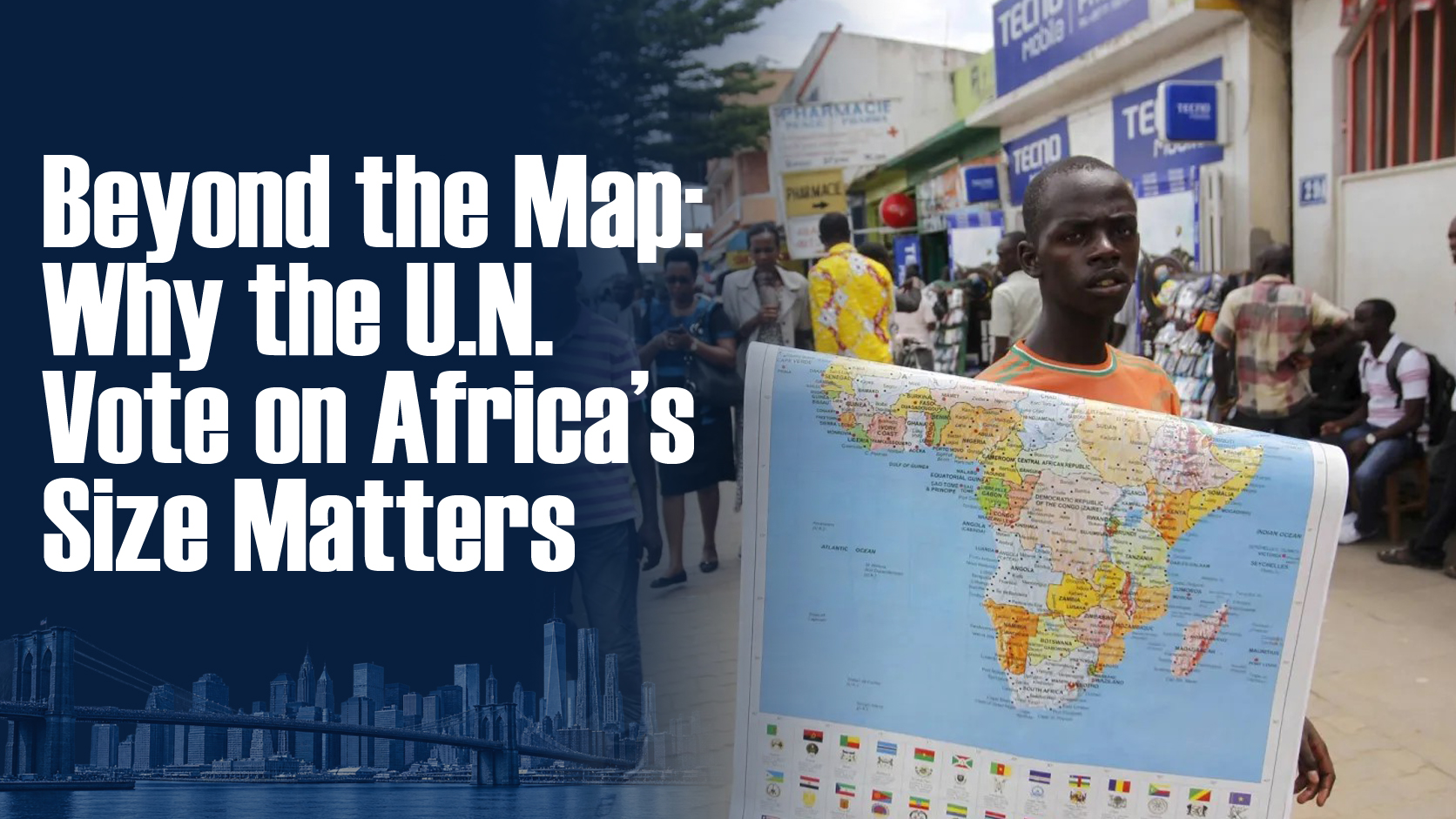
A world map looks like a neutral piece of geography, but it is also a powerful instrument of perception. The United Nations General Assembly’s endorsement of the Equal Earth projection is therefore more significant than the technical question of how continents should appear on a page. With 164 countries voting in favor and six abstaining, the decision signals a growing international interest in how geographic representation can influence the way societies understand their place in the world.
The central issue is not that the Mercator projection is simply a “wrong” map. It was created for a specific purpose: navigation. By preserving compass directions, it became exceptionally useful to sailors and later became deeply embedded in classrooms, books and digital mapping. Its weakness is different. The projection expands landmasses as they move toward the poles, meaning that countries and regions far from the Equator can appear substantially larger than they actually are.
That distortion becomes particularly consequential when maps are used not for navigation, but for education and general understanding. Africa, despite being the world’s second-largest continent by land area, can appear visually smaller than its true scale. Greenland, for example, may look comparable to Africa on a conventional Mercator map even though its actual area is only a fraction of Africa’s. Such images can become part of a person's basic mental picture of the world long before that person encounters the underlying geographic explanation.
This is where the debate moves beyond cartography.
For many African advocates, the problem is not simply mathematical distortion. It is the accumulated effect of repeatedly presenting a world in which northern countries appear larger and equatorial regions appear smaller. Critics argue that this visual imbalance can reinforce older assumptions about the relative importance of different parts of the world, particularly when the map is encountered in educational settings.
The Equal Earth projection addresses the issue by prioritizing proportional land area. It does not preserve the navigational advantages of Mercator, and its shapes are necessarily altered because every flat representation of a spherical Earth involves compromises. But its purpose is different: to give viewers a more accurate visual sense of the relative size of countries and continents.
That distinction is important because the U.N. resolution does not abolish Mercator. It is nonbinding and does not require governments, schools or digital platforms to replace it. Instead, it calls for greater awareness of the limitations of map projections, encourages educational materials to communicate geographic proportions more accurately and urges major digital map providers to engage with governments on the issue.
The practical significance may therefore depend less on the resolution itself than on what institutions do afterward.
The African Union had already supported the campaign, with Togo sponsoring the U.N. initiative. This suggests that the debate has developed into a broader effort to influence educational and public communication standards rather than remaining a dispute among cartographers. If more schools adopt area-accurate maps, the change could gradually affect how younger generations visualize the relative scale of the world's regions.
Technology has already demonstrated that such a transition is possible. Google moved its desktop map toward a globe view when users zoom out, reducing the extreme visual distortion associated with a flat Mercator display. The direction of digital mapping matters because online platforms increasingly shape geographic understanding alongside traditional school atlases.
The opposition of the United States also illustrates another dimension of the issue. Washington argued that the resolution promotes an ideological agenda and distracts from more immediate international concerns. That position reflects a legitimate question about whether an international organization should intervene in matters of representation and educational practice. Yet the overwhelming vote in favor indicates that many governments view accurate geographic representation as worthy of international attention precisely because maps can influence perception without appearing political.
The larger lesson is that visual tools are not necessarily neutral simply because they are familiar.
A map cannot eliminate every distortion. Choosing to preserve area means accepting compromises elsewhere, just as preserving direction or shape requires different compromises. The meaningful question is therefore not which projection is universally correct, but whether the projection being used matches the purpose for which it is being used.
For navigation, Mercator retains a historical and practical justification. For teaching students how large continents and countries actually are, an area-preserving projection can serve a different and arguably more appropriate purpose. Treating the two as competitors in a simple winner-takes-all contest misses the real point.
The U.N. decision is best understood as a call to reconsider the assumptions built into familiar representations. Its impact will not be measured by whether Mercator disappears from the world. It will be measured by whether educators, governments and technology companies become more deliberate about the images they use to explain the planet.
That is why the debate over Africa’s size matters. The issue is ultimately less about drawing a different map and more about recognizing that the way the world is presented can influence how the world is understood.
News You Should See
2026 Nobel Medicine Prize Honors Scientists Behind Optogenetics Breakthrough
Oil Prices Edge Lower as Stronger Middle East Exports and G7 Reserves Ease Supply Concerns
Trump Offers U.S. Assistance to Russia After Death at Siberian Plague Research Institute
Trump Takes Economic Message to Nebraska as GOP Faces Rising Cost-of-Living Pressure
U.S. Appeals Court Weighs Trump Administration’s $2.6 Billion Harvard Funding Fight
U.S. Midterm Elections Begin With Resilient Jobs Market and Persistent Cost Pressures
Latest News
The 2026 Nobel Prize in Physiology or Medicine honors Karl Deisseroth, Peter Hegemann and Georg Nagel for pioneering research behind optogenetics and its impact on neuroscience.
Oil prices edged lower as stronger Middle Eastern exports and a planned G7 release of 100 million barrels eased immediate supply concerns, while Gulf security risks and the Strait of Hormuz kept markets alert.
President Donald Trump said the United States would help Russia if needed after a laboratory worker died at a Siberian plague research institute, as Russian authorities imposed precautionary quarantine measures.
Trump’s Nebraska campaign stop highlights rising fuel and grocery costs, beef prices and growing economic pressure on Republicans ahead of the November midterm elections.
A U.S. appeals court is reviewing the Trump administration’s effort to cut Harvard’s federal research funding, with more than $2.6 billion at stake.
The U.S. enters the 2026 midterm elections with unemployment at 4.2%, while higher living and energy costs create economic pressure for households and businesses.
US services growth eased in September as input prices climbed to their highest level since July 2022, with fuel costs, supply-chain disruptions and strong demand increasing pressure on businesses.
Rising Treasury yields are increasing U.S. borrowing costs as Washington manages record debt, persistent inflation and strong economic demand, narrowing its policy options.
A EGP 16 million corporate partnership will establish and equip a bone marrow transplant unit at Cairo’s Coptic Hospital, supporting access to specialized treatment for patients.