Anthropic Rebuilds Claude Around a Unified Memory Experience Across Chat and Cowork
The new memory architecture is designed to remove repeated briefings, connect research with execution, and give users greater visibility and control over what Claude retains.

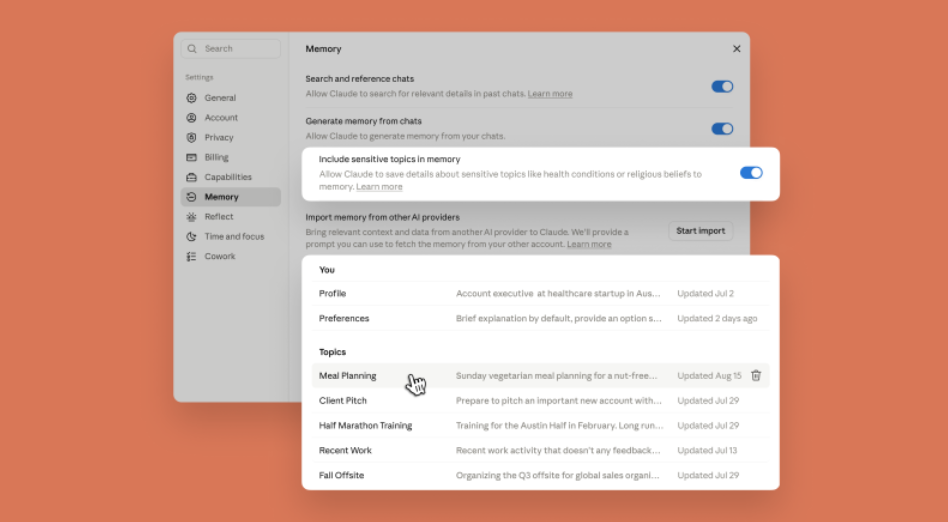
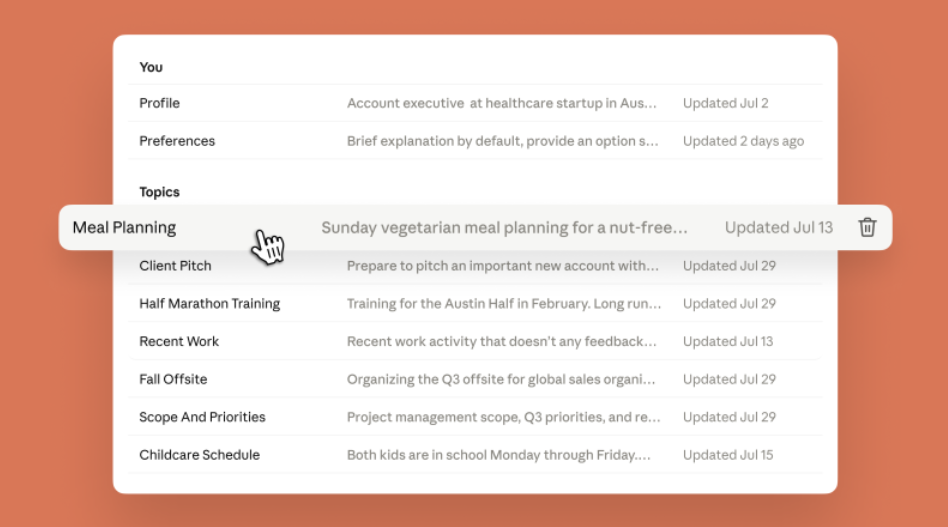
Anthropic is making a significant change to the way Claude maintains context across its products, bringing the memory systems behind Claude’s conversational experience and Claude Cowork into a single framework. The move addresses one of the central design weaknesses of AI agents: users can spend substantial time developing ideas, preferences, project details, and decisions in conversation, only to discover that the system requires much of the same information again when they move into an execution-oriented workflow.
Under the new approach, information learned through Claude’s chat experience can be carried into Cowork, allowing the two environments to operate less like separate products and more like different interfaces to the same assistant. Strategically, the change shifts Claude’s identity from an AI that responds within isolated sessions toward an assistant designed to maintain continuity throughout a broader workflow.
That distinction is particularly important as AI applications increasingly move beyond question-and-answer interactions toward tasks that involve research, planning, document creation, organization, and execution. In a conventional conversational model, the user may first discuss a project, refine an idea, establish requirements, and make decisions through multiple conversations. When the time comes to turn those discussions into an actual deliverable, however, the user may previously have had to reintroduce the relevant context to Cowork. Anthropic’s redesign is intended to remove that break in the workflow.
The company’s approach effectively connects the research stage with the action stage. A user could, for example, spend time discussing a conference with Claude and establish important details such as the expected number of attendees, the city in which the event will take place, and the speakers involved. If that user later asks Cowork to prepare an update for a manager or create an event agenda, the system can use the information already established during previous conversations rather than requiring the user to reconstruct the project brief from scratch.
From a product-design perspective, this creates a more coherent mental model. Instead of asking users to understand which Claude environment contains which piece of information, the product is moving toward an experience in which Claude itself becomes the persistent layer connecting different activities. The result is intended to make the transition between thinking about a task and actually completing it feel more natural.
The memory system is also changing in how it captures information. Rather than waiting until a conversation has ended and then producing a summary, Claude can now add relevant topics to its memory while the conversation is still taking place. This allows new information to become available more quickly between Chat and Cowork and makes the two experiences more closely synchronized.
The design has another important component: transparency. Anthropic is exposing the information Claude has retained so that users can inspect their memories and take action on them. Users can read stored information, modify it, or remove it. This gives memory a more visible product interface rather than treating it as an invisible background mechanism that users cannot inspect.
The transparency layer is particularly significant because persistent AI memory creates a different relationship between a user and an AI system. When an assistant remembers information across sessions, that information can influence future responses and actions. Giving users the ability to understand and manage those memories therefore becomes an important part of the product experience rather than an optional technical feature.
Anthropic is also placing boundaries around the types of information Claude automatically retains. By default, the system will not store personal or sensitive information such as health data, race, ethnicity, religious beliefs, political information, or gender identity. Users who want Claude to retain sensitive topics can explicitly enable the “include sensitive topics in memory” setting. The application will also notify users when a sensitive topic is saved.
There are categories of information that Anthropic says Claude will not save regardless of this preference. These include government-issued identification numbers, Social Security numbers, criminal history, immigration status, and other information that conflicts with the company’s acceptable-use policy.
The availability of the feature also gives the update a broader commercial dimension. Memory is enabled by default for Claude’s Free, Pro, and Max plans across the web, desktop, and mobile experiences. Users on iOS and Android need to update their applications to the latest version to receive the functionality.
The decision to make memory part of the default experience across multiple subscription tiers positions continuity as a core part of Claude’s product identity rather than a narrowly defined premium capability. Economically, a persistent assistant can also increase the value of repeated usage because the more a user interacts with the system, the more useful continuity can become across future tasks. Instead of treating every interaction as an independent transaction, the product can build a cumulative relationship in which previous work improves the efficiency of subsequent work.
That makes memory an important competitive feature in the broader AI assistant market. As providers increasingly compete on agents and task execution rather than model intelligence alone, the ability to preserve context can influence how deeply an AI product becomes embedded in a user’s workflow. Reducing repetitive briefing also addresses a practical cost for users: time spent reconstructing information that the system has already encountered.
The change therefore represents more than a technical modification to Claude’s memory architecture. It is a strategic redesign of how the product presents itself. By connecting Chat and Cowork through a shared memory layer, Anthropic is attempting to turn multiple AI experiences into a single continuous assistant, while simultaneously giving users greater visibility into the information that shapes that continuity.
The underlying product philosophy is straightforward: an AI assistant becomes more useful when it can remember relevant context, but that usefulness depends on making the memory understandable and controllable. Anthropic’s latest update attempts to combine both sides of that equation by making Claude more persistent while also exposing the memory it creates to user review, editing, and deletion.
News You Should See
2026 Nobel Medicine Prize Honors Scientists Behind Optogenetics Breakthrough
Oil Prices Edge Lower as Stronger Middle East Exports and G7 Reserves Ease Supply Concerns
Trump Offers U.S. Assistance to Russia After Death at Siberian Plague Research Institute
Trump Takes Economic Message to Nebraska as GOP Faces Rising Cost-of-Living Pressure
U.S. Appeals Court Weighs Trump Administration’s $2.6 Billion Harvard Funding Fight
U.S. Midterm Elections Begin With Resilient Jobs Market and Persistent Cost Pressures
Latest News
The 2026 Nobel Prize in Physiology or Medicine honors Karl Deisseroth, Peter Hegemann and Georg Nagel for pioneering research behind optogenetics and its impact on neuroscience.
Oil prices edged lower as stronger Middle Eastern exports and a planned G7 release of 100 million barrels eased immediate supply concerns, while Gulf security risks and the Strait of Hormuz kept markets alert.
President Donald Trump said the United States would help Russia if needed after a laboratory worker died at a Siberian plague research institute, as Russian authorities imposed precautionary quarantine measures.
Trump’s Nebraska campaign stop highlights rising fuel and grocery costs, beef prices and growing economic pressure on Republicans ahead of the November midterm elections.
A U.S. appeals court is reviewing the Trump administration’s effort to cut Harvard’s federal research funding, with more than $2.6 billion at stake.
The U.S. enters the 2026 midterm elections with unemployment at 4.2%, while higher living and energy costs create economic pressure for households and businesses.
US services growth eased in September as input prices climbed to their highest level since July 2022, with fuel costs, supply-chain disruptions and strong demand increasing pressure on businesses.
Rising Treasury yields are increasing U.S. borrowing costs as Washington manages record debt, persistent inflation and strong economic demand, narrowing its policy options.
A EGP 16 million corporate partnership will establish and equip a bone marrow transplant unit at Cairo’s Coptic Hospital, supporting access to specialized treatment for patients.