Ancient Fossil Reveals Mammal Ancestors Once Laid Eggs
A rare embryo fossil sheds new light on how early mammal ancestors reproduced and survived mass extinction.

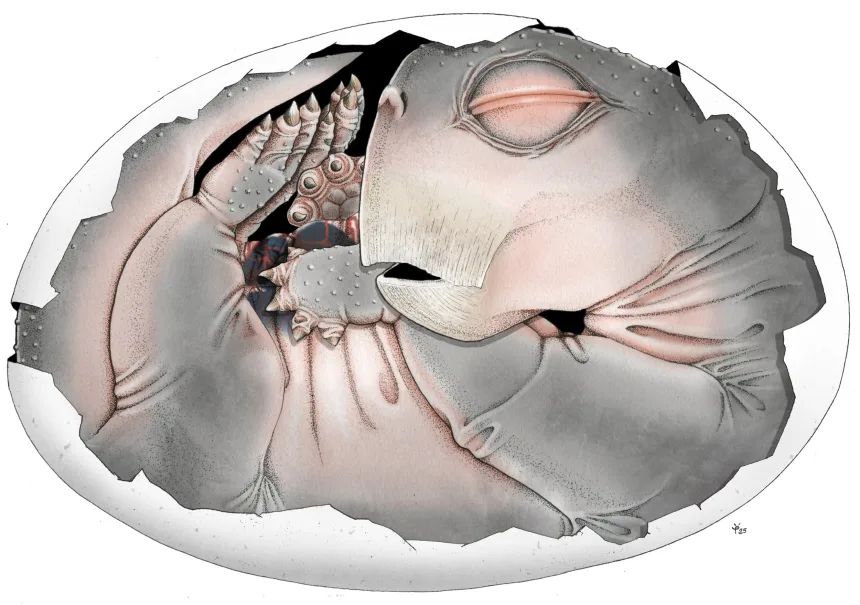
A remarkable fossil discovery is reshaping what scientists know about the early ancestors of mammals. Researchers have uncovered the fossil of a curled embryo belonging to Lystrosaurus, dating back around 250 million years, providing the first clear evidence that these ancient creatures reproduced by laying eggs.
The fossil was found in South Africa and analyzed using advanced imaging techniques, including high-resolution scans and powerful X-ray technology. What stood out to scientists was the structure of the embryo’s jaw, which had not yet fully fused — a feature seen today only in the embryos of egg-laying animals like birds and turtles.
This detail confirmed that the embryo had developed inside an egg, marking a major breakthrough in understanding how early mammal relatives reproduced.
Beyond reproduction, the discovery also helps explain how Lystrosaurus managed to survive one of Earth’s most catastrophic events — the Great Dying, which wiped out about 90% of life on the planet.
Scientists believe that laying relatively large eggs with soft, leathery shells may have given this species a survival advantage. These eggs likely retained moisture better in the harsh, dry environments that followed the extinction event, helping the species endure extreme conditions.
Additionally, the size of the eggs suggests that hatchlings were more developed at birth, allowing them to move, feed, and escape predators more effectively — increasing their chances of survival.
The findings also offer clues about the evolution of key mammalian traits, including lactation. Researchers suggest that milk production may not have originally evolved to feed offspring, but rather to keep eggs moist and protected before live birth became common.
Experts say this discovery fills an important gap in the story of how mammals evolved from reptile-like ancestors into the diverse group of animals we know today.
News You Should See
P&G Raises Fiscal 2027 Cost Warning as Oil and Freight Expenses Threaten Profits
Chemical Tank Leak in Toledo Triggers Evacuations and Industrial Disruptions
Judge Sets December 11 Deadline for Trump Deposition in BBC Defamation Case
Iowa Senate Race Tests How Far Republicans Can Separate Themselves From Trump
California State Workers Strike Over Pay, Healthcare and Return-to-Office Rules
Streaming’s October Showdown: How Disney, Netflix and Major Entertainment Brands Compete for Audiences
Latest News
Procter & Gamble expects commodity, energy and transportation costs to reduce fiscal 2027 profit by $1.4 billion. Quarterly sales rose 4% to $23.28 billion, beating analyst expectations.
A ruptured chemical tank in Toledo, Ohio, prompted evacuations, school closures and an industrial shutdown. Authorities have reduced the restricted zone as the release slows and cleanup preparations continue.
A federal judge has ordered Donald Trump to give a deposition by December 11, 2026, in his $10 billion lawsuit against the BBC, with possible sanctions for noncompliance as the discovery deadline approaches.
Iowa’s 2026 Senate race pits Republican Ashley Hinson, balancing Trump support with economic concerns, against Democrat Josh Turek, who emphasizes bipartisanship amid rising campaign spending.
Thousands of California state workers struck on October 21 over a proposed three-year pay increase, healthcare costs and a four-day office attendance requirement as contract negotiations continued.
October 2026 brings major entertainment releases across Disney+, Netflix, HBO Max, Hulu, Prime Video and Peacock. Explore how familiar franchises, exclusive programming, new music and video games shape competition for streaming audiences.
Saudia advises travelers to book flights through Al Qassim Airport for Riyadh connections, offering free hourly shuttle buses in both directions until further notice.
An AP-NORC poll shows Democratic confidence in accurate vote counting falling to 55%, while Republican confidence rises to 38%, highlighting election integrity concerns ahead of the 2026 US midterms.
Donald Trump campaigns in North Carolina ahead of the November 2026 midterms as low approval ratings, rising fuel costs, Democratic early-voting gains and funding disparities challenge Republican efforts to retain control of Congress.