America's Measles Resurgence Exposes Growing Gaps in Vaccination Coverage and Public Health Infrastructure
Declining childhood vaccination rates, public health funding cuts and controversial federal health messaging are contributing to America's measles resurgence and raising concerns about disease prevention.

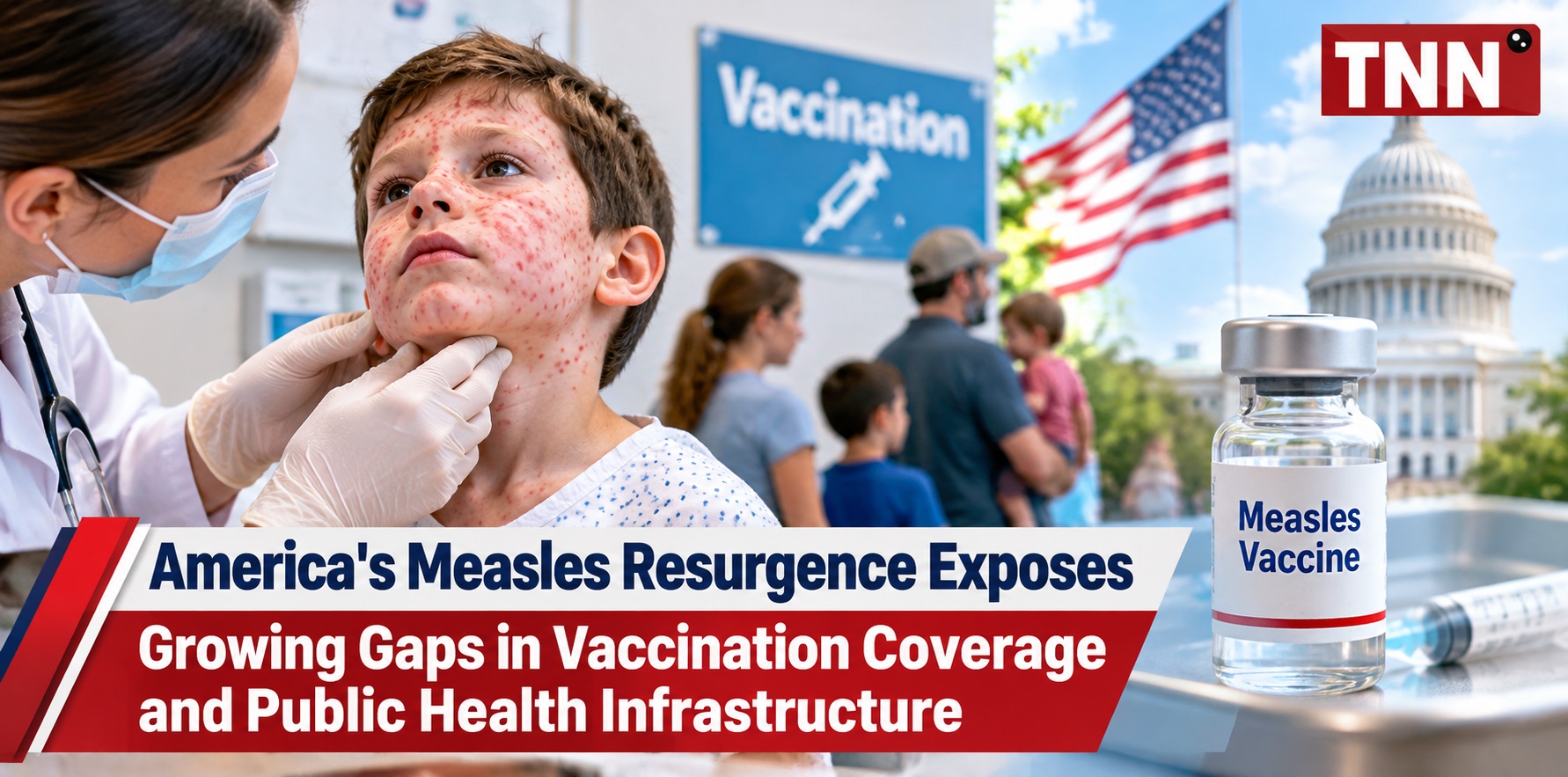
America's Measles Resurgence Exposes Weaknesses in Vaccination Coverage and Public Health Infrastructure
The resurgence of measles in the United States is highlighting a growing challenge for the country's public health system: maintaining widespread immunization while local healthcare authorities face resource constraints and public confidence in vaccines remains under pressure.
The outbreak represents more than an increase in reported infections. It reflects the cumulative consequences of declining childhood vaccination coverage, reduced public health capacity and increasingly contested communication about immunization policies. Together, these factors have weakened the protections that helped keep measles transmission under control for decades.
A nationwide outbreak signals a reversal in public health progress
By November 2026, the United States had recorded more than 7,700 measles cases and 13 deaths, according to figures cited in the investigation. The country also lost its measles-free status, reversing an achievement maintained since domestic transmission was declared eliminated in 2000.
Utah has emerged as one of the most significant centers of transmission, recording 725 cases. Nearly 65% of those infected were unvaccinated children, illustrating the direct relationship between immunization gaps and the spread of highly contagious diseases.
The outbreak initially developed within an isolated religious community before extending into wider public settings. Schools, churches, daycare centers, sporting events and other shared spaces subsequently became locations where infections were reported.
This pattern demonstrates how quickly a localized outbreak can expand when the virus reaches communities with insufficient vaccination coverage.
Falling immunization rates create wider vulnerabilities
An analysis of vaccination data covering 13 states and New York City found that childhood immunization rates declined by an average of 1.1 percentage points in 2025. This was the steepest annual reduction across the jurisdictions examined in at least six years.
Utah experienced an even sharper decline. Its vaccination coverage for seven recommended childhood vaccines dropped to 69.6% in 2025, representing a decrease of 2.4 percentage points from the previous year. The rate of first-dose measles, mumps and rubella vaccination also fell.
Although these figures represent different vaccination measures, they collectively indicate a weakening of the immunization system.
Measles presents a particularly serious challenge because of its high transmissibility. Even relatively modest declines in vaccination coverage can create conditions in which infections spread rapidly, particularly among infants, unvaccinated children and individuals with weakened immune systems.
The economic implications extend beyond the direct costs of treating infected patients. Outbreaks can place additional pressure on hospitals, require expanded testing and contact-tracing operations, disrupt educational activities and force local authorities to redirect resources from other public health priorities.
Public health funding cuts weaken the response capacity
The investigation also identified reductions in public health resources as an important part of the broader problem.
Local health departments reported losing employees and scaling back immunization initiatives following federal funding cuts. In Utah, these reductions affected nurses, epidemiologists and other professionals responsible for monitoring infectious diseases and coordinating outbreak responses.
These personnel perform functions that are difficult to replace quickly. Their responsibilities include identifying emerging infections, tracing contacts, organizing vaccination campaigns, communicating with communities and coordinating responses between healthcare institutions.
When staffing levels decline, public health agencies may find it more difficult to detect outbreaks early and prevent localized transmission from developing into larger regional emergencies.
The situation highlights a structural issue in healthcare management: maintaining effective disease prevention requires continuous investment rather than temporary funding increases after an outbreak has already begun.
Federal vaccine messaging adds another layer of uncertainty
The investigation also examined the influence of federal health communications, particularly statements by Health and Human Services Secretary Robert F. Kennedy Jr., who has previously questioned aspects of vaccine safety.
Such statements have contributed to wider public debate surrounding immunization and the role of government institutions in communicating medical guidance.
The administration, however, rejected the suggestion that Kennedy was responsible for the resurgence. A Health and Human Services spokesperson argued that childhood vaccination rates had been declining for several years before he assumed office.
This distinction is important when assessing the causes of the outbreak. The decline in immunization coverage predates the current administration, meaning that the problem cannot be attributed to a single political figure or policy decision.
Nevertheless, consistent and evidence-based public communication remains essential. Uncertainty surrounding official health messages can make it more difficult for families to evaluate vaccination recommendations and for healthcare professionals to maintain public confidence.
The economic importance of preventive healthcare
The measles resurgence demonstrates the financial value of maintaining effective vaccination programs.
Preventive healthcare generally requires sustained spending on medical personnel, vaccine distribution, public education and disease surveillance. However, these investments can reduce the likelihood of expensive emergency responses and limit the economic disruption associated with widespread infections.
When vaccination coverage declines, the costs can shift toward hospitals, families, educational institutions and government agencies.
For local authorities, the challenge is therefore not simply to increase vaccine availability. It also involves rebuilding operational capacity, improving access to immunization services and ensuring that public health information reaches communities where vaccination rates are particularly low.
Rebuilding confidence and strengthening long-term preparedness
The findings point to several priorities for American health authorities. Restoring vaccination coverage will require targeted immunization campaigns, stronger coordination between federal and local agencies, adequate staffing and sustained communication with parents.
Particular attention will be needed in communities where vaccination rates have fallen significantly, as well as among populations facing barriers to healthcare access.
The experience in Utah also demonstrates why public health strategies must extend beyond responding to confirmed infections. Early intervention, reliable vaccination records and effective community engagement are essential to preventing similar outbreaks elsewhere.
Ultimately, the return of measles transmission represents a warning about the fragility of public health achievements. Maintaining protection against preventable diseases depends not only on medical advances but also on institutional capacity, consistent policies and public confidence.
For the United States, reversing the current trend will require a long-term commitment to immunization and disease prevention rather than measures limited to controlling individual outbreaks.
News You Should See
Vivo Prepares Three New Budget Smartphones with 6,500mAh Batteries and Updated Features
Carlos Espi Delivers Late Winner as Real Madrid Overcomes Mbappé's Penalty Miss
Google Pixel 11 Introduces Faster Tensor G6 Processor and Expanded Storage
Borussia Dortmund Secure Bundesliga Victory as Felix Nmecha Delivers Key Performance
Harry Kane's Ankle Surgery Leaves Bayern Munich Facing a Major Attacking Setback
Imam Tahir Kukaj Receives 2026 Appreciation Award for Community Service
Latest News
Vivo's upcoming budget phones reportedly feature 6,500mAh batteries, 6.74-inch displays and different camera and charging specifications.
Carlos Espi scores a late winner as Real Madrid defeat Celta Vigo 2-1, despite Kylian Mbappé missing a penalty.
Google Pixel 11 reportedly features the Tensor G6 processor, 256GB storage and 25W wireless charging, alongside familiar camera and display features.
Felix Nmecha plays a crucial role as Borussia Dortmund defeat Borussia Mönchengladbach, strengthening their Bundesliga campaign.
Harry Kane undergoes left ankle ligament surgery and could miss three months, creating a major challenge for Bayern Munich and England.
Imam Tahir Kukaj receives the 2026 Appreciation Award in recognition of his commitment to community service, volunteerism, and public engagement.
Congress faces a potential partial government shutdown on December 11 as disputes over Pentagon funding, the Iran conflict and federal spending negotiations delay an agreement.
The Premier League returns on November 21, 2026, with Manchester City, Arsenal and Chelsea facing important fixtures after the international break.
The U.S. Congress honored former Egyptian President Anwar Sadat with a posthumous Gold Medal on November 18, 2026, recognizing his historic contribution to Middle East peace.