Americans Reset Their Clocks as the Fight Over Permanent Daylight Saving Time Stalls
The United States returns to standard time while lawmakers remain divided over whether the country should permanently end the twice-yearly clock change.

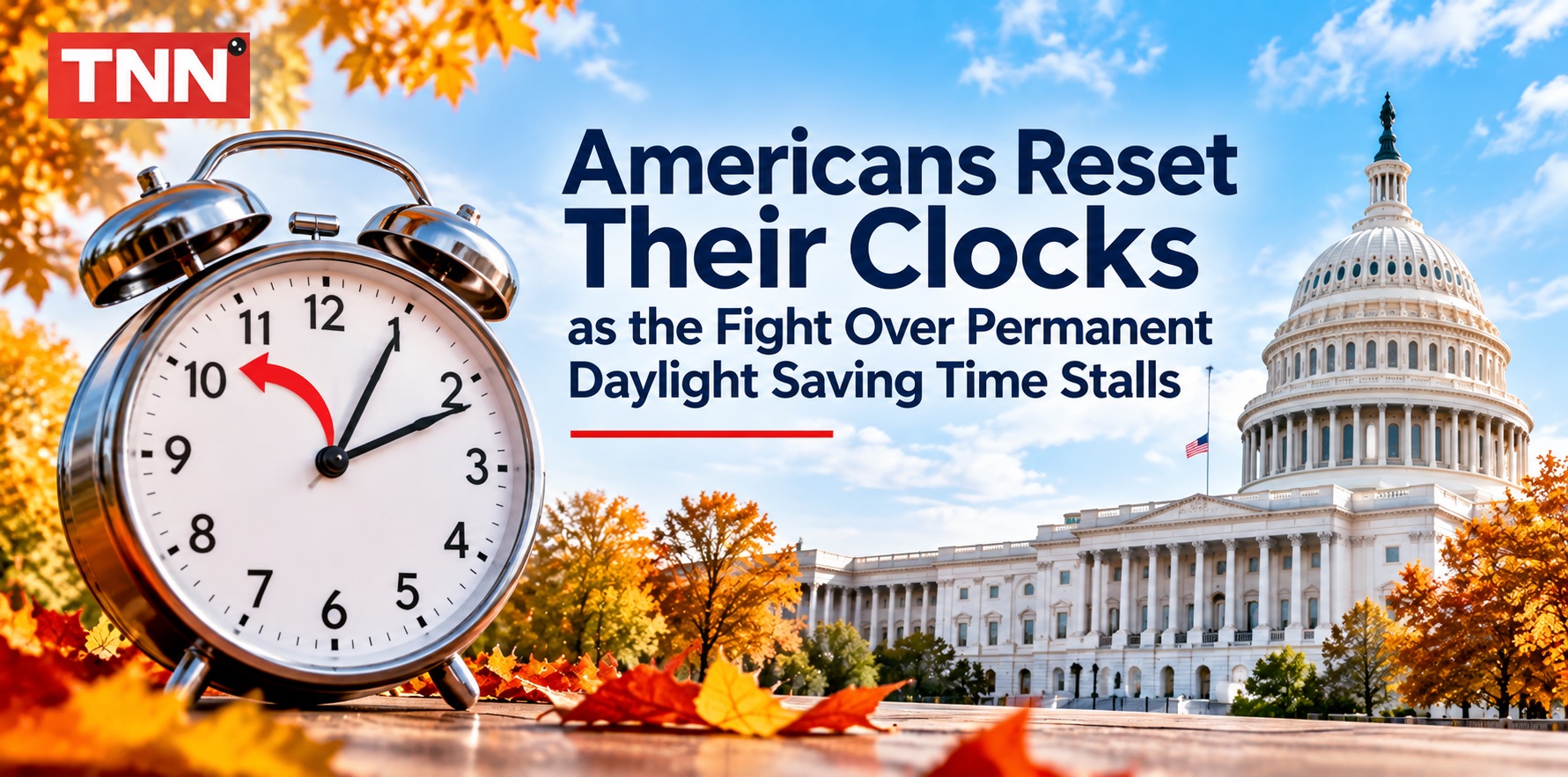
The return to standard time in the United States once again places a familiar national ritual at the center of a much larger policy debate: whether Americans should continue changing their clocks twice a year or move permanently to a single system.
At 2 a.m. Eastern Time, much of the country shifts back to standard time, beginning a period that will continue until March. While the clock adjustment itself is routine, the political question surrounding it remains unresolved. Efforts to establish permanent daylight saving time have repeatedly attracted attention in Washington but have not secured the Senate action required to turn the proposal into federal law.
The debate extends beyond the mechanics of moving clocks forward and backward. It involves questions about public health, workplace productivity, transportation safety and the practical realities of managing time across a country with major geographic differences.
Supporters of ending the twice-yearly change argue that the transitions can interrupt sleep patterns and disrupt daily routines. They also point to potential consequences for road safety and workplace performance when millions of people are forced to adjust their schedules simultaneously.
For advocates of permanent daylight saving time, the appeal is especially connected to the evening economy. More daylight later in the day can affect how people spend their leisure time, travel locally and participate in outdoor activities. Businesses that depend on consumer activity after traditional working hours could potentially benefit from brighter evenings, particularly during the winter months.
However, the same proposal creates a different set of concerns. Opponents warn that permanent daylight saving time could push sunrise much later during winter in some parts of the United States, leaving students and workers beginning their days in significantly darker conditions.
That concern illustrates why the issue has proved difficult to resolve at the national level. The United States covers a vast geographic area, and the effect of a single time policy is not uniform. A schedule that appears attractive in one region may create practical difficulties in another, particularly because sunrise and sunset patterns vary widely from north to south and east to west.
The disagreement has also become a test of how federal policy can balance national uniformity with regional realities. A permanent system would simplify the calendar by eliminating the disruption associated with clock changes, but choosing which system should remain permanent is far more complicated.
Keeping standard time year-round would address some concerns about darker winter mornings, while permanent daylight saving time would preserve longer evening daylight. Each option creates different social and economic trade-offs, making consensus difficult even among lawmakers who agree that the current system deserves reconsideration.
For businesses and institutions, the continued uncertainty means that the existing system remains part of operational planning. Schools, transportation networks, employers and digital platforms must continue managing the twice-yearly transition, while any future legislative change would require broad adjustments across the economy.
The debate also has an institutional dimension. Repeated efforts to change the system demonstrate that public support for reform does not automatically translate into legislative agreement. A proposal affecting every American household must pass through competing concerns involving health, safety, commerce and regional differences.
For now, the immediate outcome is unchanged: Americans will continue adjusting their clocks twice each year. The return to standard time may therefore be less a conclusion than another reminder that the country has yet to decide what kind of timekeeping system it wants for the future.
Until lawmakers reach a broader consensus, the clock will continue to move back in the fall and forward in the spring, preserving a decades-old practice while the debate over permanent daylight saving time remains unresolved.
News You Should See
Man City Faces Calls for Further Premier League Investigation Over Post-2018 Finances
Apple Maps Blurs Satellite Images of Key U.S. Military and NASA Sites
Who Is Delorean Bijon Brandon? The Case of Christina Downer’s Disappearance and Suspected Murder
From Siskel and Ebert to The Beatles: Celebrating Entertainment Legends
Olive Oil Before Carbs: Could Timing Influence Blood Sugar?
Jack Hughes Leads Devils to Shootout Victory, Ending Oilers’ Winning Run
Latest News
Premier League executives are debating a possible new investigation into Manchester City's finances after 2018, while the club appeals a verdict involving 114 financial-rule breaches.
Apple Maps has blurred satellite imagery of several U.S. military and NASA sites, including Cape Canaveral and Area 51. The reason for the changes remains unclear.
Delorean Bijon Brandon, 41, has been charged in connection with Christina Downer’s suspected murder after her disappearance in September 2025.
Chicago will honor film critics Gene Siskel and Roger Ebert with life-sized bronze statues, celebrating a partnership that reshaped popular film criticism.
Researchers are examining whether taking olive oil before glucose can slow stomach emptying and influence blood sugar levels, based on promising findings in mice.
Jack Hughes scores twice and adds an assist as the New Jersey Devils defeat the Edmonton Oilers 4-3 in a shootout, ending their three-game winning streak.
Researchers found that physical contact with dogs after an initial stressful task was associated with lower stress levels during a second challenge.
Researchers analyzed genetic data from 2.8 million people and identified 48 previously unknown genomic regions associated with Alzheimer's disease risk.
Screen-free schools are gaining interest among Silicon Valley tech families, raising questions about children's digital exposure and the role of technology in education.